How Omnichannel Retailers Unify Shipment Tracking from Stores, Warehouses, and Marketplaces
Omnichannel retailers unify shipment tracking by creating one shipment record for every order, connecting that record to the relevant store, warehouse, marketplace, and carrier events, and presenting normalized status information to staff and customers. The goal is not simply to collect tracking numbers. It is to establish a reliable view of what was shipped, by whom, through which carrier, and what action is required next.
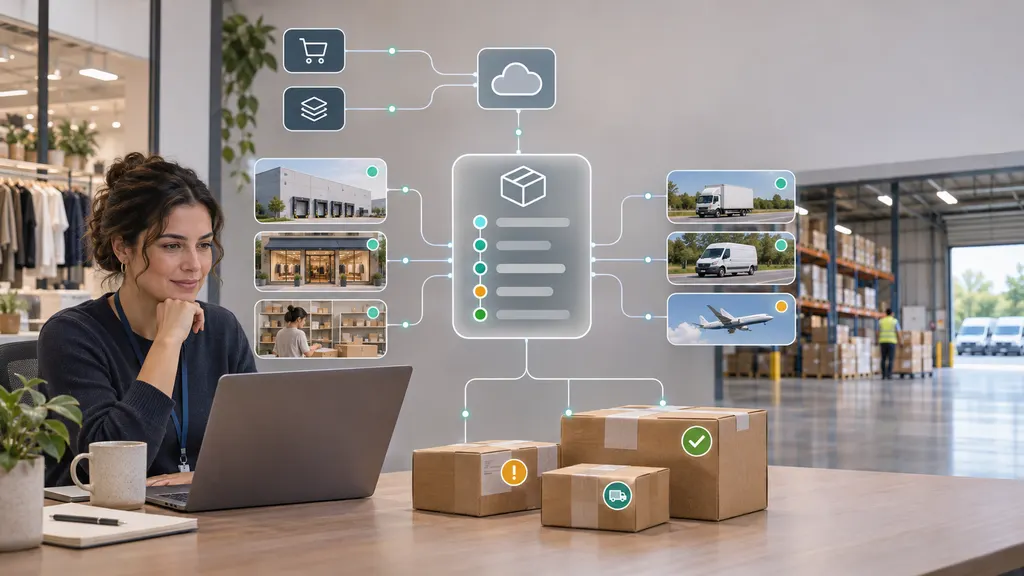
This approach matters because the same retailer may fulfill one order from a distribution center, another from a store, and a third through a marketplace or dropship partner. If each channel reports delivery information differently, customer service teams lose time reconciling records and customers receive inconsistent updates. A unified tracking process connects operational data without forcing every fulfillment source to use the same internal system.
Why omnichannel tracking becomes difficult
A single order can pass through several systems before it reaches the customer. The order may originate in an ecommerce platform or marketplace, be allocated by an order management system, fulfilled by a store or warehouse, and handed to a carrier through a shipping platform or direct carrier account. Each system may use a different identifier and status vocabulary.
- Multiple fulfillment points: stores and warehouses may ship from different locations, with different cut-off times, packaging processes, and carrier accounts.
- Split shipments: one order may produce several parcels, each with its own tracking number, delivery date, and exception history.
- Marketplace complexity: marketplace orders may have channel-specific order IDs, seller references, and notification requirements.
- Different carrier events: carriers do not always describe similar events in the same way. One may report an exception, while another provides a more specific reason.
- Returns and replacements: the outbound shipment is only part of the customer journey. A replacement parcel or return shipment must remain connected to the original order.
These issues make a shared tracking model more useful than a collection of separate tracking pages. The model should preserve the original source data while also providing a consistent operational status for reporting, customer communication, and escalation.
The operating model: one order, many fulfillment events
The first design decision is to separate the order, fulfillment, parcel, and event layers. They are related, but they are not interchangeable.
| Layer | What it represents | Useful fields |
|---|---|---|
| Order | The customer transaction | Order ID, sales channel, customer reference, destination |
| Fulfillment | The location or partner responsible for shipping | Store or warehouse ID, fulfillment method, handoff time |
| Parcel | A physical shipment within the order | Tracking number, carrier, service level, package reference |
| Event | A movement or delivery update | Timestamp, location, raw status, normalized status, exception code |
This structure prevents a common reporting error: treating an order as delivered when only one parcel has arrived. For split orders, the order-level status should be derived from all related parcels. A practical status model might distinguish between partially shipped, in transit, partially delivered, delivered, and exception requiring review. The exact labels should match the retailer’s customer service and fulfillment processes.
Connect the sources before standardizing the statuses
Retailers should map data sources before deciding which statuses to show. Start by documenting how each channel creates and updates a shipment:
- List every fulfillment source. Include distribution centers, retail stores, third-party logistics providers, dropship suppliers, and marketplace fulfillment programs where relevant.
- Record the identifiers used by each source. Keep the ecommerce order ID, marketplace order ID, fulfillment ID, parcel ID, and tracking number as separate fields when they serve different purposes.
- Identify the system of record for each event. Shipment creation may come from an order management system, while in-transit and delivery events usually come from the carrier or a tracking data provider.
- Define update frequency and ownership. Decide which system polls or receives events, who handles failed updates, and how duplicate events are removed.
- Preserve raw carrier information. A normalized status is useful for consistency, but raw descriptions and timestamps help support teams investigate unusual cases.
A multi-carrier tracking API can serve as the event collection layer when a retailer needs one integration path for multiple carriers. 17TRACK’s official API documentation describes its API resources and integration process; retailers should review the current documentation and confirm carrier, region, account, and usage requirements before selecting it for production.
View the 17TRACK Tracking API documentation
Normalize events without losing operational detail
Normalization should make data easier to interpret, not erase useful distinctions. A retailer can create a small set of customer-facing states while retaining more detailed internal categories.
- Label created: shipment information exists, but the carrier may not have recorded an acceptance scan.
- Picked up or accepted: the carrier has recorded possession of the parcel.
- In transit: the shipment is moving through the carrier network.
- Out for delivery: the carrier has indicated that delivery is planned for the current route or delivery cycle.
- Delivered: the carrier has recorded a delivery event.
- Exception: the shipment requires attention because delivery or movement may be delayed.
- Return in progress: the parcel is moving back to the retailer or another designated location.
The same customer-facing state can still carry different internal reasons. For example, “Exception” might represent an address issue, a customs hold, a weather disruption, or an attempted delivery. Those reasons should not be collapsed if they lead to different actions. Customer service may need to contact the buyer, request more information, wait for a carrier update, or initiate a replacement.
Design different views for different users
A unified data model does not require one identical screen for everyone. The action owner changes by workflow.
Store and warehouse teams
Fulfillment teams need to know whether a shipment was created, packed, handed to a carrier, or held before dispatch. Their view should emphasize unshipped orders, missing first scans, carrier handoff delays, and parcels that need investigation. A store associate may also need to see which location fulfilled the order so that inventory and customer inquiries can be routed correctly.
Customer service teams
Support agents need an order-centric view that combines every parcel, the latest event, the promised or estimated delivery information available to the business, and the next recommended action. They should not have to search separate carrier portals to determine whether a multi-parcel order is complete.
Customers
Customers usually need a clear timeline, parcel-level detail when an order is split, and an explanation of exceptions in plain language. Showing a carrier’s raw scan text without context can create confusion. The customer view should explain what has happened and what, if anything, the customer needs to do.
Marketplace and merchandising teams
These teams may need channel-level reporting: late handoffs, delivery exceptions, carrier performance by destination, and differences between store, warehouse, and marketplace fulfillment. Their reports should use consistent definitions so that a “late shipment” means the same thing across channels.
Use exception management as the control point
Visibility is valuable only when it supports action. Retailers should define rules for events that need human review. Examples include a label created without a carrier acceptance scan after the retailer’s internal threshold, repeated delivery attempts, an address-related exception, a parcel that remains at the same stage for an unusual period, or a delivery recorded while the order still has undelivered parcels.
Avoid using one universal time threshold for every carrier and destination. Transit expectations vary by service, geography, weekends, customs processes, and operating calendars. A better design stores the applicable service promise or internal threshold with the shipment, then compares incoming events against that context.
Every exception rule should have an owner and an outcome. For example, a missing first scan may be assigned to the fulfillment location, while a customs-related hold may go to an international shipping specialist. The system should record when the issue was detected, who reviewed it, what action was taken, and whether the parcel recovered without intervention.
A practical implementation sequence
- Start with a shipment inventory. Count the channels, fulfillment locations, carriers, service levels, and tracking formats currently in use.
- Choose a canonical shipment record. Decide which identifiers link orders, fulfillments, parcels, and returns, and document how duplicates are handled.
- Connect one representative source from each model. Test a warehouse shipment, a store shipment, a marketplace order, and a split shipment before expanding the integration.
- Map raw events to shared states. Keep the raw event, source timestamp, carrier name, and normalized state together.
- Test failure scenarios. Include missing tracking numbers, incorrect carrier codes, duplicate events, delayed scans, partial delivery, and returned parcels.
- Launch operational dashboards before customer messaging. Teams should be able to investigate data quality issues before automated notifications reach buyers.
- Measure data quality and operational outcomes. Review the percentage of shipments linked to the correct order, the time from carrier scan to internal update, unresolved exceptions, and support contacts related to delivery status.
A staged rollout is safer than attempting to connect every channel at once. The first release should prove that the retailer can identify the correct parcel, display the latest reliable event, and route exceptions to the right owner. Additional automation can follow after the underlying records are stable.
Questions to ask before selecting a tracking solution
- Can it associate several parcels with one order and distinguish partial delivery from complete delivery?
- How does it identify carriers, validate tracking numbers, and handle carrier changes?
- Can the retailer retain raw events while applying its own normalized status model?
- Does it support the carriers, regions, and shipping methods used by the business?
- Can events be delivered through the integration method required by the retailer, such as API requests or webhooks, where documented and available?
- How are retries, duplicate updates, rate limits, authentication, and data retention handled?
- Can operations, customer service, and customers receive different levels of detail?
- What testing and monitoring tools are available before production launch?
The right solution is the one that fits the retailer’s data ownership, fulfillment complexity, and response processes. Carrier count alone is not a sufficient selection criterion. A system that supports many carriers but cannot connect shipments to the correct order or assign exceptions may still leave the central operational problem unresolved.
FAQ
What is unified shipment tracking?
Unified shipment tracking combines shipment records and carrier events from different fulfillment sources into one consistent operational view. It can connect store, warehouse, marketplace, and partner shipments while preserving parcel-level details.
How should retailers track split shipments?
Treat each parcel as a separate shipment linked to the same order. Calculate the order-level status from all related parcels, and show which items or parcels are shipped, in transit, delivered, or delayed.
Should raw carrier statuses be shown to customers?
Usually, customers benefit from plain-language normalized statuses. Retailers should retain raw carrier events internally because they help support teams investigate exceptions and verify the source of an update.
When does a retailer need a tracking API?
An API becomes useful when a retailer needs to retrieve or manage tracking information inside its own order management, customer service, ecommerce, or data systems. The retailer should confirm the provider’s current documentation, supported carriers, authentication model, and usage requirements before implementation.
What is the first step in an omnichannel tracking project?
Create a shipment inventory and map the relationships among orders, fulfillment locations, parcels, carriers, and events. This exposes missing identifiers and inconsistent processes before the retailer invests in broader automation.