Humidity Controlled Space
What Is a Humidity Controlled Space?
A humidity controlled space is an enclosed area in which the moisture level of the air is managed to meet specified storage or handling requirements. In warehousing and logistics, it may be a room, storage zone, cabinet, or other enclosure used to protect moisture-sensitive goods. Its operating requirements should identify the acceptable humidity range, relevant temperature conditions, and how conditions are monitored.
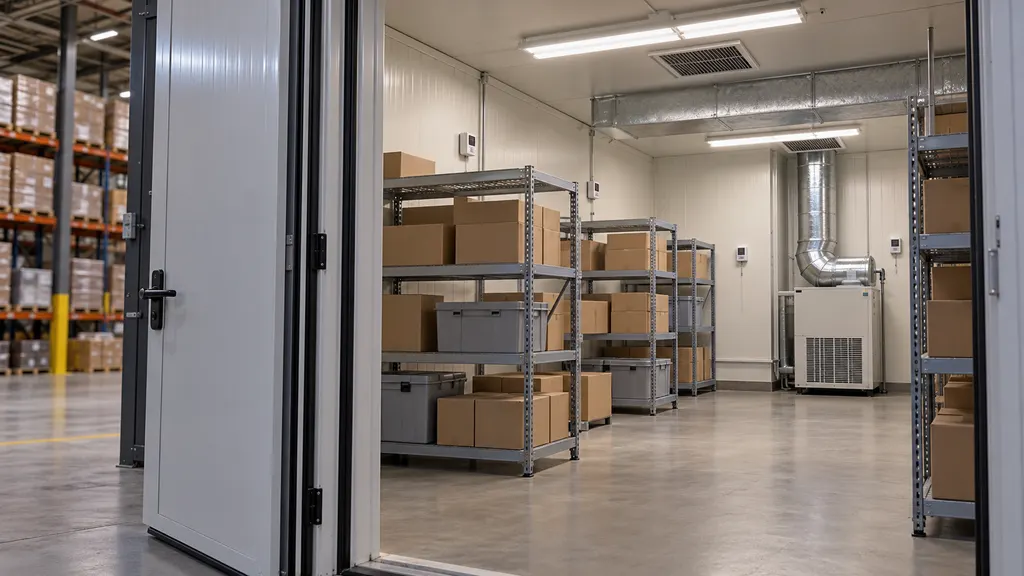
The term describes an environmental capability, not a universal storage specification. It does not, by itself, establish a particular humidity range, certification, or suitability for every product. The appropriate conditions depend on the goods, their packaging, manufacturer instructions, and any applicable quality or regulatory requirements.
Humidity and Product Storage
Humidity matters because moisture in the surrounding air can interact with products and packaging. Depending on the material and exposure conditions, excessive moisture can contribute to corrosion, mold growth, swelling, or deterioration of moisture-sensitive contents. Conditions that are too dry can also be unsuitable for some materials. The objective is therefore to maintain an appropriate environment, rather than simply to make a warehouse as dry as possible.
Relative humidity
Relative humidity, commonly abbreviated as RH, expresses how close air is to saturation at its current temperature. It is stated as a percentage. Because saturation conditions change with temperature, relative humidity can change when air is heated or cooled even if its water vapor content remains unchanged.
This relationship makes temperature relevant to humidity control. A humidity reading without temperature information provides an incomplete picture of storage conditions. For goods with defined environmental requirements, both measurements may need to be evaluated together.
Dew point and condensation
Dew point is the temperature at which air becomes saturated when cooled without changing its water vapor content. Condensation can occur when a surface is at or below the dew point of the surrounding air. A cold product entering a warmer, humid handling area may therefore develop surface moisture even when the destination area's humidity reading is within its normal operating range.
For this reason, controlling a storage room does not eliminate every moisture risk. Transfers between environments, cold surfaces, packaging condition, and local airflow can be as important as the room's recorded average humidity.
How a Humidity Controlled Space Works
A controlled space combines an enclosure, moisture-management equipment, and a method for checking performance. Its design should reflect the required conditions and the moisture entering or generated within the space.
- Enclosure: Walls, doors, seals, and suitable building materials help limit uncontrolled exchange with surrounding air.
- Dehumidification: Equipment removes moisture when conditions would otherwise exceed the specified range. Different technologies may be appropriate for different temperatures and moisture loads.
- Humidification: Some applications require moisture to be added when the air becomes too dry. Humidity control does not necessarily mean dehumidification alone.
- Temperature management: Heating or cooling may be needed alongside moisture control because temperature affects relative humidity and condensation risk.
- Air distribution: Airflow helps the controlled conditions reach the intended storage locations rather than only the area near a sensor.
- Monitoring and response: Sensors, records, alarms, and operating procedures allow personnel to detect and investigate deviations.
Installing equipment is not the same as demonstrating that a space meets its requirements. Performance should be assessed under relevant operating conditions, including expected inventory loads, door openings, and seasonal influences. A reading taken beside a dehumidifier may not represent conditions behind densely packed stock or near an external wall.
Use in Warehousing and Ecommerce Fulfillment
In a supply chain, a humidity controlled space is a storage or handling resource. It may be used for incoming goods, reserve inventory, components awaiting assembly, finished products, or returned goods awaiting assessment. The need follows the product's environmental requirements, not whether it is sold through an ecommerce marketplace, a physical store, or a wholesale channel.
For example, a retailer may assign a moisture-sensitive product to a controlled storage room while keeping other inventory in ordinary warehouse space. The relevant requirements should accompany the product record and warehouse instructions so that receiving staff, inventory planners, and fulfillment personnel apply the same conditions.
Storage protection also has limits. Moving an item from a controlled room to an uncontrolled packing bench, loading dock, or vehicle introduces a new exposure. Whether that exposure is acceptable depends on the product, protective packaging, duration, and environmental conditions. A warehouse service description should not be interpreted as proof that the entire delivery journey is humidity controlled.
Cross-border movements
International shipments may pass through environments with different temperatures and moisture conditions. Warehousing, consolidation, transport, inspection, and final delivery can each create a separate exposure. Where humidity is important, the shipping plan should identify which stages require environmental control and which rely on packaging protection.
Humidity control does not itself determine customs classification or guarantee customs clearance. Its role is to maintain appropriate physical conditions for the goods. Product-specific documentation and environmental records may be relevant to quality management, but they do not replace applicable import or export requirements.
Related Terms and Important Distinctions
| Term | Main meaning | Relationship to humidity control |
|---|---|---|
| Humidity controlled space | An enclosure where air moisture is managed against specified requirements. | The requirements should identify the acceptable conditions and monitoring arrangements. |
| Temperature controlled space | An area managed to maintain specified temperature conditions. | Temperature control alone does not establish that humidity is maintained within a required range. |
| Climate controlled space | A broad commercial description of managed indoor conditions. | The service specification must clarify whether humidity is included and what limits apply. |
| Cold storage | Storage maintained at a low temperature appropriate to the goods. | Low temperature does not, by itself, demonstrate suitable moisture conditions or eliminate condensation risk. |
| Dry storage | A context-dependent description of storage intended to keep goods dry. | It should not be assumed to include a measured humidity range unless one is specified. |
| Moisture-barrier packaging | Packaging designed to restrict water vapor transfer. | It protects the packaged contents rather than controlling the surrounding warehouse air. |
These terms can overlap in commercial usage. A facility may provide both temperature and humidity control, but the label alone is insufficient to establish its capability. The written storage specification is the more useful basis for evaluating suitability.
Defining and Checking Storage Requirements
A practical specification connects the product's needs with measurable facility conditions. It should distinguish required limits from preferred operating settings and explain what happens when conditions move outside the permitted range.
- Identify the product requirements. Review manufacturer instructions, material characteristics, packaging specifications, and applicable quality requirements. Do not select a humidity range simply because it is advertised as standard warehouse practice.
- Define the measurement basis. State whether the requirement concerns relative humidity, dew point, or another moisture measure. Include temperature conditions where relevant.
- Define the controlled boundary. Identify whether protection applies to a cabinet, room, warehouse zone, or wider operation. Include receiving, picking, and packing areas if they fall within the requirement.
- Assess representative locations. Select monitoring points that reflect where goods are stored. Consider doors, external walls, airflow restrictions, and other locations where conditions may differ.
- Establish monitoring arrangements. Specify suitable instruments, recording intervals, calibration arrangements, and record retention according to the application.
- Set response procedures. Identify who investigates an alarm, what information is recorded, and how potentially affected inventory is assessed.
- Review operational changes. Changes to racking, equipment, stock density, door use, or building layout may affect environmental performance and warrant reassessment.
There is no single humidity setting appropriate for all warehouse inventory. For example, United States pharmaceutical manufacturing regulations require drug products to be stored under appropriate conditions of temperature, humidity, and light so that their identity, strength, quality, and purity are not affected. That requirement is specific to its regulatory context; it is not a universal humidity limit for ecommerce goods.
Packaging, Transfers, and Excursions
Room control and packaging protection address different parts of the moisture problem. A controlled room manages the surrounding air, while suitable packaging can limit exposure at the product level. Desiccants may help manage moisture within an appropriate package, but their effectiveness depends on factors such as package integrity, moisture ingress, and available capacity. They are not an unconditional substitute for specified storage conditions.
Transfers deserve particular attention when goods move between cold and warm environments. A handling procedure may require goods to remain protected while their temperature changes, where supported by product and packaging instructions. Opening packaging immediately after a temperature transition can expose cold contents to humid air.
An excursion is a departure from specified environmental limits. An excursion does not automatically prove that goods are damaged, and an apparently normal room reading does not prove that all goods were protected. Assessment should consider the recorded conditions, duration, product sensitivity, packaging, sensor location, and relevant acceptance criteria. Questionable inventory may need to be held pending an authorized quality decision.
QA
Is humidity controlled storage the same as air-conditioned storage?
No. Air conditioning can affect humidity, but it does not by itself demonstrate that a specified humidity range is maintained. The facility must have suitable controls and monitoring for the required conditions.
What is the correct humidity level for a warehouse?
There is no universal setting. Appropriate conditions depend on the goods, packaging, manufacturer instructions, and applicable requirements. A product-specific specification is more reliable than a general warehouse target.
Does a humidity controlled warehouse protect goods during shipping?
Not automatically. Warehouse control applies within its defined boundary. Transport and transfer stages need their own assessment, using environmental control, protective packaging, or other measures appropriate to the goods.
Can condensation occur in a humidity controlled space?
Yes. Condensation can occur on a surface at or below the surrounding air's dew point. Cold goods entering a warmer area can therefore require additional handling precautions even when the area's humidity is within its specified range.
Sources
- National Weather Service: Relative Humidity and Dewpoint — Supports the explanation of relative humidity, temperature dependence, and dew point.
- United States Environmental Protection Agency: A Brief Guide to Mold, Moisture and Your Home — Supports the general relationships between moisture, condensation, and mold prevention; its residential guidance is not presented as a warehouse storage specification.
- Electronic Code of Federal Regulations: 21 CFR 211.142, Warehousing Procedures — Supports the pharmaceutical-specific requirement for appropriate temperature, humidity, and light during storage.