How to Ship Food to Another State: Agriculture Rules, Packing, and Carriers
To ship food to another state safely and legally, first identify the food’s risk and origin, then check agriculture restrictions at the destination, choose a carrier service that can meet the delivery window, and pack the shipment to control temperature, moisture, and leakage. Shelf-stable foods are usually the simplest to send. Meat, dairy, fresh produce, plants, seeds, and frozen or refrigerated foods require more careful review because federal, state, and carrier rules may apply at the same time.
The right process is different for a homemade gift, a farm shipment, and an ecommerce order. The steps below focus on shipments within the United States. They are practical shipping guidance, not a substitute for advice from the destination state’s agriculture department or a food-safety regulator.
Start with the food, not the box
Before comparing postage or freight options, classify what you are sending. The classification determines the main compliance and packaging questions.
- Shelf-stable packaged food: Sealed dry goods, canned products, baked goods with low moisture, and commercially packaged snacks are generally easier to transport because they do not normally require temperature control. Check the product label, expiration guidance, and packaging condition before shipping.
- Perishable food: Fresh meals, soft cheese, seafood, meat, cut fruit, cream-filled pastries, and similar products may require refrigeration or freezing. The shipment needs an appropriate insulated container, coolant, and a delivery plan that limits time in transit.
- Plant and agricultural material: Live plants, soil, seeds, some fruits, vegetables, and other plant products may be restricted because they can carry pests or diseases. Restrictions can depend on the commodity’s origin and the destination’s quarantine rules.
- Animal products: Meat, poultry, eggs, dairy, animal feed, and wildlife-related products may involve different federal or state requirements. Commercial shipments can also be subject to inspection, labeling, processing, or licensing rules.
- Alcohol and other regulated products: Alcohol is not an ordinary food shipment. Carrier authorization, licensing, age verification, and state-specific rules may apply. Do not place alcohol in a standard food parcel without confirming the legal and carrier requirements.
Also ask whether the food is homemade or commercially produced. A personal gift and a business sale may be treated differently by a regulator, carrier, or marketplace. If you are shipping food as part of a recurring business operation, confirm labeling, facility, tax, and licensing obligations rather than assuming that a small parcel is exempt.
Check agriculture and food rules at both ends
Federal rules provide an important baseline, but they do not eliminate state-level restrictions. The destination state may regulate the entry of plants, fruits, vegetables, soil, livestock products, or other agricultural materials. Some restrictions apply only to particular counties, pest zones, or commodities.
Use the following sequence before packing:
- Identify the exact contents. Record the product type, ingredients, whether it is raw or processed, and whether it contains plant or animal material.
- Identify the origin. The state, county, farm, or growing area can matter for quarantined commodities. Keep supplier or harvest information for commercial shipments.
- Check the destination state’s agriculture department. Look for plant quarantine, agricultural import, food establishment, and animal-product guidance. Search for the specific commodity instead of relying on a general shipping page.
- Check federal requirements. USDA agencies may regulate plant and animal products, while the Food and Drug Administration regulates many foods and food facilities. Requirements vary by product and transaction.
- Check the carrier’s restricted-items policy. A product can be legally movable but still subject to carrier packaging, service, labeling, or liability limits.
For plant material, the USDA Animal and Plant Health Inspection Service provides a searchable “Don’t Move Firewood” and regulated-materials framework, while state agriculture departments publish destination-specific quarantine information. A common mistake is to assume that washing or boxing produce removes a quarantine restriction. It may not. If the rule is unclear, contact the relevant state agency before tendering the shipment.
For food safety, the FDA’s basic principle is that perishable foods must be kept at safe temperatures during handling and transport. A carrier’s delivery estimate is not the same as a food-safety guarantee. If you cannot reasonably control the temperature for the entire journey, choose a shelf-stable alternative or do not ship the item.
How to pack food for interstate shipping
Use primary, secondary, and outer packaging
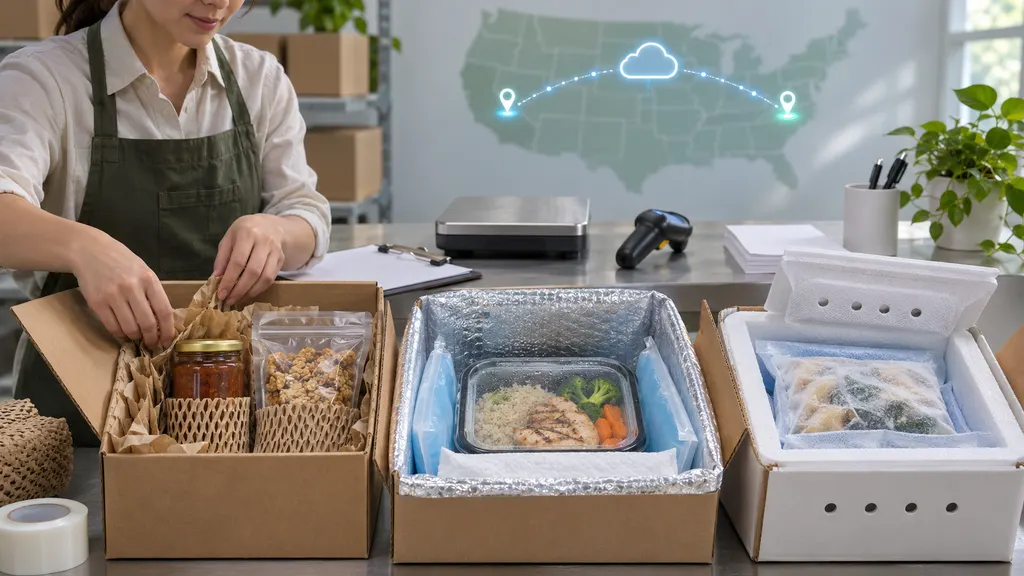
A reliable parcel normally has three protective layers. The primary container holds the food and should be sealed against leakage. The secondary layer contains spills and cushions the product. The outer carton protects the shipment from compression, punctures, and handling.
For liquids, sauces, oils, and moist foods, use a leak-resistant primary container, seal the closure with a suitable method, place it in a watertight bag or liner, and surround it with absorbent material. Do not rely on a thin retail package as the only barrier. Leave enough room for cushioning without allowing the container to move inside the box.
For baked goods, prevent crushing and moisture transfer. Wrap individual pieces when appropriate, use a rigid inner container, and avoid packing warm food in a sealed box because condensation can damage texture and encourage spoilage. Fragile items such as glass jars need separation and cushioning on every side.
Refrigerated and frozen shipments
Temperature-sensitive food requires more than an insulated bag. Use an insulated shipper sized for the product, enough coolant for the planned route, and a strong corrugated outer carton. Pack the contents tightly enough to reduce air gaps, but do not compromise the insulation or allow food containers to break under pressure.
Gel packs are commonly used for chilled products. Dry ice can keep products frozen, but it is regulated as a hazardous material in transportation. The carrier and service must accept it, and the package normally needs the appropriate dry-ice marking, weight information, ventilation, and documentation. Dry ice should not be placed in an airtight container because sublimation produces carbon dioxide gas.
Use the shortest practical transit time and avoid a weekend or holiday delay when the service schedule makes that possible. Send early in the week when appropriate, add delivery instructions, and tell the recipient when the parcel is expected. A temperature indicator can help document conditions, but it does not make unsafe food safe. For high-value or repeated shipments, validate the package with a test shipment or temperature logger before scaling up.
Label the package clearly
Include the sender’s and recipient’s complete addresses, a return address, and any carrier-required markings. For temperature-sensitive goods, a label such as “Keep Refrigerated” can communicate handling needs, but it does not replace proper packaging or guarantee special treatment. If dry ice is present, follow the carrier’s current marking and documentation instructions exactly.
For business shipments, retain the product name, lot or batch information, ingredients, allergen information, shipment date, and destination details when relevant to your records. Do not put a vague description such as “food” on a commercial shipping document when the carrier or regulator requires a more specific description.
Choosing between USPS, UPS, FedEx, and freight
No carrier can remove the sender’s responsibility for legal compliance or food safety. The best service depends on product stability, package size, destination, delivery speed, and whether temperature control is required.
| Shipment situation | Practical carrier approach | Main check before shipping |
|---|---|---|
| Shelf-stable parcel | Compare USPS, UPS, and FedEx service levels by destination and package size. | Packaging strength, delivery estimate, restrictions, and declared contents. |
| Chilled or frozen parcel | Use a carrier service that accepts the packaging and any coolant or dry ice involved. | Transit time, weekend exposure, acceptance rules, and temperature plan. |
| Large or repeated business shipment | Evaluate parcel contracts, regional services, or a qualified freight provider. | Pallet protection, appointment needs, documentation, claims process, and food-safety controls. |
| Restricted agricultural product | Choose a carrier only after confirming the destination rule and required documents. | Quarantine status, permit or certificate requirements, and inspection procedures. |
USPS Publication 52 explains postal restrictions and packaging expectations for hazardous, perishable, and other special items. UPS and FedEx publish separate guidance for shipping perishables and dry ice. These policies can change by service and destination, so check the current official page before each new product launch or shipping program.
Freight packaging becomes more important as volume increases. A palletized food shipment needs stable stacking, edge protection, stretch wrap, moisture control, and labels that remain visible after handling. Do not assume that a freight carrier provides refrigeration merely because the product is described as perishable. Confirm the equipment, temperature range, handoff points, and claims procedure in writing.
A practical pre-shipment checklist
- Confirm whether the food is shelf-stable, refrigerated, frozen, raw, processed, plant-based, or animal-derived.
- Check the destination state’s agriculture and food rules for the exact product and origin.
- Review the carrier’s prohibited, restricted, perishable, dry-ice, and liability policies.
- Select packaging based on the expected temperature and transit duration, not only on box size.
- Use leak containment and cushioning for every liquid, glass, or fragile item.
- Ship early enough to reduce weekend and holiday exposure when the product is perishable.
- Provide accurate contents and contact details, and keep shipment and product records.
- Tell the recipient when to expect the delivery and what to do if the package arrives warm, damaged, or leaking.
If the shipment is rejected, delayed, damaged, or delivered outside the planned temperature range, do not automatically reship or consume the contents. Document the condition, contact the carrier, and apply your food-safety procedure. For commercial operations, recurring failures usually indicate a packaging, service-level, or cutoff-time problem that should be corrected before increasing volume.
FAQ
Can I ship homemade food to another state?
Sometimes, but the answer depends on the food, the destination, and whether the shipment is a personal gift or a commercial sale. Shelf-stable items are generally easier to manage than meat, dairy, cream-filled foods, or fresh produce. Check the destination state’s cottage-food and agriculture rules before shipping homemade products.
Can I send fresh fruit or vegetables across state lines?
Some produce can move freely, while other commodities may be restricted because of plant pests or disease. Restrictions can depend on the origin and destination. Check USDA APHIS guidance and the destination state agriculture department for the specific commodity.
Is dry ice allowed in a food package?
Dry ice may be accepted by some carriers and services, but it is regulated because it releases carbon dioxide gas. Packaging, ventilation, labeling, quantity, and documentation requirements apply. Confirm the current carrier rules before tendering the parcel.
What is the safest carrier for perishable food?
There is no universally safest carrier. Compare the available delivery speed, acceptance rules, packaging requirements, pickup schedule, weekend exposure, and claims process. The packaging and route plan are as important as the carrier name.
Does a faster shipping service guarantee that food will be safe?
No. A faster service can reduce transit exposure, but it does not guarantee a temperature or handling result. The sender remains responsible for selecting suitable packaging and a realistic delivery plan.