How to Choose a Tracking API: Five Capabilities Businesses Should Evaluate
Businesses that handle large volumes of shipping data every day use tracking for more than checking a package’s whereabouts. E-commerce platforms monitor order fulfillment, insurers use shipment records to review claims, financial institutions use logistics data to inform risk assessments, and brands use delivery information to manage post-purchase support.
A Shipment Tracking API, also known as a Track and Trace API, connects business systems to global shipping data. Companies can retrieve tracking events from multiple carriers, consolidate the data in their own systems, and use it to monitor deliveries, detect exceptions, and inform operational decisions.
How should businesses compare the Shipment Tracking API solutions available? These five capabilities can help teams define their selection criteria and choose a solution that fits their needs.
1. Global Carrier Network: Does It Cover Your Markets and Use Cases?
Cross-border businesses often use a mix of international express carriers, postal operators, dedicated cross-border shipping providers, and regional delivery companies. As they enter new markets, they typically add more carriers. Building and maintaining a separate integration for each one increases both development effort and ongoing costs.
1.1 Global Coverage Across 3,500+ Carriers
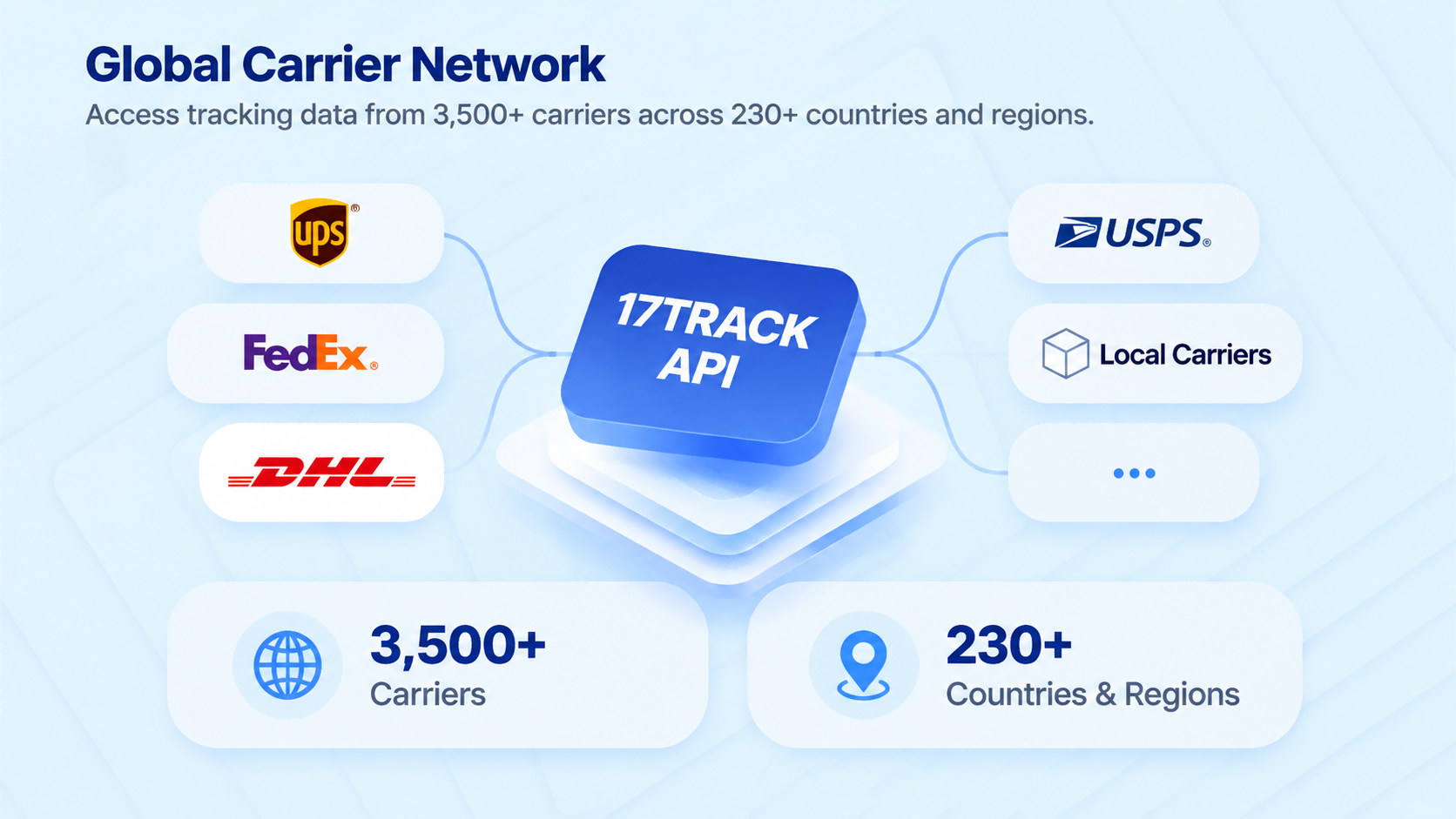
When evaluating carrier coverage, check the total number of carriers alongside coverage for your key markets and actual shipping routes.
17TRACK Shipment Tracking API supports 3,500+ carriers across 230+ countries and regions. Businesses can access tracking data from international couriers, postal operators, and regional carriers through a single interface.
A unified integration for carriers such as UPS, FedEx, and DHL, as well as local providers, reduces duplicate development and makes it easier to manage tracking across shipping channels.
1.2 Adapt to Diverse Enterprise Scenarios
Tracking APIs are not limited to cross-border eCommerce. They also serve businesses that need to access, verify, or manage logistics data. 17TRACK API supports a wide range of business use cases, including:
- E-commerce fulfillment: Monitor delivery progress and manage order fulfillment.
- Insurance claims: Use tracking events and delivery records to support claims reviews.
- Financial risk management: Use shipping data to support transaction verification and risk assessments.
- Post-purchase support for brands: Use delivery records to answer shipping questions and investigate delivery disputes.
- Freight forwarders and SaaS providers: Consolidate data across shipping channels to offer customers a unified tracking service.
Carrier coverage determines which shipping channels a Tracking API can connect to. The ability to support specific use cases determines how well that data fits into business workflows. Check whether the API integrates with the systems you use and supplies the data those workflows require.

2. Tracking Accuracy: Can It Identify the Carrier and Retrieve Valid Tracking Events?
Tracking accuracy depends on a responsive API, correct carrier identification, and access to usable tracking events. Different carriers can use overlapping tracking number formats, and the carrier information a business submits may be incorrect. A request sent to the wrong carrier can return "Not Found" even while the shipment is moving normally. Carrier detection and the handling of tracking errors are therefore important to overall accuracy.
2.1 AI and Rule-Based Matching Improve Carrier Detection
Traditional carrier detection relies largely on tracking number length, prefixes, and character patterns. When several carriers use similar formats, fixed rules can match a number to the wrong carrier.
The 17TRACK API combines an in-house AI model with rule-based matching and draws on years of shipping data to identify carriers. It cross-checks signals such as tracking number patterns, regions, and frequently used carriers, achieving a carrier detection rate of 95%+.
AI-assisted detection and ongoing refinement of matching rules help businesses reduce carrier mismatches and improve tracking accuracy.
2.2 Investigating "Not Found" Results to Improve Tracking Success
"Not Found" does not necessarily mean that a shipment has not been dispatched. It may also result from incorrect carrier matching, invalid tracking number information, or the carrier not yet having generated tracking events. By combining carrier matching, query parameter validation, and continuous monitoring, 17TRACK helps businesses identify different types of tracking exceptions and narrow down potential causes.
For recurring tracking exceptions, 17TRACK monitors data performance across carriers, regions, and accounts. It uses AI-powered carrier detection, automatic carrier switching, tracking number correction, and continuous monitoring to identify and resolve data issues.
Identifying the causes of tracking failures and refining how they are handled helps businesses retrieve more usable shipping data and reduces the disruption that "Not Found" results cause in daily workflows.
3. Data Standardization and Advance Services: What Data Can 17TRACK Provide?
For businesses, retrieving shipment tracking data is only the first step. The real value lies in transforming data from different carriers into unified, actionable information that can be easily understood and integrated into business workflows.
As tracking supports more workflows, teams may also need proof of delivery, estimated delivery dates, on-demand tracking, and shipping analytics. The consistency of the data and the range of available services determine which workflows a Tracking API can support.
3.1 A Common Format With 9 Main Statuses and 30 Substatuses
17TRACK API provides 9 main statuses and 30 sub-statuses, standardizing tracking events from different carriers into a unified framework while preserving detailed shipment tracking information.
The main statuses cover stages such as Information Received, In Transit, Out for Delivery, Delivered, Failed Attempt, Exception, Expired, and Available for Pickup.
Businesses can use a common data structure to identify shipment progress, delivery, and exceptions, then configure workflows around those events.
3.2 Advance API Services for More Shipping Workflows
The 17TRACK API offers several advance services that give businesses access to additional shipping data for different workflows.
| Advance Service | What It Does |
|---|---|
| POD (Proof of Delivery) | Retrieve proof of delivery and related shipment information to support fulfillment verification and dispute handling. |
| EDD (Estimated Delivery Date) | Access estimated shipment delivery dates to set delivery expectations and notify customers. |
| Real-Time API | Request the latest available tracking data on demand for workflows that require more timely updates. |
| Multilingual Tracking Event Translation | Translate tracking updates from carriers in different countries and regions to simplify multilingual data processing. |
| Email Notifications | Receive email updates when a shipment status changes. |
| Analytics Dashboard | Analyze shipping data to assess transit times and inform logistics decisions. |
These Advance services go beyond basic shipment tracking, enabling businesses to leverage proof of delivery (POD), estimated delivery dates (EDD), and logistics analytics to support fulfillment management, customer service, and risk control based on their specific business needs.
4. Data Timeliness and Logistics Insights: Can It Surface Updates and Operational Issues?
Businesses that track large volumes of shipments need timely updates so they can spot shipping exceptions early and identify patterns across many shipments.
Delayed updates can cause teams to miss opportunities to address exceptions, affecting customer support, order fulfillment, and the customer experience. Without analysis across shipments, teams may also struggle to assess how individual carriers and routes perform.
When choosing a Tracking API, evaluate update frequency alongside ongoing monitoring, exception detection, and shipping analytics.
4.1 Updates Within Minutes and Webhook Delivery
The 17TRACK API provides enterprise-grade tracking data updates, with standard update intervals of 1–3 hours and minute-level updates available for key shipment milestones. Through Webhook notifications, businesses can receive tracking updates as soon as shipment statuses change, reducing delays caused by repeated polling requests.
To meet different business requirements, 17TRACK also supports dynamic update frequency optimization, adjusting polling intervals based on shipment progress. Dedicated traffic resources are available to support large-scale shipment tracking and ensure reliable performance as business volumes grow.
4.2 Exception Monitoring and Carrier Performance Analysis
The 17TRACK API combines ongoing monitoring with automated detection to help teams identify delays, shipment exceptions, and changes in "Not Found" results. Customer service and fulfillment teams can use this information to decide when to follow up.
Businesses using multiple carriers also need to understand how each shipping channel performs.
The 17TRACK API provides insights into transit times, shipping exceptions, and tracking data performance across carriers. Teams can use these insights to evaluate carriers, adjust routes, and improve delivery services.
5. Enterprise Integration and Service Reliability: Can It Support Long-Term Use at Scale?
For businesses, a Tracking API is not just a one-time data lookup tool. It is a core service that needs to be continuously integrated with systems such as order management, customer support, fulfillment, and risk control. Any performance bottlenecks, data interruptions, or delayed technical support can disrupt multiple business operations.
Evaluate throughput, integration flexibility, service reliability, and ongoing support against both current needs and expected business growth.
5.1 High Throughput and Bulk Tracking
The 17TRACK API supports bulk tracking number registration and can process more than 400,000 tracking data updates per hour. This capacity supports high-concurrency tracking and helps businesses retrieve shipping data reliably as order volumes grow.
5.2 Enterprise SLA and Dedicated Support
The 17TRACK API offers enterprise customers a service-level agreement (SLA) with annual service availability of at least 99.9%. Enterprise customers can also receive support from a dedicated customer success manager, along with monthly business reviews (MBRs) and quarterly business reviews (QBRs) to discuss API usage, system performance, and changing business needs.
From Shipment Tracking to Operational Insights
The 17TRACK API combines a global network of 3,500+ carriers with AI-assisted carrier detection, standardized tracking statuses, exception monitoring, and carrier performance analysis. It supports e-commerce platforms, freight forwarders, financial institutions, insurers, brands, and SaaS providers.
Businesses can use 17TRACK to follow individual shipments, manage tracking data at scale, and apply shipping insights to order fulfillment, customer experience, and operational decisions.