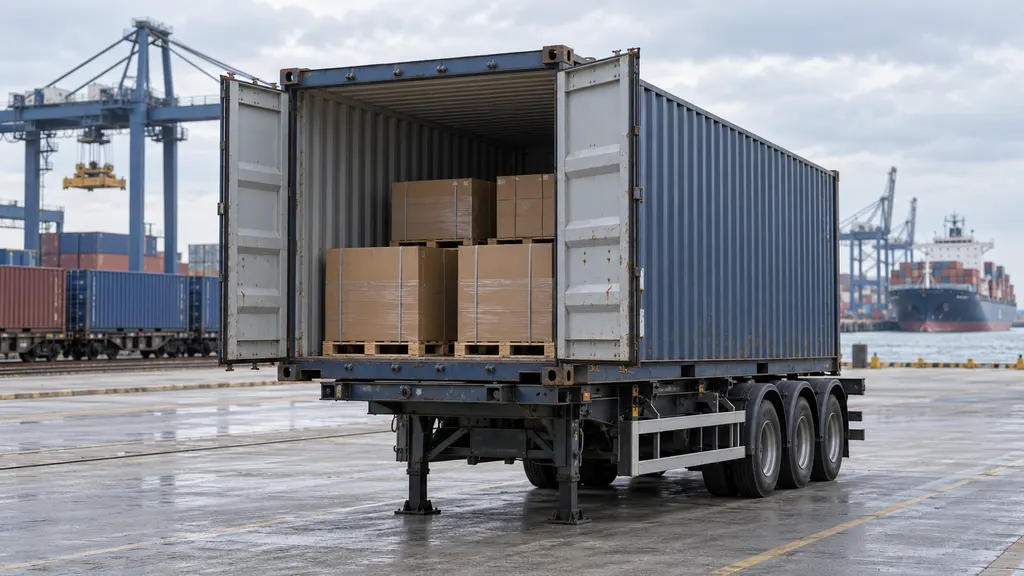
Containerization
What Is Containerization?
Containerization is the use of standardized, reusable freight containers to transport goods as a single handling unit, particularly across ships, trains, and trucks. Instead of unloading and reloading individual packages at every transfer point, operators move the loaded container between compatible vehicles and terminals. In logistics and international trade, containerization refers to both the physical preparation of cargo in containers and the wider transport system that makes these transfers possible.
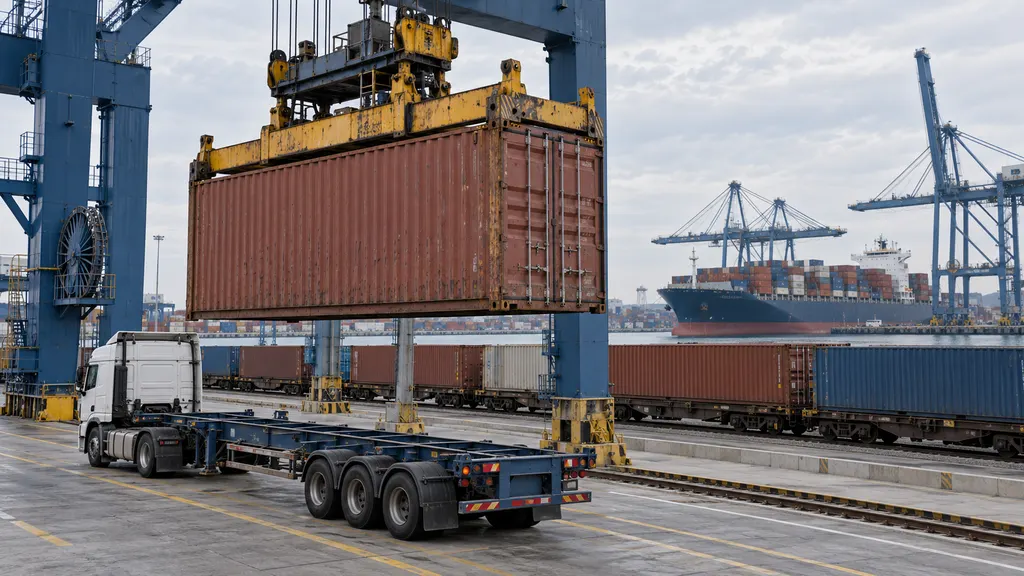
The container provides a common interface between different transport modes, but the goods inside still need suitable packaging, weight distribution, and securing. Containerization does not mean that a shipment remains unopened throughout its journey: consolidation, customs inspection, transloading, or delivery arrangements may require the container to be opened or the cargo to be transferred.
In this entry, the term concerns freight transport, not software containerization, which is a separate computing concept.
How Containerization Works
A containerized shipment connects cargo preparation, inland transport, terminal handling, main carriage, and destination distribution. The exact sequence depends on the route, service agreement, cargo, and whether the container holds one shipper's goods or consolidated shipments.
- Assess the cargo and select equipment. The shipper or its service provider considers dimensions, weight, packaging, temperature requirements, dangerous goods restrictions, and loading access. Equipment must suit both the cargo and the planned transport route.
- Inspect the container. Before loading, the responsible party checks whether the unit is suitable for the cargo. Relevant checks include structural condition, cleanliness, dryness, door operation, and evidence of damage or contamination.
- Pack and secure the goods. Cartons, pallets, machinery, or other cargo are positioned to distribute loads appropriately. Blocking, bracing, lashings, or other suitable securing measures help prevent movement during transport. The industry often calls loading a container stuffing or packing.
- Complete identification and shipment information. Container identification, seal information where applicable, cargo descriptions, and transport documentation connect the physical unit with the shipment records. Applicable weight verification and dangerous goods requirements must also be addressed.
- Move the container through the transport network. Trucks, trains, vessels, and terminal equipment handle the container as a unit. Cargo can remain inside while the container changes transport modes.
- Release, unpack, and distribute the cargo. Following the necessary transport and customs release procedures, the container is delivered to an agreed location or unpacked at a freight facility. Goods may then enter a warehouse, fulfillment center, or another transport operation.
These steps involve different responsibilities. A freight forwarder may coordinate bookings and documentation, while a carrier performs a transport leg and a terminal operator handles transfers. The party arranging transport is not necessarily the party physically packing the container.
Container Equipment and Shipment Arrangements
Equipment type and shipment arrangement describe different aspects of containerization. Equipment describes the physical unit and its capabilities. Full container load and less than container load describe how cargo is booked and organized; they are not container designs.
Common Equipment Types
| Equipment | Main characteristic | Relevant cargo considerations |
|---|---|---|
| General-purpose dry container | Enclosed container for cargo that does not require active temperature control | Packaging, moisture exposure, door clearance, and load distribution |
| Refrigerated container | Equipment designed to maintain specified temperature conditions | Temperature settings, airflow, power availability, and cargo preparation |
| Open-top container | Allows loading through the top rather than relying only on end-door access | Overhead handling, cargo height, securing, and weather protection |
| Flat-rack container | A platform-based unit suitable for some cargo that cannot fit within an enclosed container | Out-of-gauge dimensions, lifting arrangements, route acceptance, and restraint |
| Tank container | A tank within a handling frame for compatible liquid or other tank-suitable cargo | Product compatibility, cleaning, filling limits, and applicable cargo regulations |
Nominal container dimensions do not by themselves establish whether a load will fit. Internal dimensions, door openings, payload limits, equipment condition, and carrier acceptance also matter. Containerization is therefore an equipment-selection problem as well as a space-planning exercise.
Full Container Load and Less Than Container Load
| Arrangement | Meaning | Operational implication |
|---|---|---|
| Full container load, or FCL | A shipment arrangement in which a container is booked for a customer's cargo rather than shared through an LCL consolidation service | The container need not be physically full; packing and unpacking locations depend on the agreed service |
| Less than container load, or LCL | A shipment arrangement in which separate consignments are consolidated into a shared container | Cargo is handled at consolidation and deconsolidation facilities before or after the containerized transport leg |
The choice between FCL and LCL depends on more than cargo volume. Weight, handling sensitivity, routing, available services, delivery requirements, and the full set of transport and handling charges may affect the decision. Neither arrangement is universally cheaper or faster.
Role in Cross-Border Ecommerce and Supply Chains
Containerization is relevant to ecommerce when inventory moves in bulk between suppliers, importers, warehouses, and fulfillment centers. It is distinct from the individual parcel delivery that follows a consumer order. A container can carry goods intended for many future orders without itself being a consumer-facing shipment.
For example, a retailer may arrange for cartons of household products to travel from a supplier to an overseas fulfillment warehouse. The cartons may be palletized and packed into a container, moved by truck to a port, carried by vessel, and transported inland after arrival. Once the goods are received and recorded as inventory, individual units can be picked and packed for customer delivery. This is an illustrative supply chain, not a required sequence for every ecommerce shipment.
A freight forwarder may help coordinate the container booking, consolidation, documentation, and connections between transport legs. Customs clearance remains a separate requirement: placing goods in a container does not change their tariff classification, origin, value, or applicable import restrictions.
Businesses may encounter the term in freight quotations, supplier shipping instructions, warehouse receiving plans, port operations, and cargo insurance discussions. Container numbers identify equipment, while purchase orders, shipment references, and parcel tracking numbers identify different commercial or operational records. These references should not be treated as interchangeable.
Benefits and Limitations
Containerization allows compatible handling equipment and transport services to move cargo without separately handling each package at every interchange. An enclosed container can also provide a physical barrier against some external exposure and unauthorized access. These characteristics can simplify transfers, but they do not guarantee an undamaged, uninterrupted, or secure shipment.
- Handling efficiency depends on the network. Compatible terminals, lifting equipment, vehicles, and suitable access are needed. A destination without appropriate facilities may require additional handling or transloading.
- Cargo can still move inside the container. External standardization does not prevent poorly secured packages from shifting, collapsing, or damaging adjacent goods.
- Moisture and temperature remain relevant. An enclosed dry container does not automatically provide temperature control or eliminate condensation. Cargo preparation and protective measures must reflect the goods and route.
- Weight can constrain use before space does. Dense goods may reach a permitted weight limit while substantial internal volume remains unused. Container, vehicle, axle, and route restrictions must be considered together.
- Equipment and terminal availability affect operations. Containerization does not remove congestion, missed connections, inspection delays, or the need to return equipment under the applicable transport agreement.
Safety, Packing, and Weight Verification
The IMO/ILO/UNECE Code of Practice for Packing of Cargo Transport Units, known as the CTU Code, provides guidance on packing and securing cargo throughout intermodal transport. It addresses cargo transport units more broadly than freight containers alone. The code is a non-mandatory global code of practice; applicable laws and contractual requirements must be assessed separately.
The International Convention for Safe Containers, or CSC, establishes a framework for the safety approval, examination, and maintenance of containers used in international transport. Container approval and examination do not establish that a particular cargo has been correctly packed. Equipment safety and cargo securing are related but separate responsibilities.
For packed containers subject to the relevant SOLAS requirements, the shipper identified in the transport document is responsible for providing the verified gross mass, or VGM. The permitted approaches are weighing the packed container or using an approved method to determine the combined mass of the cargo, packing and securing materials, and container tare. VGM is a condition for loading an applicable packed container onto a ship, not a substitute for checking load distribution or securing.
A practical pre-dispatch review should therefore distinguish several questions:
- Is the container suitable and in an acceptable condition for the intended cargo?
- Can the cargo pass through the loading opening and be positioned safely?
- Are packaging, stacking strength, load distribution, and securing appropriate for the journey?
- Do the cargo and equipment comply with applicable weight and route restrictions?
- Are cargo descriptions, container identification, required declarations, and weight information consistent?
- Are arrangements in place for destination unloading and equipment return?
Related Terms and Common Misunderstandings
| Term | Relationship to containerization | Important distinction |
|---|---|---|
| Intermodal transport | Movement using successive transport modes while retaining the same loading unit | Containerization enables intermodal movements, but a containerized shipment does not necessarily use multiple modes |
| Palletization | Grouping goods on a pallet for handling | Pallets can be loaded inside a container; palletization and containerization can occur in the same shipment |
| Breakbulk cargo | Cargo handled as separate packages or units rather than inside a freight container | It is not the same as unpacking a container at destination |
| Transloading | Transferring cargo between vehicles or loading units | Moving a sealed container from a ship to a truck is not the same operation as transferring its contents into another trailer |
| Twenty-foot equivalent unit, or TEU | A reference unit used to express container capacity or traffic | TEU is not a measure of cargo weight or a count of individual products |
Containerization also does not replace freight packaging. Cartons, crates, pallets, cushioning, and other protective materials may still be needed inside the unit. Similarly, a container seal can help indicate whether access has occurred, but it does not certify the contents, demonstrate correct packing, or eliminate the possibility of customs inspection.
QA
What is the main purpose of containerization?
Its main purpose is to move goods in a standardized handling unit, allowing compatible transport equipment to transfer the container without repeatedly handling the individual packages inside.
Does FCL mean a container must be completely full?
No. FCL describes the shipment arrangement, not a requirement to use every part of the container's internal space. Weight, cargo characteristics, and commercial requirements may leave space unused.
Is containerization the same as intermodal transport?
No. Containerization concerns the use of freight containers. Intermodal transport concerns movement across different transport modes using the same loading unit. A containerized shipment can be intermodal, but the terms describe different aspects of transport.
Does a container protect goods without additional packaging?
Not necessarily. Goods may still require protective packaging, moisture management, and securing against movement. The appropriate measures depend on the cargo, equipment, and journey.
Sources
- Encyclopaedia Britannica: Containerization — Definition, transport-system context, and standardized container handling.
- International Maritime Organization: IMO/ILO/UNECE CTU Code — Cargo transport unit packing, equipment suitability, load distribution, securing, and intermodal safety guidance.
- International Maritime Organization: International Convention for Safe Containers — Container safety approval, examination, and maintenance framework.
- International Maritime Organization: Verification of the Gross Mass of a Packed Container — SOLAS verified gross mass requirements, shipper responsibility, and permitted verification methods.