Best Poly Mailer Size for Clothing: Size Chart by Garment Type
The best poly mailer size for clothing is the smallest bag that fits the folded garment bundle without stretching the seal or crushing the contents. As a practical starting point, use a 9 x 12-inch mailer for lightweight tops, a 10 x 13-inch mailer for shirts and thin sweaters, a 12 x 15.5-inch mailer for jeans or small multi-item orders, and a 14.5 x 19-inch mailer for bulky hoodies, jackets, or larger bundles. Confirm the fit with a sample package because garment thickness, folding method, mailer gussets, and the way a supplier measures its bags can change the result.
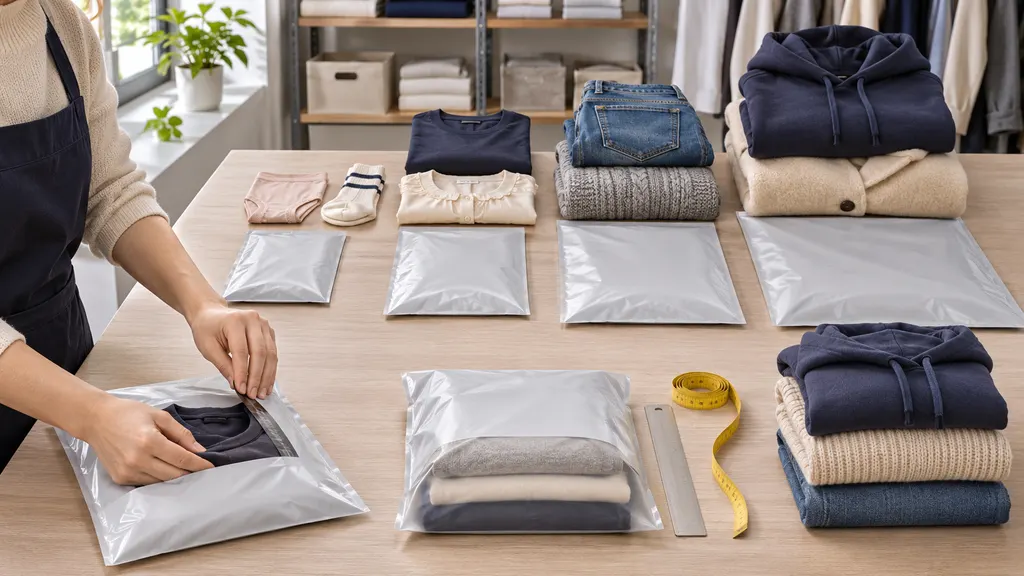
For apparel sellers, choosing the right poly mailer size is a packaging and fulfillment decision, not just a shopping-list detail. An undersized bag can force the clothing into the seam, while an oversized bag uses more material and may require extra void management. The goal is a neat, secure package that protects the garment and can move through the carrier network without unnecessary bulk.
Quick poly mailer size chart for clothing
The recommendations below are starting points for commonly folded apparel. They assume a standard flat poly mailer without a large gusset. The dimensions refer to the nominal bag size shown by the supplier, not necessarily the exact interior space available after the flap and seams are considered.
| Garment or order | Suggested starting size | Why it fits | Check before standardizing |
|---|---|---|---|
| Tank top, camisole, or thin tee | 9 x 12 in | Usually sufficient for one compact, lightweight item | Large sizes, embellishments, and retail packaging |
| One shirt, blouse, or lightweight top | 10 x 13 in | Provides more fold and seal clearance | Structured collars, thick fabric, or gift boxes |
| Two or three thin tops | 12 x 15.5 in | Allows a wider and thicker bundle | The folded stack must not reach the adhesive flap |
| Jeans, chinos, or trousers | 12 x 15.5 in | Accommodates denser folded fabric | Waist size, denim weight, and metal hardware |
| Sweatshirt or thin sweater | 12 x 15.5 in to 14.5 x 19 in | The correct choice depends mainly on loft | Hood, fleece thickness, and whether air is compressed |
| Hoodie or bulky knit | 14.5 x 19 in | Gives a bulky bundle room without overloading seams | Very thick fleece may need a gusseted bag or box |
| Light jacket or small outerwear item | 14.5 x 19 in or larger | Allows for thicker panels, zippers, and lining | Hood, padding, hard hardware, and return packaging |
| Mixed apparel order | 14.5 x 19 in to 19 x 24 in | More room for different folds and item shapes | The largest item usually determines the bag size |
Important: these are packaging guidelines, not universal size standards. A 10 x 13-inch mailer from one supplier may have different usable dimensions from a bag with the same label from another supplier. Request a specification sheet or measure a sample before buying in bulk.
How to choose the correct size
1. Fold the garment the way your team actually ships it
Sizing a mailer from an unfolded shirt or jacket will usually overstate the space required. Instead, use the final packing method: fold the item, add tissue paper or an inner bag if you use one, and include any hangtag, thank-you card, or order insert. If the package will be returned in the same mailer, include the return label process in the test as well.
Measure the folded bundle's length, width, and thickness. The length and width should fit inside the usable body of the mailer, while the thickness should not force the side seams or closure apart. For a repeatable process, record the dimensions of the smallest, largest, and most frequently ordered versions of each garment.
2. Leave room for the adhesive flap
A mailer is not fully usable from edge to edge. The adhesive strip and flap need a clean area to close, and the contents should sit below that closure rather than underneath it. If the folded clothing reaches the top of the bag, the seal may be exposed to tension when the parcel is handled.
As a practical test, place the bundle into the bag without forcing it. The opening should close with the garment lying flat enough that the adhesive strip contacts itself across its intended width. If the flap only closes after you compress the item aggressively, move up one size or choose a gusseted design.
3. Account for fabric loft and hard components
Two garments with the same folded footprint may need different mailers because one is much thicker. Fleece, wool, quilted fabric, and brushed cotton retain more air than thin polyester or jersey. Hoodies also create extra volume around the hood, while jackets may have zippers, snaps, buckles, or other components that create pressure points.
Do not rely on stretching the poly film to make an undersized bag work. A flexible mailer can accommodate minor variation, but excessive tension can make sealing difficult and may increase the chance of tearing during handling. When a garment has hard edges or sharp hardware, fold those areas inward and consider an additional protective layer.
4. Choose between a flat mailer and a gusseted mailer
Flat mailers work well for folded shirts, leggings, and other low-profile apparel. Gusseted mailers add depth and can be more suitable for sweatshirts, multiple garments, or clothing packed with protective materials. The extra depth may reduce the need to force a bulky bundle into a wide but shallow bag.
A gusset does not remove the need to check length and width. A bag can have enough depth but still be too short for a folded pair of trousers or a jacket. Compare all three dimensions and verify how the supplier describes the gusset measurement.
Best mailer sizes by garment type
T-shirts, tanks, and lightweight tops
A 9 x 12-inch mailer is a reasonable starting point for one compact lightweight top. A 10 x 13-inch bag is safer for larger sizes, looser folds, thicker jersey, or an order that includes an insert. If the shirt is sold in a retail box, the box dimensions—not the shirt dimensions—should determine the mailer, and a rigid shipping method may be more appropriate.
Shirts, blouses, and dresses
A 10 x 13-inch or 12 x 15.5-inch mailer often provides a better starting point for collared shirts and blouses because their structure can prevent a very tight fold. Dresses vary widely. A thin jersey dress may fit in a 12 x 15.5-inch bag, while a long, lined, pleated, or embellished dress may need a larger mailer or a box. Protect sequins, beads, and protruding hardware from direct contact with the outer film.
Jeans, trousers, and skirts
Denim is compact but dense. A 12 x 15.5-inch mailer is a useful starting point for one pair of jeans or trousers, although larger waist sizes and heavy denim may need more room. Fold the legs evenly and place buttons, rivets, and zippers toward the inside of the bundle where possible. For multiple pairs, test the stack thickness rather than simply doubling the single-item recommendation.
Sweaters, sweatshirts, and hoodies
Bulky knitwear is where mailer sizing errors occur most often. A 12 x 15.5-inch bag may work for a thin sweater, but a fleece sweatshirt or hoodie will commonly need a 14.5 x 19-inch bag or a gusseted alternative. Compressing the garment may reduce volume, but it should not prevent the closure from sealing flat. If the product must retain its shape or has a high loft, a carton may provide better protection and more predictable dimensions.
Jackets and outerwear
Light jackets can start with a 14.5 x 19-inch mailer, but padded, lined, or structured outerwear may exceed the practical capacity of a standard poly bag. Check the folded bundle for hard points and pressure around the shoulders, zipper, and hood. A larger gusseted mailer or a corrugated box may be more appropriate when the garment is expensive, delicate, or likely to be damaged by compression.
Poly mailer sizing mistakes to avoid
- Using the garment label as the packaging specification. A size designation such as medium or large does not describe the folded shipping dimensions.
- Ignoring the flap and seams. Nominal outside dimensions are not the same as usable interior dimensions.
- Choosing one size for every order. A small single-shirt order and a mixed winter apparel order have different volume requirements.
- Measuring only length and width. Thickness is often the deciding factor for sweaters, hoodies, and multi-item shipments.
- Overfilling the mailer. If the closure is under tension, the package is not correctly sized even if it technically closes.
- Skipping a carrier acceptance check. Carriers publish packaging and preparation requirements that can affect how a parcel should be sealed, labeled, and presented.
A simple packaging test for ecommerce fulfillment
Before ordering thousands of mailers, create a small packaging test using the largest garment in each major product category. Pack the item exactly as a customer order would be packed. Add the normal inserts, label, and any inner protection. Then check the following:
- Does the garment enter the bag without catching on the seams or adhesive?
- Can the flap close across a clean, flat surface?
- Does the bundle move freely enough to avoid constant pressure on one corner?
- Are zippers, snaps, or other hard parts protected from the outer film?
- Can the shipping label be applied to a reasonably flat area?
- Does the finished parcel remain within the applicable carrier preparation and measurement requirements?
Test a few packed samples through normal warehouse handling. Look for split seams, punctures, open flaps, wrinkled labels, and packages that are difficult to stack. This small exercise can reveal that a slightly larger mailer improves packing speed and consistency, or that a box is justified for a narrow product category.
How size affects shipping operations
Mailer size influences more than material consumption. A consistent size range can simplify storage, pick-and-pack training, shipping-station layout, and inventory counting. However, too many sizes create their own operational burden. Most apparel sellers can begin with a small set of sizes mapped to product groups, then add a larger or gusseted option when order data shows a repeated need.
Record the packed dimensions and weight of representative orders. Use those measurements when reviewing carrier services, rate rules, and fulfillment workflows. A poly mailer is often efficient for soft goods, but the lowest-material option is not automatically the lowest-total-cost option if it slows packing, causes repacks, or increases damage and returns.
Final recommendation
For a basic clothing assortment, start by testing 9 x 12-inch mailers for thin single-item orders, 10 x 13-inch mailers for standard tops, 12 x 15.5-inch mailers for jeans and small multi-item orders, and 14.5 x 19-inch mailers for hoodies, bulky sweaters, and light outerwear. Treat those sizes as a test plan rather than a universal chart. The right choice is the smallest mailer that closes without strain, protects the garment's hard points, leaves room for the shipping label, and fits your carrier and fulfillment process.
FAQ
What is the most common poly mailer size for clothing?
There is no single standard size for all clothing. A 10 x 13-inch mailer is a practical starting point for many individual shirts and lightweight apparel items, while 12 x 15.5 inches or 14.5 x 19 inches is more suitable for thicker garments or multi-item orders. Confirm the usable dimensions with a sample from your supplier.
Can a hoodie fit in a 10 x 13-inch poly mailer?
A very thin hoodie may fit, but a standard or fleece hoodie will often be too bulky for comfortable sealing in that size. Test the folded bundle. If the flap is under tension or the seams bulge, use a larger or gusseted mailer.
Should clothing be folded before placing it in a poly mailer?
Yes. Fold the garment using the same method your fulfillment team will use, then measure the final bundle. This gives a more useful result than measuring the garment while it is flat or hanging.
Do poly mailer dimensions include the flap?
Suppliers do not always present dimensions in exactly the same way. Check whether the listed size describes the outside dimensions, the bag body, or another measurement convention. The usable body will be smaller than the total package footprint when the flap, seams, and closure area are considered.
When should I use a box instead of a poly mailer?
Use a box when the garment is structured, fragile, heavily embellished, difficult to compress, or likely to be damaged by pressure or puncture. A box may also be preferable when the order contains multiple bulky items or when the package needs more shape protection.
Sources
- United States Postal Service, Quick Service Guide: Physical Standards — reference for postal package preparation and physical standards.
- UPS, Packaging and Shipping Guidelines — carrier guidance relevant to preparing and closing shipments.
- FedEx, Packaging Guidelines — carrier guidance on packaging selection and shipment preparation.