Tow Tractor
What Is a Tow Tractor?
A tow tractor is a powered vehicle designed primarily to pull trailers, carts, or other wheeled equipment rather than lift and carry goods on forks. In logistics, tow tractors move materials within warehouses, distribution centers, factories, airport handling areas, and similar facilities. The goods normally rest on the attached equipment, while the tractor provides the pulling force and controls the movement of the connected combination.
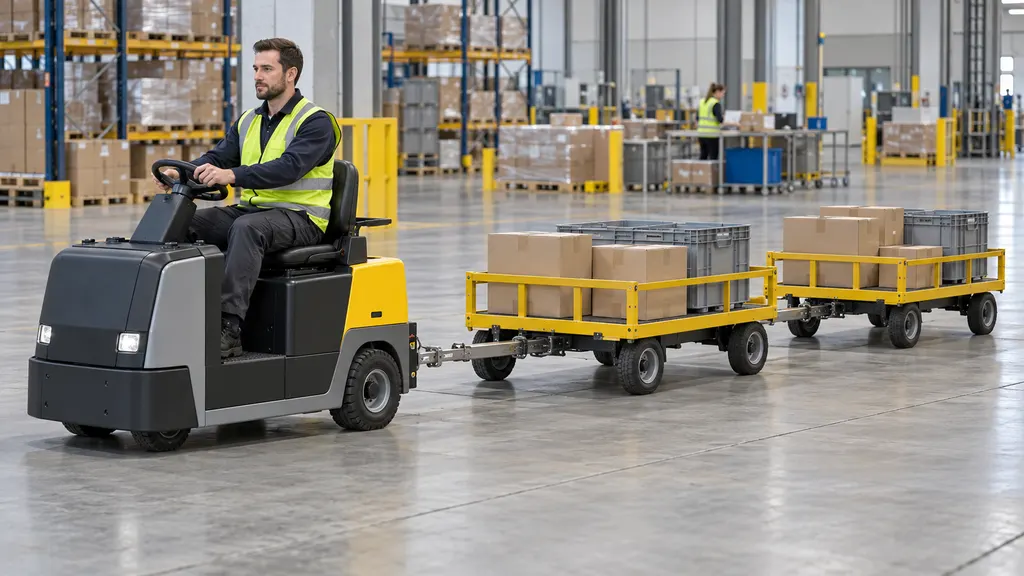
Tow tractors are also called towing tractors, and the term tug is used in some workplaces. These names are not completely standardized across industries. A warehouse tow tractor should not be confused with a road tractor that pulls a semitrailer, or with a recovery vehicle used to tow disabled road vehicles.
Role in Logistics and Fulfillment
A tow tractor is a form of materials-handling equipment. Its main role is to move goods between operating areas, rather than to store inventory, identify orders, or perform customs procedures. Depending on the facility, it may connect receiving areas, storage locations, picking zones, packing stations, production lines, and outbound staging areas.
In an ecommerce fulfillment center, for example, a tow tractor may pull carts containing picked items from a picking area to packing stations. Another route may collect empty containers and return them for reuse. These are illustrative workflows, not functions performed by every tow tractor or adopted by every fulfillment operation.
In cross-border logistics, the same equipment may move goods inside an export warehouse, cargo terminal, or import distribution center. Its use does not determine the goods' customs status. Required identification, segregation, and movement controls remain separate operational responsibilities.
The term is commonly encountered in equipment specifications, warehouse layouts, materials-handling plans, operator instructions, and workplace transport assessments. Understanding it helps distinguish an internal movement resource from a vehicle used for transport between separate destinations.
How a Tow Tractor Works
A tow tractor transfers pulling force through a coupling that connects it to a trailer or cart. Depending on the equipment design and operating limits, it may tow a single trailer or several connected trailers. A tractor with multiple trailers is often described as a tugger train or tow train.
The tractor does not need to lift the goods to move them. Instead, the trailers support the load on their own wheels. This makes the design of the entire combination important: tractor performance alone does not establish whether a particular trailer arrangement is suitable.
- Prepare the load: Place goods on compatible carts or trailers and secure them against movement as required by the load and equipment.
- Connect the equipment: Attach the coupling and any required safety connections according to the manufacturer's instructions.
- Check the combination: Confirm that the tractor, trailers, load, and route fall within the applicable operating limits.
- Move along the route: Travel at a speed appropriate to visibility, surface conditions, pedestrian activity, and the behavior of the trailers.
- Stop and disconnect: Park and secure the equipment before releasing connections or transferring goods.
This sequence explains the operating principle; it does not replace equipment-specific training. Coupling procedures, braking arrangements, and parking requirements differ among designs.
Design Characteristics
Tow tractors can be described along several independent dimensions. Operator position, power source, and operating environment are separate characteristics, rather than mutually exclusive equipment classes. A seated vehicle, for example, may be electrically powered and intended for indoor use.
| Design dimension | Possible arrangements | Operational significance |
|---|---|---|
| Operator position | Pedestrian-controlled, stand-on, or seated designs | Affects how the operator controls the vehicle and enters or leaves the operating position. |
| Power source | Battery-electric or internal-combustion designs | Influences charging or fueling arrangements, emissions considerations, and suitability for the workplace. |
| Control method | Operator-controlled or automated designs | Changes the requirements for navigation, interaction with people, and system supervision. |
| Operating environment | Equipment intended for indoor, outdoor, or specified mixed use | Requires attention to surfaces, gradients, weather exposure, and environmental limitations. |
These descriptions do not imply that every combination is available or appropriate. Equipment suitability must be established from the relevant manufacturer's documentation and the conditions at the site.
Towing Capacity and Operating Limits
Towing capacity is not the same as lifting capacity. A forklift's lifting rating concerns loads supported by its lifting equipment under specified conditions. A tow tractor's rating concerns pulling a permitted trailer load or combination under stated conditions. The figures should not be treated as directly interchangeable.
Specifications may also state drawbar pull, which describes pulling force at the towing connection. Force and mass are different quantities: a drawbar-pull figure cannot simply be read as the mass of goods the vehicle can tow. Starting resistance, rolling resistance, gradients, and traction affect the force required.
Practical assessment should consider the following:
- Total towed mass: Include the trailers themselves as well as the goods and any handling equipment carried on them.
- Starting and stopping: The combination must be able to start, stop, and remain secured under the intended conditions.
- Gradients and surfaces: Slopes, uneven flooring, poor traction, and changes in surface condition can alter performance.
- Coupling compatibility: Connections must be suitable for the tractor, trailers, and forces involved.
- Trailer configuration: Trailer quantity, steering behavior, and braking arrangements influence operation.
- Route geometry: A combination must fit through turns, doors, intersections, and staging spaces without creating unsafe encroachment.
A maximum figure in a specification is therefore not a universal permission to tow that mass on every route. The applicable limits and conditions must be checked for the complete operating arrangement.
Tow Tractor and Related Equipment
| Term | Primary function | Distinction from a tow tractor |
|---|---|---|
| Forklift truck | Lifts, carries, and positions loads using forks or attachments. | A tow tractor primarily pulls wheeled equipment and is not defined by a lifting mast. |
| Pallet truck | Raises a pallet sufficiently to move it over a supporting surface. | The pallet is supported by the truck rather than carried on a separate towed trailer. |
| Tugger train | Moves several connected trailers as one operating combination. | The term describes the tractor-and-trailer arrangement, not just the powered vehicle. |
| Terminal tractor | Repositions semitrailers around freight yards or terminals. | It serves a different handling role from a warehouse tractor pulling carts. |
| Aircraft towing tractor | Moves aircraft on the ground. | It is a specialized aviation application; its requirements should not be inferred from warehouse equipment. |
The word tug can refer to different towing machines, including pedestrian-controlled devices. Consequently, the name alone is insufficient to establish capacity, coupling compatibility, or intended use. Equipment documentation is more precise than informal workplace terminology.
Route Planning and Safety Considerations
A tow tractor route must accommodate the whole connected combination, not only the powered vehicle. Trailers can follow a different path through a turn, and additional trailer length affects clearance at crossings and loading points. Checking whether the tractor fits through a doorway is not enough to establish that the train can pass safely.
Workplace transport planning should consider pedestrian separation, visibility at intersections, designated stopping locations, and the space required for connecting or disconnecting trailers. Where reversing is necessary, the site needs a method suitable for the actual equipment and surrounding activity. Reversing a multi-trailer combination should not be assumed to behave like reversing a single vehicle.
Pre-use checks should follow the equipment instructions and applicable workplace procedures. Relevant items may include steering, brakes, warning devices, tires or wheels, couplings, and visible trailer damage. A defect affecting safe operation requires an appropriate response before the equipment is used.
Legal requirements vary by jurisdiction and equipment type. In the United States, OSHA's powered industrial truck standard includes tractors within its stated scope and contains requirements concerning operator training and safe operation. It should not be treated as a worldwide rule or as a substitute for checking which requirements apply to a particular workplace.
When a Tow Tractor Fits the Workflow
A tow tractor may suit a workflow in which goods are already supported on wheeled carts and need to move repeatedly between defined points. For example, a retailer may organize a collection route that brings several carts of picked goods to packing and returns empty carts on the return journey.
However, the tractor does not eliminate the loading, unloading, sorting, or identification work at either end. If goods need to be placed on elevated storage racks, separate lifting equipment may still be required. If routes involve tight turns, frequent reversing, or limited staging space, the proposed trailer arrangement needs particular scrutiny.
An operational assessment should therefore examine the complete handling cycle: where goods are loaded, how carts are identified, where the train can stop, who disconnects equipment, and how empty carts return. These questions establish whether towing fits the process without assuming an automatic improvement in cost, speed, or productivity.
QA
What does a tow tractor do in a warehouse?
It pulls carts or trailers carrying goods between warehouse areas. Depending on the workflow, it may move picked items, replenishment materials, empty containers, or other internal loads.
Is a tow tractor the same as a forklift?
No. A forklift primarily lifts and positions loads, while a tow tractor primarily pulls wheeled equipment. Some specialized equipment combines functions, so its documented design and limits remain important.
How much can a tow tractor pull?
There is no single capacity for all tow tractors. The permitted load depends on the model, trailers, coupling, braking arrangements, route, and operating conditions specified for the equipment.
What is the difference between a tow tractor and a tugger train?
The tow tractor is the powered vehicle. A tugger train is the connected arrangement of the tractor and multiple trailers.
Sources
- Encyclopaedia Britannica: Industrial truck — Reference context for industrial materials-handling vehicles and the distinction between towing and load-handling functions.
- Occupational Safety and Health Administration: 29 CFR 1910.178, Powered industrial trucks — United States regulatory scope, including tractors, and requirements concerning training, inspection, and safe operation.
- Health and Safety Executive: Workplace transport — Workplace transport guidance supporting discussion of site layout, vehicle suitability, pedestrian interaction, and safe movement.