Proof of Delivery Meaning: Signatures, Photos, and How to Request It
Proof of delivery (POD) is a record documenting a shipment’s delivery. Depending on the service, it may include a recipient’s signature, a delivery photo, the delivery date and time, or other delivery details. To request it, check the carrier’s official tracking page first, then contact the carrier or the sender if the record is unavailable. A tracking status marked “Delivered” is not necessarily the same as a detailed proof-of-delivery document.
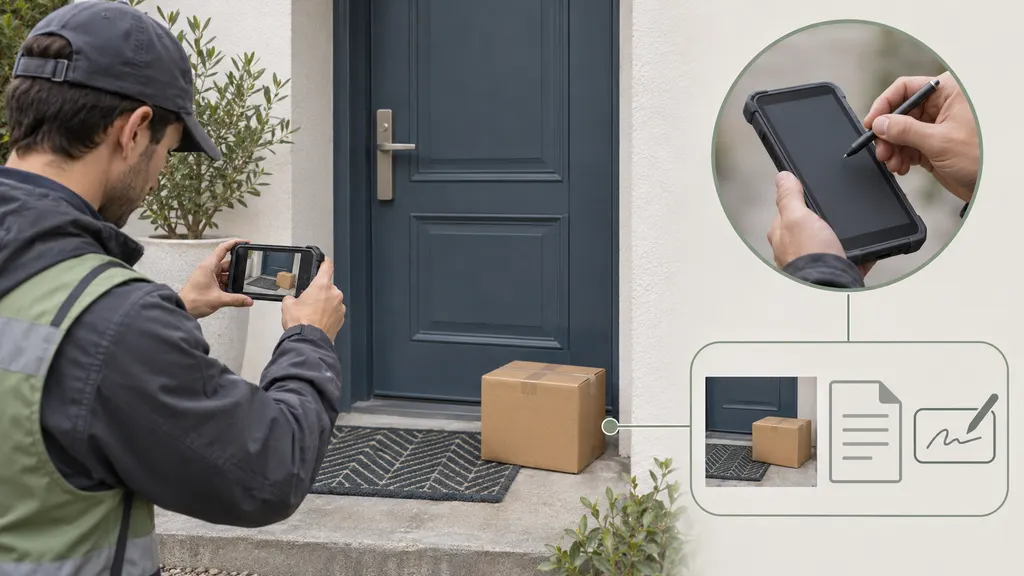
If your package is missing, the most useful question is not simply whether delivery was recorded. It is whether the record helps establish where the shipment was left, who accepted it, and whether those details match your delivery instructions.
What does proof of delivery actually prove?
Proof of delivery documents the delivery event recorded by a carrier or delivery provider. Its evidentiary value depends on what was captured. A signature records an acknowledgment of receipt; a photograph shows a package at a particular location; a delivery timestamp records when the delivery event was entered.
Those details do not all establish the same thing. A photo may show a parcel outside a door without showing that the intended recipient collected it. A signature may belong to someone authorized to receive deliveries rather than the named buyer. A timestamp alone does not identify the person who received the shipment.
The practical rule: read the contents of the record, not just its label. A document called “proof of delivery” may contain different information depending on the carrier, shipping service, destination, and delivery method.
Also distinguish delivery from condition and completeness. A record confirming receipt does not necessarily establish that every ordered item was inside, that the contents were undamaged, or that the shipment matched the purchase order.
Signatures, photos, and other delivery records
| Record type | What it can show | What to check |
|---|---|---|
| Signature record | An acknowledgment by the person who accepted delivery, sometimes accompanied by a recorded name. | Whether the signer is known and whether the service required a particular recipient or another eligible person. |
| Delivery photo | The package and its surroundings when the photo was taken. | Whether the entrance, floor, door, parcel area, or other landmarks match your property. |
| Electronic delivery record | Delivery details such as a timestamp, recorded location description, or recipient information. | Whether the details identify the actual handover or only a completed delivery scan. |
| Signed delivery receipt | Receipt of a shipment, sometimes with package counts or exceptions noted at handover. | Whether shortages, visible damage, or other delivery exceptions were recorded. |
Signature proof of delivery
A signature is useful when you need to establish that someone accepted the shipment. However, “signature required” should not automatically be read as “the named buyer must personally sign.” The eligible signer depends on the purchased service and its rules.
For a concrete example, USPS describes its Proof of Delivery service as a response letter containing delivery information and the recipient’s signature for eligible items. Its extra-services guidance separately explains signature-related options. These distinctions matter: the service selected when a shipment is sent affects the evidence available afterward.
Photo proof of delivery
A delivery photo is often most useful for locating a parcel. Look beyond the package itself. Compare the door design, doormat, wall color, building number, lobby layout, or parcel shelf with the actual delivery address.
A matching photo supports the conclusion that the parcel was left at that location. It does not, by itself, establish what happened afterward. An unfamiliar photo is a reason to report a possible misdelivery, but avoid guessing the exact address from an unclear image.
Electronic proof of delivery
Electronic proof of delivery, sometimes shortened to ePOD, describes a digital delivery record rather than a separate guarantee of what it contains. It may incorporate a signature, photo, timestamp, or delivery notes. Do not assume it includes GPS coordinates, a full street address, or an image of the shipping label unless those details are actually present.
How to request proof of delivery
- Find the shipment’s tracking number. Use the dispatch email, order details, or shipping receipt. An order number usually identifies the purchase within the seller’s system, not the parcel within the carrier’s system.
- Open the carrier’s official tracking page. Review the completed delivery event and look for wording such as “Proof of delivery,” “Delivery photo,” “Signature,” or “Delivery details.” The exact labels vary.
- Complete any access checks. The carrier may require account access or shipment information before displaying sensitive delivery details. Supply information only through an official website or verified support channel.
- Save the available record. Download the document or retain the delivery details and photo where permitted. Keep the tracking number and delivery date with the record so it remains identifiable.
- Contact the carrier if the record is missing or incomplete. Ask what delivery evidence exists for that particular shipment, rather than assuming a signature or photo was collected.
- Ask the sender to request it when necessary. The seller or shipper may have access to shipment records or an account-based investigation process that is unavailable to the recipient.
If you initially tracked the package through a shopping platform or a tracking aggregator, use the named carrier’s official channel to request the underlying record. A tracking summary is useful for following progress, but it should not be treated as a substitute for a carrier-issued delivery document.
What information should you provide?
Prepare the tracking number, recipient name, delivery address, recorded delivery date, and your relationship to the shipment. Include the order number when contacting the seller. If the parcel appears to have been handed to a local delivery partner, ask which provider holds the final delivery record.
For a business delivery, also identify the department, receiving desk, warehouse, or loading dock that should have accepted it. This helps distinguish an incorrect delivery from an internal handover that has not yet reached the intended employee.
A request you can copy
Please provide the available proof of delivery for tracking number [tracking number], marked delivered on [date], to [delivery address]. Please include any signature, recorded recipient name, delivery photo, delivery time, and location description available for this shipment. I am the [recipient/sender]. [If applicable: I have not received the package, and the delivery details need to be investigated.] Please confirm whether the sender must make this request.
This wording asks for existing evidence without implying that every shipment must have every type of record. If the request becomes an investigation, keep the reference number and written responses.
What to do when tracking says delivered but the package is missing
Request the delivery evidence and report non-receipt as separate actions. Obtaining a POD does not necessarily open a missing-package investigation, and opening an investigation does not necessarily send you the delivery document.
- Check the delivery details. Compare the recorded time, location description, photo, and signer with what you know.
- Check legitimate receiving locations. Ask household members, reception staff, the mailroom, or building management whether they accepted or moved the parcel.
- Describe the mismatch precisely. “The photo shows a different entrance” or “The signer is not known to our receiving team” is more actionable than “The tracking is wrong.”
- Notify the seller. Explain that the package has not been received and share the relevant delivery evidence. Ask whether the seller needs to initiate the carrier inquiry.
- Preserve your records. Keep the order confirmation, tracking history, POD, correspondence, and any relevant photographs.
If the photo matches your property but the parcel is absent, report that specific situation. If the photo shows a different property, report a suspected misdelivery. If an unfamiliar person signed, ask the carrier to investigate the recorded handover rather than assuming the signature proves theft or fraud.
Do not wait for a universal waiting period quoted elsewhere online. Investigation, claim, marketplace, and payment-dispute deadlines can differ. Check the applicable instructions promptly so a search for delivery evidence does not cause you to miss another required step.
How sellers and receiving teams should use a POD
For sellers, proof of delivery is evidence to evaluate, not an automatic reason to reject a customer’s complaint. Confirm that the record belongs to the correct shipment and examine whether it supports delivery to the intended location. A completed scan with no identifying detail deserves a different assessment from a clear location photo or a recognizable signature.
For receiving teams, compare the delivery record with internal receiving logs, parcel counts, and staff handovers. A shipment may have reached the building without reaching the individual who ordered it. For freight or multi-piece deliveries, review any recorded shortages or damage exceptions as well as the acknowledgment of receipt.
If delivery evidence will matter for a future shipment, select the appropriate service before dispatch. You generally cannot create a missing signature or delivery photograph afterward simply by requesting a POD. Confirm the available service, eligible signer, access method, and record-retention arrangements with the carrier when those details are operationally important.
FAQ
Is a tracking screenshot the same as proof of delivery?
Not necessarily. A screenshot showing “Delivered” preserves the displayed tracking status, but it may omit the signature, photo, recipient information, or delivery details found in a separate POD. If someone requests formal delivery evidence, ask which document and details they require.
Can I get proof of delivery without a signature?
Possibly. A shipment may have a photo or electronic delivery record without a recipient signature. Whether that is available depends on the service and what was captured. Requesting proof afterward does not mean a signature will exist.
Can the recipient request proof, or must the sender do it?
Start with the carrier’s tracking page as the recipient. If access is restricted or a formal inquiry requires the shipping account holder, ask the sender to request the record. The process varies by carrier and service.
Is proof of delivery legally conclusive?
Do not assume so. Its significance depends on the record, the disputed facts, the applicable agreement, and local law. A signature or photo may support a position without resolving every question about location, authority to receive, damage, or missing contents. For a legal dispute, seek advice relevant to the jurisdiction.
Does a POD guarantee a refund or prevent one?
No universal refund outcome follows from a POD alone. Sellers, marketplaces, payment providers, and carriers apply their own applicable terms and procedures. Submit the record together with a clear explanation of what it does or does not establish.
Sources
- USPS: What is Proof of Delivery? — Official explanation of the USPS delivery record and its service-specific availability.
- USPS: Insurance & Extra Services — Official descriptions of delivery-confirmation and signature-related services. These are USPS examples, not universal rules for all carriers.