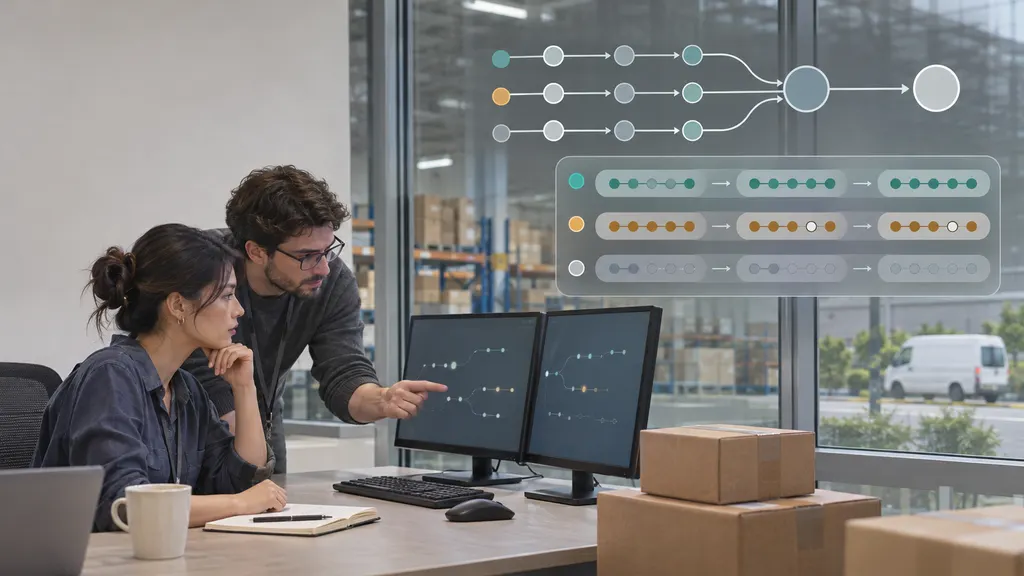
Logistics System Simulation
What Is Logistics System Simulation?
Logistics system simulation is the use of a computational model to represent how goods, orders, information, and operational resources move and interact within a logistics system over time. It allows analysts to test operating rules, capacity changes, and disruptions without first making those changes in the physical operation. Applications include warehouse planning, inventory replenishment, transportation networks, ecommerce fulfillment, and returns processing.
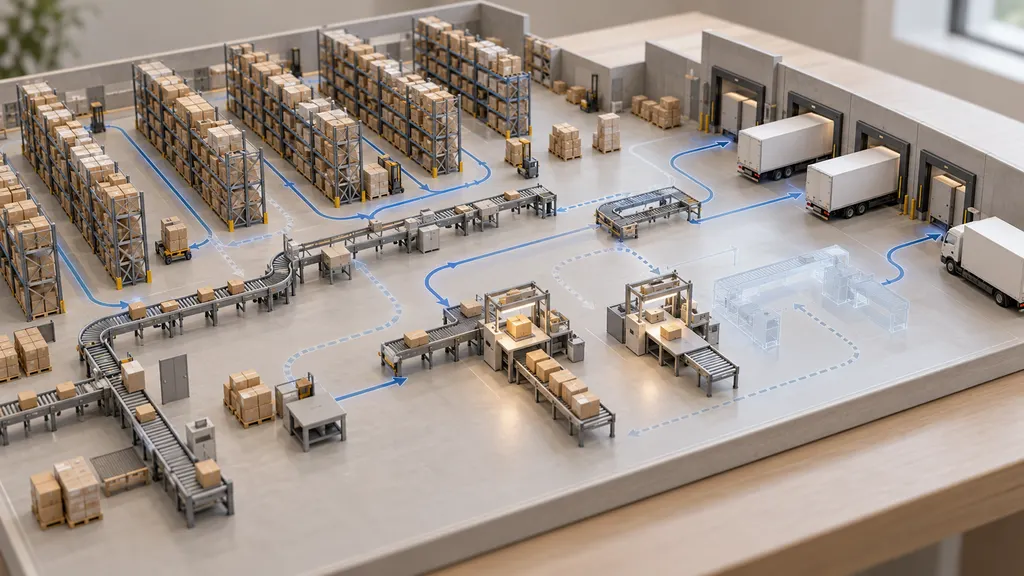
A simulation represents selected aspects of a real or proposed system, rather than reproducing every detail. For example, a warehouse model may represent order arrivals, picking queues, packing stations, and carrier collection times while leaving out activities that do not affect the question being studied. Its results describe what happens under specified assumptions; they are not guaranteed predictions of future performance.
Scope in Logistics and Ecommerce
The modeled system can be a single activity, such as parcel sorting, or a connected network of suppliers, warehouses, transport services, and delivery destinations. Choosing the boundary is important because a change that improves one activity may create a constraint elsewhere. Increasing picking capacity, for instance, may simply move the queue to packing if packing capacity remains unchanged.
In ecommerce, simulation can connect customer demand with inventory availability, order release, fulfillment capacity, dispatch schedules, and delivery commitments. An order and a shipment are not necessarily equivalent: an order may be divided into multiple shipments. A useful model preserves that distinction whenever split fulfillment affects workload, transport costs, or service performance.
In cross-border logistics, the modeled process may include export preparation, international transport, customs processing, destination handling, and final delivery. Customs processing should be represented using relevant evidence and explicit assumptions. A model cannot establish whether goods legally qualify for release or replace applicable customs requirements.
Users may encounter the term in warehouse design studies, logistics engineering reports, distribution network proposals, capacity planning projects, and operational improvement assessments. In these contexts, the essential question is not whether the model looks realistic, but whether it is sufficiently credible for the decision it supports.
Main Modeling Approaches
Several established simulation approaches can be applied to logistics. They describe different modeling perspectives and are not necessarily mutually exclusive.
| Approach | How It Represents a System | Illustrative Logistics Use |
|---|---|---|
| Discrete-event simulation | System state changes when events occur, such as arrivals, service completions, or departures. | Examining queues at picking, packing, loading, or sorting resources. |
| Agent-based simulation | Individual entities follow behavioral rules and interact with other entities or their environment. | Exploring interactions among vehicles, workers, or independently managed facilities. |
| System dynamics | Aggregate stocks, flows, feedback loops, and delays describe change over time. | Studying inventory and backlog responses to replenishment policies or demand changes. |
| Monte Carlo simulation | Repeated sampling from probability distributions explores uncertainty in calculated outcomes. | Estimating the range of total lead times or costs under uncertain inputs. |
These approaches overlap in practice. A discrete-event model may use random sampling to generate handling times, while a larger network model may combine aggregate inventory flows with detailed facility processes. Random sampling alone does not necessarily capture queues, resource competition, or the sequence of operational events.
What a Logistics Simulation Contains
A model translates an operational question into a defined set of entities, resources, rules, and measurements. Important components include:
- Entities: the items moving through the model, such as orders, shipments, pallets, containers, vehicles, or returns.
- Resources: capacity needed to perform work, including employees, equipment, loading docks, storage positions, and transport capacity.
- Activities and events: picking, inspection, packing, loading, departure, arrival, or completion of a processing step.
- Queues and buffers: places where work or goods wait because the next activity cannot begin.
- Operating rules: order priorities, inventory allocation, replenishment triggers, shift schedules, routing decisions, and dispatch cutoffs.
- Inputs and uncertainty: demand patterns, processing times, transit times, equipment availability, and other conditions relevant to the study.
- Outputs: measurements used to compare scenarios, such as throughput, waiting time, backlog, resource utilization, and cost under stated assumptions.
The required detail depends on the decision. A study of daily warehouse staffing may need shift patterns and hourly order arrivals. A study of long-term distribution capacity may instead use more aggregated demand and transport assumptions. Additional detail is useful only when it materially improves the model's ability to answer the question.
How a Simulation Study Works
- Define the decision and performance measures. Specify what is being compared and how alternatives will be judged. For example, a study might compare whether changing order release rules or adding packing capacity reduces missed dispatch cutoffs.
- Set the system boundary. Identify the facilities, processes, time horizon, and external conditions included. Record exclusions, particularly when they could affect interpretation.
- Develop a conceptual model. Describe process flows, resource constraints, queue rules, and assumptions before implementing the computational model. Operational staff can help identify missing steps and unrealistic rules.
- Prepare input data. Check timestamps, units, missing records, duplicate events, and differences between planned and actual activity. Separate ordinary operations from disruptions when that distinction matters.
- Build and verify the model. Check whether the implementation follows the conceptual design. Trace individual entities, test simplified cases, and confirm that inventory and shipment counts remain consistent.
- Validate for the intended use. Compare model behavior with relevant observations and operational knowledge. Assess whether the model is sufficiently accurate for the specific decision, rather than treating validation as proof of universal accuracy.
- Design and run experiments. Compare a baseline with defined alternatives. Keep unrelated assumptions consistent, allow adequate run length, and use repeated runs where random variation affects results.
- Interpret and document findings. Report assumptions, uncertainty, trade-offs, and limitations alongside the results. Preserve enough detail for another analyst to understand how the conclusions were reached.
This workflow is iterative. Unexpected results may reveal a coding error, an incorrect assumption, a data problem, or a genuine operational interaction. Each possibility requires investigation rather than automatic acceptance or rejection of the output.
Data and Experimental Design
Input quality is more than selecting an average processing time. Two operations with the same average duration can produce different queues if their variability differs. Demand concentrated before a dispatch cutoff may also create a different workload from the same total demand spread evenly across the day.
Dependencies matter as well. Higher order volume may coincide with a different product mix, larger orders, or congestion-related handling delays. Sampling each input independently can produce unrealistic combinations when those relationships are important. Analysts should preserve meaningful relationships where the evidence supports doing so and disclose assumptions where it does not.
Starting conditions require explicit treatment. A model that begins with an empty warehouse queue may understate waiting during established operations. Depending on the study, analysts may initialize the model from an observed state or use a warm-up period before collecting performance measurements. A short, time-bounded operation, such as a specific dispatch window, may instead require a deliberately defined initial backlog.
For stochastic models, repeated runs help distinguish the effects of a proposed change from random variation. Results should identify the measurement period and summarize relevant uncertainty, rather than presenting a single run as a definitive answer. Sensitivity analysis then examines whether conclusions change when uncertain inputs or assumptions are varied.
Interpreting Performance Measures
| Measure | What It Shows | Interpretation Check |
|---|---|---|
| Throughput | Work completed during a defined period. | Specify whether the unit is orders, shipments, parcels, pallets, or another entity. |
| Cycle time | Elapsed time between defined start and end events. | State the boundaries and whether waiting time is included. |
| Resource utilization | The modeled proportion of available capacity occupied. | High utilization alone does not establish that service performance is acceptable. |
| Queue length or backlog | Work waiting for processing. | Examine peaks and end-of-period work, not just averages. |
| Cutoff attainment | The proportion of eligible work completed before a defined deadline. | Define eligibility and the exact completion event. |
| Modeled cost | Cost calculated from included activities and rates. | Identify excluded costs and distinguish estimates from actual expenditure. |
Measures should be read together. Higher throughput may coexist with longer waiting times, and lower staffing cost may coincide with more missed cutoffs. Simulation makes such trade-offs visible; it does not decide which trade-off an organization should accept.
Illustrative Applications
Warehouse Dispatch Planning
A retailer may model orders arriving throughout a working day, with picking teams feeding shared packing stations. The model can compare additional picking capacity, additional packing capacity, and revised order release priorities. If packing is the binding constraint, increasing picking alone may enlarge the packing queue without increasing shipments ready for collection. This is a hypothetical example, not a reported business outcome.
Cross-Border Fulfillment
An ecommerce seller may compare fulfillment routes with different transport schedules and processing-time assumptions. A useful model can distinguish time spent waiting for departure from time in transit and time awaiting destination processing. It can test how delays propagate into delivery estimates, but its findings remain conditional on the route, shipment characteristics, and processing assumptions represented.
Returns Processing
A returns operation may model receipt, inspection, disposition, and restocking as separate activities. Inspection outcomes can direct items toward different processing paths. The model can examine workload and inventory availability, while refund timing must be represented separately if it follows different business rules. Receiving a return does not, by itself, establish that a refund has been issued or that an item is ready for resale.
Related Terms and Important Boundaries
| Related Term | Relationship to Logistics System Simulation |
|---|---|
| Optimization | Searches for a preferred solution under defined objectives and constraints. Simulation evaluates behavior under specified scenarios; the two can be combined. |
| Forecasting | Estimates future conditions, such as demand. Forecasts may supply simulation inputs, but a simulation is not automatically a forecast. |
| Digital twin | A digital representation connected to a physical counterpart. Simulation can be a component, but a standalone simulation should not automatically be described as a digital twin. |
| Tracking | Records or reports observed shipment events. Tracking data can inform a model, whereas simulation generates behavior under modeled conditions. |
| Analytical model | Uses mathematical relationships to calculate results. Simulation instead executes modeled behavior or samples outcomes; either approach may suit a particular question. |
Limitations and Reliability Checks
A visually detailed animation is not evidence that a model is valid. Verification asks whether the model has been implemented correctly; validation asks whether it is sufficiently accurate for its intended purpose. A model can pass implementation checks while still omitting an operational constraint that matters to the decision.
Before relying on findings, check whether the baseline is credible, alternatives use comparable assumptions, and conclusions remain meaningful under plausible input changes. Also check for unrealistic unlimited buffers, missing shift breaks, unavailable transport capacity, or shipment flows that exceed inventory availability.
Results should remain traceable to the model version, input dataset, operating rules, and experiment settings. When a process changes materially, previous validation may no longer support the same use. Simulation is therefore best understood as structured evidence for a decision, not a substitute for operational judgment or subsequent measurement.
QA
What is logistics system simulation used for?
It is used to examine how logistics operations may behave under alternative capacity levels, operating rules, demand patterns, or disruptions before making physical changes.
Is logistics simulation the same as optimization?
No. Simulation evaluates modeled scenarios, while optimization searches for a preferred solution according to defined objectives and constraints. They can be used together.
Can simulation predict exact delivery times?
It can estimate delivery outcomes under stated assumptions, including uncertainty where modeled. It cannot guarantee an individual shipment's delivery time or account for conditions outside its scope.
What data is needed for a logistics simulation?
Required data depends on the decision. Relevant inputs can include order arrivals, process durations, inventory, resource capacity, shift schedules, transport schedules, and operational routing or priority rules.
Sources
- Manuel D. Rossetti, Simulation Modeling and Arena — Educational reference for discrete-event modeling, queues, input modeling, experiment design, and output analysis.
- Robert G. Sargent, Verification and validation of simulation models, Journal of Simulation — Academic reference for verification, validation, model credibility, and fitness for an intended purpose.
- Wikipedia, Computer simulation — Supplementary reference for the general concept of computational simulation and distinctions among modeling approaches.