How to Improve Packaging and Fulfillment to Prevent Delivery Damage
Preventing delivery damage starts before a parcel reaches the carrier. Use packaging that fits the product, protects its most vulnerable parts, and stays closed through normal handling. Then support that packaging with accurate fulfillment procedures, documented inspections, carrier-compliant labels, and a feedback loop that identifies recurring failure points.
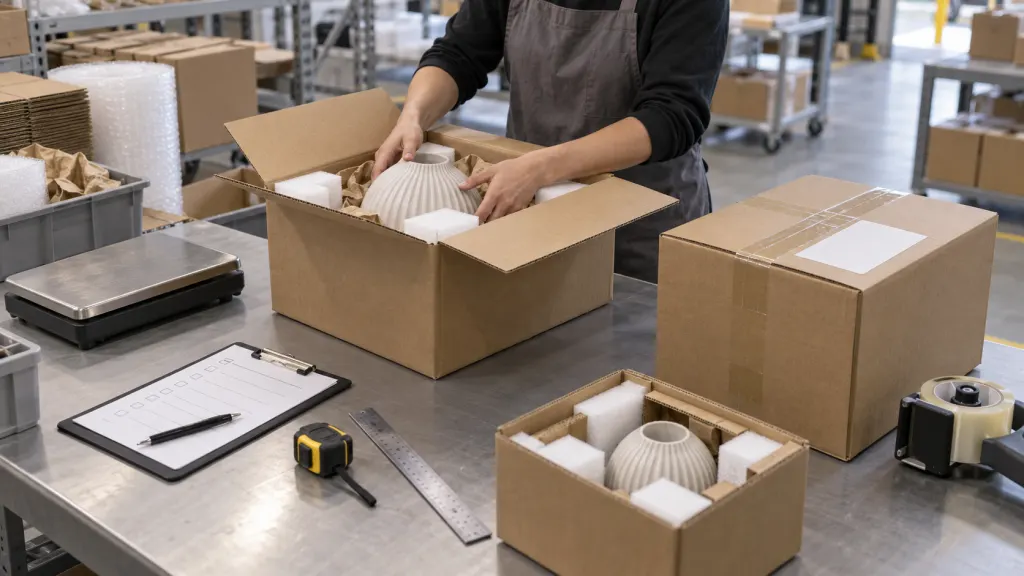
Damage is rarely caused by one mistake alone. A fragile item may be placed in an oversized box, surrounded by insufficient cushioning, sealed poorly, and shipped without a final verification step. Improving the complete packaging and fulfillment process is more reliable than simply adding more packing material.
Start with a damage analysis
Before changing materials or warehouse procedures, classify the damage you are seeing. Review customer complaints, returned products, carrier claims, warehouse notes, and delivery photographs where available. Look for patterns such as:
- Crushed corners or collapsed cartons
- Broken or bent products
- Scratches caused by movement inside the package
- Water exposure or contamination
- Missing parts caused by an opened or torn package
- Products packed incorrectly or sent without required protection
Record the product, packaging format, fulfillment location, destination, carrier, shipment service, and damage type for each incident. This can reveal whether the problem is concentrated in a particular stock-keeping unit, packaging size, warehouse shift, route, or carrier service. Avoid assuming that the carrier is responsible until the packaging and fulfillment records have been reviewed.
Match the package to the product
Choose the right box size
An oversized box gives the product more room to move and may require excessive void fill. A box that is too small can compress the product or leave no space for protective material. Select a carton that provides enough room for cushioning while limiting uncontrolled movement.
Measure the product after accounting for irregular shapes, handles, corners, and accessories. If the product is sold in several sizes, create packaging specifications for each version rather than relying on a general instruction such as “use a medium box.”
Protect the product’s weak points
Different products fail in different ways. Glass may need separation and impact protection. Electronics may require protection from impact and movement. Liquids need secure closures and containment for leaks. Apparel may need protection from moisture rather than heavy cushioning. Furniture and other large goods may need edge, corner, and surface protection.
Map the likely damage points for each product category and specify the protection required at those points. More material is not always better if it creates an unstable package or prevents the carton from closing correctly.
Use suitable outer packaging
The outer carton must remain intact during normal transportation and handling. Inspect cartons for crushed edges, moisture damage, weak seams, and signs of reuse that could reduce their strength. For heavier or more vulnerable products, packaging specifications may need to address board strength, internal partitions, edge protection, or reinforced closures.
Carrier guidance should be treated as a baseline, not as a complete product-engineering specification. UPS, for example, publishes packaging advice covering box selection, cushioning, sealing, and labeling. FedEx also provides packaging guidance for preparing shipments. Review the requirements that apply to the destination, service, package type, and product.
Control movement inside the parcel
Internal movement creates repeated impacts and allows the product to strike the carton. After packing, gently shake or turn a sample package according to your internal test procedure. The product should not move freely, and protective material should not immediately collapse or shift away from vulnerable areas.
Use internal dividers when products can collide with one another. Keep heavy items below lighter items, and prevent sharp edges from contacting the product or carton. If multiple products share one package, assess both the protection between items and the protection around the group as a whole.
Void fill should stabilize the contents without forcing the carton open. It should also remain effective when the package is stored, moved, or exposed to ordinary changes in orientation. Document the type and approximate amount of protective material for each approved packaging configuration so that results do not depend entirely on individual packer judgment.
Improve sealing and labeling
Seal the carton consistently
A well-packed box can still fail if the closure is weak or applied inconsistently. Use a sealing method appropriate for the carton, its weight, and the expected handling environment. Make sure the sealing surface is clean and that tape is applied with adequate contact over the main seams. Heavy or high-value shipments may require additional closure or security controls defined by the packaging specification.
Do not use damaged cartons or rely on labels to compensate for a structurally weak package. Replace packaging that has lost its shape, has exposed contents, or cannot be sealed securely.
Keep labels visible and scannable
Place the shipping label on a flat surface where it is unlikely to be covered by tape, another label, a seam, or a corner. Remove or cover obsolete labels and barcodes when reusing outer packaging. Confirm that the shipping address, service information, and handling marks match the order and package.
Handling marks can communicate that a shipment needs special care, but they do not replace appropriate physical protection. The package should remain safe even when it is handled in a way that is not ideal.
Build packaging checks into fulfillment
Packaging quality improves when it is part of the fulfillment workflow rather than an informal final step. A practical process can include the following controls:
- Order review: Identify fragile, liquid, oversized, temperature-sensitive, or otherwise high-risk items before picking.
- Pick verification: Confirm the product, quantity, variant, and condition before packing.
- Packaging selection: Use a documented packaging rule or system prompt for the product and order configuration.
- Pack-station check: Verify cushioning, separation, closure, and label placement.
- Weight and dimension check: Compare the completed package with expected shipment information and investigate unusual differences.
- Exception handling: Escalate damaged inventory, missing protective material, unclear instructions, or packaging substitutions.
- Record keeping: Retain enough information to connect the shipment with the product, packaging format, packer or station, and fulfillment date.
The objective is not to add unnecessary manual work. It is to place a small number of checks at points where an error can still be corrected cheaply. For high-volume operations, barcode scans, cartonization rules, photo capture, weight checks, and workstation prompts can reduce reliance on memory, provided the underlying rules are maintained.
Test packaging before scaling it
Packaging changes should be tested with representative products and realistic shipping conditions. Test the weakest product variation, the heaviest expected configuration, and combinations that are most likely to move inside the carton. Include the actual closure method, label placement, and protective materials used in production.
For important packaging decisions, consider a formal distribution test method. The International Safe Transit Association publishes standards and protocols for evaluating packaged products in distribution. The appropriate method depends on the product, package, distribution environment, and test objective. A packaging engineer or qualified laboratory can help select and interpret a test rather than treating a single informal drop test as proof of performance.
After a design passes testing, monitor real shipments. A package can perform well in a controlled test and still fail because of inconsistent packing, material substitutions, seasonal moisture, or a product change. Re-test when the product, carton, supplier, protective material, fulfillment site, or shipping profile changes materially.
Manage materials and warehouse execution
Approved packaging is only useful when it is available and stored correctly. Keep cartons and protective materials dry, clean, and protected from crushing. Separate visually similar materials that serve different purposes, and label storage locations clearly.
Maintain a current packaging specification for each relevant product or order type. It should identify the approved carton or mailer, internal protection, sealing method, label position, and any special handling steps. Include photographs or simple diagrams where they reduce ambiguity.
Train packers using real examples of acceptable and unacceptable packages. Supervisors should audit the process periodically, especially after a new product launch, a staffing change, a packaging supplier change, or a rise in damage complaints. If packers frequently improvise, investigate whether the approved packaging is unavailable, too slow to use, difficult to understand, or unsuitable for actual orders.
Use damage data to improve the process
Track damage by product, package type, warehouse, carrier, destination, and failure mode where the data is available. Separate confirmed damage from other delivery complaints, such as late delivery, theft, incorrect address, or product-quality problems. This prevents packaging changes from being judged against incidents they cannot solve.
Prioritize problems using both frequency and consequence. A frequently damaged low-value item may justify a packaging redesign, while an uncommon failure involving a hazardous or high-value product may require immediate controls. After making a change, compare the same failure categories over a defined period and check whether the change created new problems, such as higher packing time, dimensional-weight charges, or customer difficulty opening the parcel.
Customer service and fulfillment teams should use a shared escalation process. Photos of the outer carton, internal protection, product condition, and shipping label can be useful evidence, subject to applicable privacy and retention requirements. The goal is to identify the failure mechanism and correct it, not simply to issue a refund for each individual case.
Consider the full cost of packaging decisions
The cheapest carton or the largest amount of cushioning may not produce the lowest total cost. Evaluate packaging against product loss, replacement shipments, claims administration, labor, storage, dimensional-weight charges, material consumption, and the customer experience.
At the same time, avoid adding protection without evidence that it addresses a real failure mode. A smaller, well-designed package can sometimes improve stability and reduce material use, but that conclusion should be verified with testing and shipment data. Packaging decisions should balance protection, operational consistency, transport cost, sustainability goals, and ease of handling.
A practical implementation sequence
Teams that need a manageable starting point can use this sequence:
- Identify the products and damage types creating the greatest operational or customer impact.
- Inspect the current package from product placement through final sealing.
- Define a written packaging specification for each high-risk product or order type.
- Test the revised package with representative configurations.
- Train the relevant fulfillment staff and make approved materials available at the workstation.
- Add a small number of verification steps, such as weight checks or pack-station audits.
- Monitor damage and fulfillment exceptions after implementation.
- Review the specification when the product, packaging, supplier, site, or shipping profile changes.
The most reliable damage-prevention programs combine product-specific packaging, consistent warehouse execution, appropriate testing, and feedback from actual shipments. If damage continues after packaging improvements, investigate other contributors such as product quality, storage conditions, address accuracy, carrier handling, service selection, or delivery-site risks.
FAQ
What is the most common packaging mistake to check first?
Start by checking whether the product can move inside the package and whether vulnerable parts are protected from the outer carton. Also inspect carton condition and sealing. These checks often reveal practical problems without requiring an immediate change to the entire packaging system.
Should every product use the same packaging materials?
No. Packaging should reflect the product’s size, weight, fragility, shape, leak risk, and expected distribution conditions. Standardizing approved packaging rules can improve consistency, but one material or carton is unlikely to be suitable for every product.
How can a small business improve packaging without buying specialized equipment?
Begin with a damage log, product-specific packing instructions, reliable cartons, suitable cushioning, clear sealing procedures, and regular pack-station checks. Use representative shipment tests and customer photographs to identify failures before investing in automation or laboratory testing.
When should packaging be professionally tested?
Professional testing is particularly useful for fragile, high-value, regulated, large, or frequently damaged products, and when a packaging change will be used at scale. The test method should match the product and distribution environment. A qualified packaging specialist can help select an appropriate standard or protocol.
Can “Fragile” labels prevent delivery damage?
A handling label may communicate that a parcel needs care, but it cannot compensate for inadequate cushioning, a weak carton, poor sealing, or excessive internal movement. Treat labels as supplementary instructions rather than the primary protection.