How to Buy Us Black Friday Deals and Ship Them to Australia
To buy US Black Friday deals from Australia, first check whether the retailer ships directly to your Australian address. If it does not, a US parcel-forwarding service may provide a delivery address and arrange onward shipping. Before paying, compare the full delivered cost, confirm the item is permitted into Australia, and check whether the retailer accepts forwarding addresses.
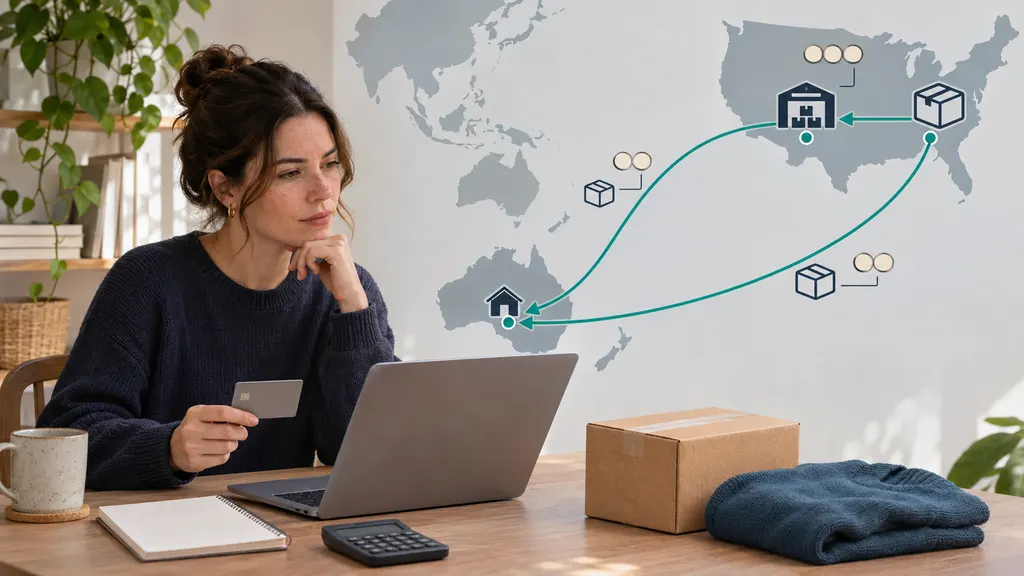
The lowest US sale price is not always the cheapest purchase. Currency conversion, international freight, GST, forwarding fees and difficult returns can outweigh the discount. Direct shipping is usually the simpler option when the retailer offers a suitable service at a competitive total price.
Choose your shipping route before the sale starts
Work out how your order will reach Australia before a limited-time deal goes live. Discovering an address restriction or an expensive freight quote after checkout can leave you paying cancellation, storage or return charges.
Option 1: Buy from a retailer that ships directly to Australia
Enter your Australian delivery address early in checkout. Shipping eligibility can vary by product, even within the same store. A retailer may ship clothing internationally but exclude batteries, oversized goods or particular brands.
Check the final checkout screen rather than relying on a general international-shipping page. Confirm the shipping charge, currency, delivery service, and whether taxes or import charges are included. If the retailer collects import charges in advance, read how that collection works and whether additional charges could still arise.
Best fit: A straightforward purchase where the retailer accepts your address, offers an acceptable delivered price and provides a workable returns process.
Option 2: Use a US parcel-forwarding address
A parcel forwarder receives your purchase at a US address and arranges a separate shipment to Australia. You normally register first, receive an address with an account or suite identifier, and enter those details when ordering from the retailer.
This creates two delivery stages: the retailer to the US warehouse, then the warehouse to Australia. The retailer's free domestic shipping offer, if available, covers only the first stage. Forwarding, handling and international transport are separate costs.
Before registering, confirm that the service accepts your product category and delivers to your Australian postcode. Also check whether the retailer permits orders to forwarding warehouses. A valid US delivery address does not guarantee that an order will be accepted.
Best fit: A US-only offer with enough savings to cover the extra shipping stage, fees and return risk. It is less suitable when the item is bulky, restricted, fragile or likely to need an exchange.
Check the product, not just the discount
A product can be available for purchase in the US yet be unsuitable for use in Australia. Check the exact model, specifications and package contents before comparing prices.
- Electrical compatibility: Read the voltage and frequency rating. A plug adapter changes the plug shape, not the appliance's operating voltage. Do not assume a US appliance will work safely in Australia.
- Warranty: Ask whether the manufacturer will honour the warranty in Australia and where a faulty product must be sent. Do not assume an international warranty exists.
- Connectivity and regional restrictions: Check network compatibility, account-region requirements, subscriptions and any region-specific functions.
- Sizing and specifications: Use measurements and model numbers rather than relying only on familiar-looking size labels or product names.
- Safety and recalls: Check relevant Australian product requirements and recall information, particularly for electrical goods, children's products and safety equipment.
For expensive purchases, save the product page and the seller's written answers. A model-specific confirmation is more useful than a general statement that a brand sells internationally.
Calculate the landed cost in Australian dollars
Use the amount you expect to pay to receive and keep the item, not the advertised US price. Build your estimate from these components:
- The sale price in US dollars.
- US domestic delivery and any applicable US sales tax.
- Currency conversion and any card or payment-provider fees.
- Forwarding, receiving, repacking, consolidation or storage fees.
- International shipping and any optional shipment protection.
- GST, customs duty where applicable, and clearance or processing charges.
- Delivery surcharges that apply to your address or shipment.
Illustrative example: Suppose a sale item costs A$180 after conversion, while domestic shipping and tax add A$20, forwarding fees add A$15, and international freight adds A$55. The subtotal is A$270 before any remaining applicable taxes or charges. Against an Australian delivered price of A$285, the apparent bargain leaves only A$15 to absorb those costs and the inconvenience of an overseas return. These figures are hypothetical, not shipping quotes.
US sales tax depends on the transaction and delivery destination; do not assume every warehouse address produces a tax-free purchase. Likewise, a quoted exchange rate may differ from the rate your payment provider ultimately applies. Compare the final payable amount and avoid counting the same tax twice if it has already been collected.
How Australian GST and the A$1,000 threshold affect purchases
The Australian Border Force distinguishes goods with a customs value of A$1,000 or less from higher-value imports. For most goods within that lower-value category, duties and taxes are generally not collected at the border, but GST may still be collected at the point of sale. Exceptions apply, including to alcohol and tobacco products.
Goods with a customs value over A$1,000 generally require an import declaration and may attract GST, customs duty and processing charges. Australia's standard GST rate is 10%, but calculating an import bill is not necessarily as simple as adding 10% to the advertised item price. The relevant taxable amount and treatment depend on the import.
The threshold concerns customs value, not an arbitrary total from your card statement. Multiple orders packed into one shipment can also change the import position. If consolidation brings a shipment close to or above the threshold, check the Australian Border Force guidance before authorising dispatch. Do not understate values or describe purchases as gifts to avoid charges.
Check import and transport restrictions before ordering
Two separate checks matter: whether Australia permits the goods to enter, and whether the forwarding service and carrier will transport them. Passing one check does not satisfy the other.
Australia's BICON database provides biosecurity import conditions. Check it before buying food, seeds, plant material, animal products or other goods that may present a biosecurity risk. Wooden items and used outdoor equipment may also need closer attention, depending on their materials and condition.
Transport restrictions can affect lithium batteries, power banks, perfume, aerosols and other hazardous goods. A service may accept a battery installed in a device but restrict a loose battery, or impose different conditions for different routes. Get confirmation for the exact product and proposed service rather than relying on a broad statement that electronics are accepted.
If the rules are unclear, resolve them before purchase. A retailer's willingness to deliver to a US warehouse is not confirmation that the parcel can legally or practically continue to Australia.
Prepare your forwarding account and place the order
If forwarding is necessary, check the service's terms before sending anything to its warehouse. Focus on the charges and procedures that could affect your particular order:
- Address format: Copy the warehouse address and your suite or account number exactly.
- Payment acceptance: Check whether the retailer accepts your Australian billing address and payment method. Do not enter false billing information to bypass a restriction.
- Receiving process: Find out how an arriving parcel is matched to your account and what happens if its identifier is missing.
- Storage: Check when storage charges begin, especially if you plan to wait for several orders.
- Inspection and photos: Establish whether these services are available, what they show, and whether they cost extra.
- Claims: Read compensation limits, exclusions, packaging requirements and reporting deadlines.
Save your order confirmation, invoice, product description and retailer tracking number. Check whether the sale timing is stated in a US time zone; the corresponding time in Australia can fall on a different calendar day. Avoid relying on a countdown from another region's storefront.
Decide whether consolidation actually saves money
Combining several purchases into one international parcel can reduce duplicated handling and shipping charges, but it is not automatically cheaper. Carriers may charge using the greater of actual weight and dimensional weight, which reflects the space a parcel occupies.
Ask for a quote based on the packed dimensions and weight. Repacking a small item from a large retail carton may reduce freight, but removing original packaging can affect protection, resale value or return eligibility. Give clear instructions about which packaging must remain.
Consolidation also means waiting for the last parcel. An item that arrives late at the warehouse can delay everything else, while the return window for an earlier purchase continues to run. Compare the saving against storage charges, customs implications and the cost of delaying the whole order.
Track each delivery stage separately
Keep a simple record linking each retailer order to its US domestic tracking number, warehouse reference and international tracking number. The original retailer number may stop being useful once delivery to the forwarding warehouse is complete.
A domestic status of “delivered” means that delivery stage has ended; it does not mean the parcel has left for Australia. Allow for warehouse receiving and processing, then check your forwarding account for the onward booking and tracking details.
For supported shipments, 17TRACK's tracking page can help you check carrier updates. Use it as a visibility tool, not as a substitute for the retailer, forwarder or carrier: tracking does not authorise customs clearance, amend an address or resolve a delivery claim.
If progress stops, contact the party responsible for the current stage. Ask the retailer about a parcel not yet delivered to the warehouse, the forwarder about receiving or dispatch, and the relevant carrier or clearance contact about an international shipment. For a time-sensitive gift, allow for both transport legs and warehouse processing rather than relying on the retailer's domestic estimate.
Check returns before committing to the deal
Read when the return window begins. It may start from delivery to the US warehouse, rather than arrival at your Australian home. By the time you inspect the purchase, much of that window could have passed.
A prepaid US return label should not be assumed to cover shipping from Australia. Ask who pays for each leg, whether original packaging is required, and whether sale items are subject to special return conditions. Also check whether the retailer limits support for purchases sent through a forwarder.
Buying rule: Choose the US deal when the verified delivered saving comfortably covers the additional risk. If the saving is narrow, Australian availability, easier returns and locally supported warranty arrangements may make the domestic purchase better value.
FAQ
Can I order from a US store using an Australian credit card?
Sometimes, but acceptance depends on the retailer and payment checks. A store may reject an overseas billing address or a forwarding destination. Check its payment and shipping policies before the sale, and keep your billing details accurate.
Is an order under A$1,000 automatically GST-free?
No. For eligible low-value imported goods, GST may be collected at checkout even when border duties and taxes are generally not collected. Product exceptions and the details of the transaction matter. Consult Australian Border Force guidance rather than treating the threshold as a blanket tax exemption.
Should I combine all my Black Friday orders into one parcel?
Only after comparing quotes. Consolidation may save on duplicated fees, but a larger box, storage costs, restricted items or a change in customs treatment can reduce the benefit. Ask for the packed shipment's dimensions, weight and total forwarding charge first.
What if my tracking says delivered but I have nothing in Australia?
Check which leg the number covers. It may show delivery to the US forwarding warehouse. Match the tracking number to your order, check the warehouse receiving record, and obtain the onward shipment number before treating it as a missing Australian delivery.
Will a US Black Friday order arrive before Christmas?
Do not assume it will. Stock availability, domestic delivery, warehouse processing, international transport and clearance all affect arrival. Check service-specific estimates and cutoffs before buying, and distinguish an estimated delivery date from a guaranteed commitment.
Sources
- Australian Border Force: Buying online — guidance on buying goods from overseas, the A$1,000 threshold, and potential import charges.
- Australian Government: BICON Australian Biosecurity Import Conditions — product-specific biosecurity import requirements.
- Product Safety Australia — Australian product safety information and recalls.
- 17TRACK: Package tracking — tracking lookup for supported shipments.