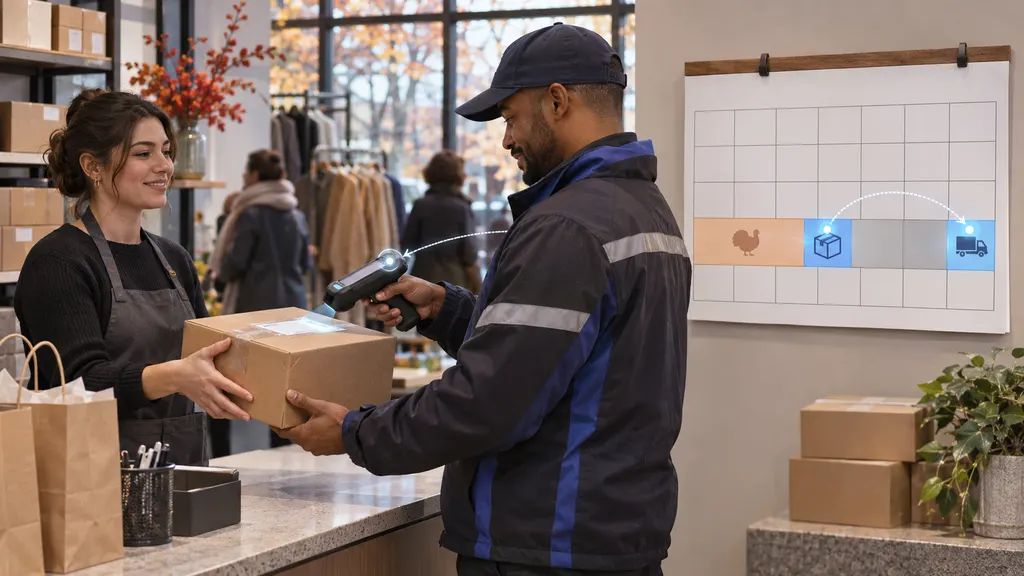
How Returns Platforms Use a Shipment Tracking API to Track Return Shipments
Returns platforms use a shipment tracking API to connect an approved return to its physical shipment. The platform records the return shipment’s carrier and tracking identifier, retrieves tracking events, and uses those events to show progress or prompt an operational review. The API provides shipment visibility; the returns platform still owns the return request, policy decisions, warehouse inspection, and refund workflow.

For a returns operations or product team, the useful question is not simply whether an API can display a tracking status. It is whether the integration can reliably identify the right return shipment, interpret the events it receives, and prevent a tracking update from triggering the wrong customer message or refund action.
Where tracking fits in a return
A return begins as a business record: a customer asks to send an item back, and the merchant decides what to authorize. A tracking record describes a different thing: the movement of a parcel. Connecting the two records lets a returns platform answer questions such as whether the customer appears to have handed off the parcel, whether it is moving toward the return destination, and whether a delivery event has been reported.
That connection must be explicit. An order may contain several items, a customer may make more than one return against the same order, and one return may involve multiple parcels. The original outbound tracking number should not be mistaken for the return tracking number. A practical data model keeps separate identifiers for the order, return authorization, return parcel, carrier, and tracking record, then stores the relationships between them.
Tracking also has a clear boundary. A carrier delivery event can indicate that a parcel reached an address or facility. It does not establish that the warehouse received the expected item, that the item passed inspection, or that a refund is due. Those decisions need their own evidence and rules.
The integration flow, from authorization to receipt
1. Create the return record before following the parcel
The returns platform first records the request, the items involved, the authorized destination, and the permitted resolution. If the return uses a merchant-issued label, the platform can associate the label’s tracking identifier with the return parcel. If the customer arranges shipping independently, the platform may need a way to collect and validate the carrier and tracking number before monitoring begins.
This is the first point where data quality affects visibility. A tracking number without a reliable parcel-to-return association can produce a perfectly accurate carrier update on the wrong return. Teams should also decide how they will handle corrected tracking numbers, replacement labels, and customers who submit the same identifier twice.
2. Register or look up the shipment
The platform sends the information required by its chosen tracking provider to establish or retrieve a shipment record. The exact request fields and sequence depend on that provider’s documentation. At a minimum, an implementation needs a dependable way to associate the provider’s shipment reference with its own return-parcel record. Where carrier identification is needed, the platform should confirm how ambiguous or unsupported carrier details are handled rather than assuming a tracking number alone is sufficient.
Keep the provider response, integration errors, and the date the platform began monitoring. An accepted request is not necessarily proof that a carrier has scanned the parcel. Before the first scan, the customer-facing state may need to say that tracking is pending rather than that the return is in transit.
3. Ingest updates without losing the original event
Depending on the API, updates may arrive through a webhook, be retrieved by polling, or use another documented method. The integration should preserve the provider’s raw event information alongside any simplified status displayed in the returns platform. Useful fields may include the event description, event time, location when supplied, carrier reference, and the time the platform received the update.
Those two times answer different questions. An event timestamp describes when an activity was reported to have occurred; a receipt timestamp shows when the returns platform learned about it. Delays, repeated deliveries, and out-of-order messages can otherwise make a return appear to move backward. If the provider offers event identifiers, use them for deduplication. If it does not, define a cautious deduplication method and test it with real integration samples.
4. Translate tracking events into return states
Carrier event descriptions are not a return policy. The returns platform typically maps them into a smaller set of operational states, such as awaiting handoff, in transit, delivery reported, or needs review. The mapping should account for unknown events instead of silently treating every unrecognized update as progress.
For example, a first carrier scan may be sufficient to tell a customer that their parcel appears to be on its way. It may not be sufficient to promise a refund date. A delivery event may help the warehouse prioritize a matching parcel, but a refund rule may still require physical receipt and inspection. Teams should write these distinctions into the workflow before connecting statuses to automated actions.
5. Close the loop with warehouse evidence
Once a parcel arrives, the warehouse or return facility may scan an internal barcode, match the parcel to a return authorization, inspect its contents, and record the outcome. These are returns-management events, not carrier-tracking events. Where both systems are connected, the platform can show a more useful sequence: shipment movement, delivery reported by the carrier, parcel received by the facility, and disposition completed.
That sequence also helps resolve exceptions. If tracking reports delivery but no warehouse receipt appears, an operator can investigate the destination, carrier event, facility intake queue, and parcel identifier before making a customer-facing claim. If the warehouse receives a parcel without a usable tracking history, the physical receipt can still be recorded; missing tracking data should not erase independent warehouse evidence.
What a tracking API can and cannot tell the platform
A shipment tracking API can make carrier-reported movement available to another application, subject to the provider’s documented coverage, event availability, and integration behavior. It cannot by itself verify a return’s contents or decide whether a merchant’s policy has been met. It may also have no update to report before the first carrier scan.
The distinction matters when designing automation. Statuses should be treated as signals with defined uses, not as interchangeable proof. A carrier handoff event might trigger a progress notification. A delivery event might create a warehouse follow-up task. A confirmed warehouse receipt might move the return toward inspection. The refund or exchange decision should follow the merchant’s actual rules and the evidence those rules require.
Customer-facing language should reflect the same boundary. “The carrier reports your return was delivered” is more precise than “We have approved your refund” when no inspection has occurred. Likewise, “We are waiting for the first carrier update” is more informative than an unexplained blank tracking page.
Design checks that prevent avoidable return-tracking errors
- Match at parcel level. Test split returns, multiple parcels under one authorization, replacement labels, and repeated returns against one order. Each parcel needs an unambiguous association with its own tracking record.
- Define status precedence. Decide what happens if an older in-transit event arrives after a delivery event. Preserve the event history without automatically downgrading the displayed return state.
- Separate provider errors from carrier silence. An authentication failure, rejected request, or failed webhook processing is an integration problem. No scan yet is a different condition and should be communicated differently.
- Plan for duplicates and retries. Update delivery can be repeated. Make event ingestion safe to retry, and avoid sending the same customer notification or creating the same task twice.
- Protect customer and shipment data. Restrict access to tracking credentials, retain only the data the workflow needs, and review the provider’s documented authentication and security requirements before launch.
- Keep a manual path. Some returns will have incomplete, late, or mismatched tracking information. Operators need a way to investigate and correct the return record without inventing carrier events.
These checks are most useful when tested against concrete scenarios rather than a single successful shipment. A small test set should include no first scan, an incorrect tracking number, a duplicate event, an out-of-order event, a delivery report without warehouse receipt, and a warehouse receipt without a matching delivery report. The expected customer message and operator action should be specified for each case.
Choosing the API and defining the division of work
Start with the return lanes and carriers the business actually uses. Then verify, in the provider’s current documentation, how shipment registration works, which identifiers are required, how updates are delivered, what event data is exposed, and how errors and retries are handled. Confirm the relevant carriers and return routes directly rather than inferring them from a general statement about carrier coverage. Test with representative shipments before relying on mapped statuses for customer communication or automation.
17TRACK publishes a Tracking API overview and API documentation; its 17RETURNS product page addresses the returns-management side of the workflow. They are relevant starting points for a team assessing tracking visibility alongside a returns process. The existence of both product areas should not be taken as proof that a particular integration, carrier, event, or automated refund rule is available. Verify the exact workflow in the current documentation and, where necessary, with the provider.
For procurement or a proof of concept, ask the team that owns returns policy and warehouse operations to review the status mapping with engineering. Engineering can confirm whether the API delivers usable events; operations can confirm whether those events justify the proposed action. A successful integration is one that helps staff and customers follow the parcel while keeping authorization, receipt, inspection, and resolution as distinct steps.
FAQ
Does a return need a different tracking number from the original order?
The platform should maintain separate outbound and return shipment records. A return commonly travels as a separate shipment, so its tracking identifier must be associated with the return parcel rather than assumed to be the original order’s outbound identifier. The exact identifiers available depend on how the return is shipped.
Can a tracking API confirm that a refund should be issued?
No tracking event alone confirms that the returned item meets the merchant’s refund conditions. The platform can use carrier events as inputs to a workflow, but refund eligibility may also depend on authorization, physical receipt, inspection, and the merchant’s policy.
What if tracking shows delivery but the warehouse cannot find the parcel?
Keep the carrier-reported delivery event and the warehouse-receipt record separate. Check the reported destination and event details, then investigate the facility’s intake and matching process. Do not silently convert carrier delivery into confirmed warehouse receipt.
Are webhooks required to track return shipments?
Not necessarily. The update method depends on the chosen provider and its documented options. If webhooks are available, plan for authentication, retries, duplicate deliveries, and processing failures. If polling is used, choose an interval and stopping rule that fit the return workflow and the provider’s requirements.
When should a customer see the first tracking update?
That depends on when the carrier reports an event and when the integration receives it. Creating a label or registering a shipment may happen before a carrier scan. Display that distinction clearly so customers do not interpret a pending first update as confirmed movement.