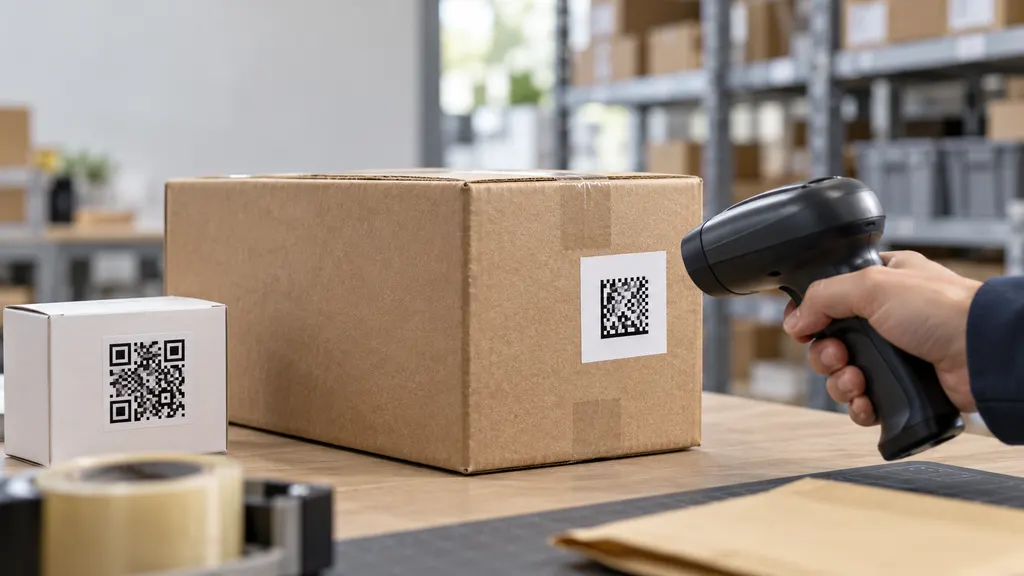
Application Identifier (AI)
What Is an Application Identifier (AI)?
An Application Identifier (AI) is a standardized numeric prefix in the GS1 system that identifies the meaning and format of the data that follows it. In logistics, warehousing, and ecommerce fulfillment, GS1 Application Identifiers allow systems to distinguish information such as a product identifier, a logistics-unit identifier, a batch number, or an expiration date within a barcode or another supported GS1 data representation.
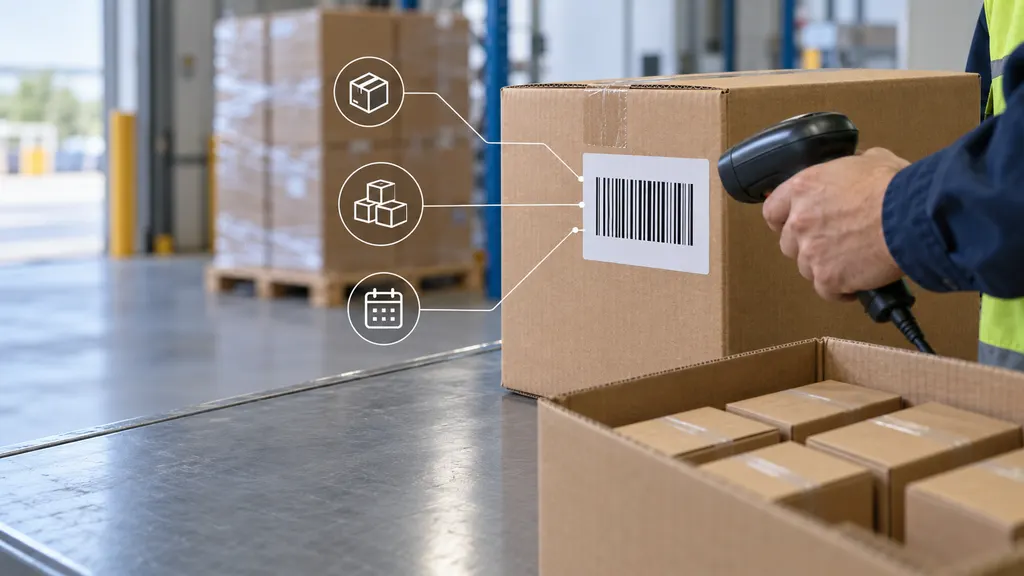
An AI consists of two, three, or four digits. It is not usually the business identifier itself: it tells the receiving system how to interpret the associated value. For example, AI 01 identifies a field containing a Global Trade Item Number (GTIN), while AI 00 identifies a field containing a Serial Shipping Container Code (SSCC). The authoritative definitions, formats, and usage rules are maintained by GS1.
In this context, AI means Application Identifier, not artificial intelligence. The abbreviation also appears in other technical fields, but the GS1 meaning is the relevant one when discussing product identification, logistics labels, and supply-chain barcode data.
How Application Identifiers Work
A GS1 data element combines an Application Identifier with its associated data field. Several data elements can be carried together when the chosen barcode and applicable GS1 rules permit it. A receiving application reads the AI, determines the expected field structure, extracts the value, and assigns that value to the appropriate business field.
This provides an agreed vocabulary between organizations. Without a shared interpretation rule, a sequence of digits might be mistaken for a product number, a date, or a shipment reference. An AI supplies that interpretation, although the receiving software must still implement the relevant parsing and validation rules.
Human-readable notation and encoded data
Application Identifiers are commonly shown in parentheses in the human-readable text accompanying a barcode. For example, (17)271231 represents AI 17 followed by an expiration-date value in YYMMDD format: December 31, 2027. The parentheses help a person recognize the AI; they are not encoded as ordinary parentheses in the GS1 barcode data.
Barcode scanners and their software interfaces may expose control information differently. As a result, a printed label, a scanner's text output, and an application's stored record may not look identical even when they represent the same data. Implementations should distinguish the printed representation from the encoded structure rather than attempting to parse the visible parentheses alone.
Field lengths and separators
Some AI data fields have a prescribed length, while others allow a variable number of characters up to a specified maximum. This distinction matters when multiple fields appear together. A parser needs to know where one value ends before it can identify the next AI.
For variable-length fields, an appropriate separator is generally needed when another data element follows. In GS1 barcode implementations, this involves the separator mechanism specified for the relevant symbology, including FNC1 where applicable. Software interfaces may represent a separator as a group separator character. Exact requirements should be taken from the GS1 General Specifications rather than inferred from the appearance of a label.
Common Application Identifiers in Logistics
The following examples illustrate frequently relevant GS1 data fields. They are selected examples, not a complete list or a substitute for the official AI definitions.
| AI | Data identified | Data format | Practical significance |
|---|---|---|---|
| 00 | Serial Shipping Container Code (SSCC) | 18 numeric digits | Identifies an individual logistics unit, such as a pallet or parcel. |
| 01 | Global Trade Item Number (GTIN) | 14 numeric digits | Identifies a trade item rather than a particular shipment. |
| 10 | Batch or lot number | Variable length, up to 20 permitted characters | Associates a trade item with a production batch or lot. |
| 11 | Production date | Six numeric digits, YYMMDD | Communicates the production date associated with the item. |
| 15 | Best-before date | Six numeric digits, YYMMDD | Communicates a best-before date, which is distinct from an expiration date. |
| 17 | Expiration date | Six numeric digits, YYMMDD | Supports expiry-related handling when applicable to the product. |
| 21 | Serial number | Variable length, up to 20 permitted characters | Distinguishes an individual instance when used with the relevant product identifier. |
The official definitions also specify matters that this summary does not reproduce, including permitted character sets, required associations with other data, and particular validation rules. A field's maximum length does not mean every value must occupy that length.
Use in Warehousing and Ecommerce Fulfillment
Application Identifiers sit at the interface between physical identification and business records. A warehouse may scan an incoming logistics unit, retrieve its SSCC, and match that identifier to an expected receipt. Product-level data can separately identify the trade item, batch, expiration date, or serial number relevant to inventory handling.
The barcode does not need to contain every detail of the transaction. An SSCC can serve as a reference to information held in a warehouse system or exchanged between trading partners. Similarly, a GTIN identifies a trade item, while descriptions, commercial terms, and order allocations can remain in connected databases.
For example, a retailer receiving date-sensitive stock may read a product identifier, lot number, and expiration date from a compatible label. If its warehouse software supports those fields, it can record the lot and date against the receipt. Whether that information then affects stock rotation depends on the retailer's configured inventory rules; the presence of an AI does not itself enforce a picking policy.
During returns processing, a supported product-and-serial-number combination may help staff match a physical unit to an existing record. This does not establish the customer's entitlement to a refund, prove product authenticity by itself, or replace the merchant's return authorization process.
Cross-border shipments
Shared GS1 definitions can help trading partners interpret identification data across organizational and national boundaries. However, an AI is not a customs declaration field merely because it appears on an international shipment. GS1 identifiers do not replace tariff classification, origin information, commercial invoices, or any other documentation required for a particular transaction.
Likewise, an SSCC should not automatically be treated as a carrier tracking number. A carrier or logistics integration may associate the two, but that association must exist in the relevant systems. The Application Identifier describes the data field; it does not guarantee access to transport events.
Application Identifiers and Related Terms
| Term | What it represents | Relationship to an AI |
|---|---|---|
| GTIN | An identifier for a trade item | AI 01 declares that the following field contains a GTIN. |
| SSCC | An identifier for an individual logistics unit | AI 00 declares that the following field contains an SSCC. |
| Barcode symbology | The rules used to represent data in a machine-readable symbol | A compatible symbology carries AI-defined data; the AI is not the barcode type. |
| SKU | A stock-keeping reference assigned within a business's inventory system | It is not interchangeable with an AI or automatically equivalent to a GTIN. |
| Carrier tracking number | A reference used within a carrier's tracking process | It should not be assumed to be an SSCC or another GS1 identifier without verification. |
GS1-128 and GS1 DataMatrix are examples of barcode formats used to carry GS1 AI element strings. Ordinary Code 128 or Data Matrix symbols should not be assumed to follow GS1 rules solely because they look similar. Both the encoding and the data structure matter.
Implementation and Validation Checks
A successful scan only confirms that a scanner has decoded a symbol. It does not establish that the values are valid, correctly associated, or suitable for the intended business transaction. A practical implementation should check several layers:
- Confirm the data carrier. Establish whether the label uses the expected GS1 barcode format and whether the scanner reports the information needed to recognize it.
- Preserve field boundaries. Ensure that scanner configuration, middleware, and application interfaces do not discard separators required for parsing.
- Validate the AI and field format. Check the identifier against the official definitions, including field length and permitted characters. Avoid treating every AI as a two-digit prefix.
- Apply identifier-specific rules. Validate check digits where required, such as for GTINs and SSCCs, and interpret date fields according to GS1 rules.
- Check required associations. Confirm that additional attributes, such as serial or batch information, are associated with the identifiers required by the relevant AI rules.
- Check business relevance. Compare the parsed values with expected items, receipts, or logistics units. A structurally valid identifier can still refer to the wrong goods.
- Test the complete interface. Use representative labels with different field lengths, field orders, and separator positions, rather than testing only one successful scan.
Implementations should use the current GS1 definitions rather than an informal list copied into software without maintenance. Where organizations exchange AI-based data, agreeing on supported fields and error handling is as important as agreeing on the physical label.
Common Misunderstandings
- An AI is not a unique identifier for an item. It identifies the meaning of a field. The following value supplies the product, logistics-unit, batch, or other information.
- Not every barcode contains Application Identifiers. Their presence depends on the data structure and the relevant GS1 implementation.
- Visible parentheses are not field separators in the encoded barcode. They are a human-readable convention and should not be confused with the actual separator mechanism.
- A best-before date and an expiration date are not the same GS1 field. AI 15 and AI 17 communicate different date meanings and should not be substituted for one another.
- Standardized data is not automatic interoperability. Receiving software still needs compatible parsing, validation, field mapping, and business rules.
QA
What does AI mean on a logistics barcode?
It means Application Identifier: a GS1 numeric prefix that identifies the meaning and format of the following data, such as an SSCC, GTIN, batch number, or expiration date.
What is the difference between AI 00 and AI 01?
AI 00 identifies a field containing an SSCC for an individual logistics unit. AI 01 identifies a field containing a GTIN for a trade item. They describe different identification purposes.
Are Application Identifiers the same as barcode types?
No. Application Identifiers define data fields. A barcode type, or symbology, defines how information is represented in a machine-readable symbol. Compatible GS1 barcode formats can carry AI-defined fields.
Does scanning an Application Identifier provide shipment tracking?
Not by itself. The scan supplies identification or attribute data. Tracking events require a relevant system and an established association between the scanned identifier and the shipment records.
Sources
- GS1: Application Identifiers — Official overview of Application Identifiers and their role in defining GS1 data fields.
- GS1 Application Identifiers Reference — Individual AI definitions, data formats, field lengths, and association rules.
- GS1 General Specifications — Technical rules for GS1 identification, barcode encoding, human-readable interpretation, separators, and validation.