What Is Proof of Delivery (POD)? How a Tracking API Helps Payment Providers Manage Risk and Improve Merchant Services
After a customer pays for an order, delivery still needs to be confirmed. When a customer files a chargeback claiming they did not receive the goods, the payment provider needs to verify whether the merchant fulfilled its delivery obligation. Proof of delivery (POD) from the carrier can serve as evidence alongside the transaction record and the tracking information supplied by the merchant.
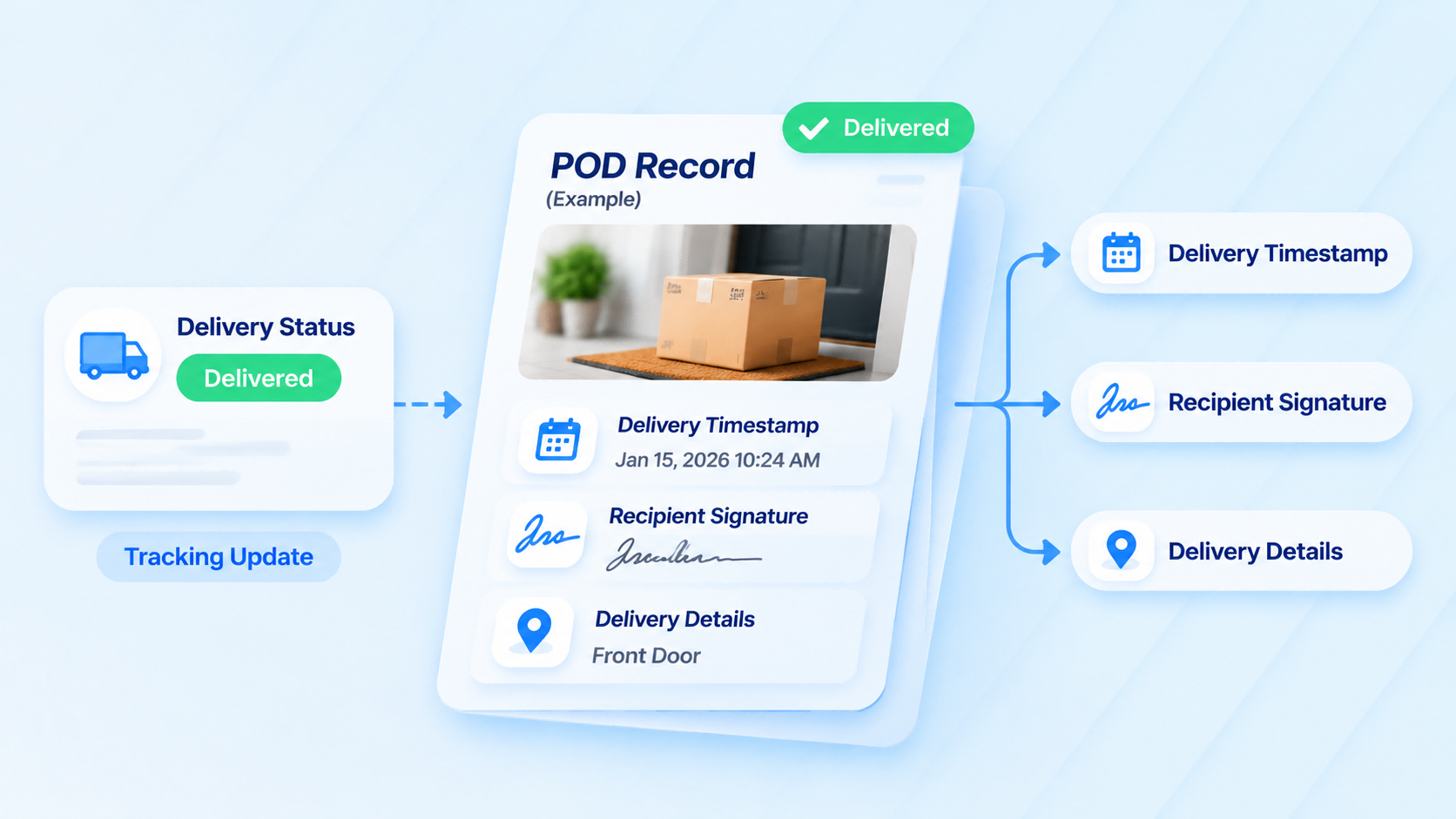
POD can include delivery timestamps, signatures, and other details that help payment providers verify whether the goods were delivered.
Merchants use different carriers, and POD availability and retrieval methods vary by carrier. A multi-carrier Tracking API gives payment providers one way to retrieve tracking events and available POD records across carriers and link them to transactions and orders.
This can streamline chargeback handling and give payment providers shipping data they can use in day-to-day risk management and merchant fulfillment oversight.
1. Why Payment Providers Need Proof of Delivery
Payment providers can use POD to check whether a package arrived and retrieve specific delivery evidence for fulfillment reviews and chargeback disputes.
In an Item Not Received chargeback, the merchant needs evidence that the goods were delivered as agreed. A shipment record alone may be insufficient to establish that the package reached the customer or an authorized recipient.
This issue is particularly relevant during peak e-commerce season. In an analysis of approximately 3.03 million chargeback disputes, Chargeflow found that 34.7% of disputes over Black Friday weekend in 2025 involved an Item Not Received claim, compared with 19.9% in a typical week. The Black Friday share was 1.74 times as high.
Delivery evidence was also associated with dispute outcomes. In a 2026 study of one million chargeback disputes, Stripe found that for physical goods, cases with delivery confirmation had a 27-percentage-point higher win rate than cases without it. With a GPS map of the delivery location and the recipient’s signature, the total difference reached 44 percentage points.
For a full picture of fulfillment, payment providers can look beyond dispatch records and basic tracking statuses. Where available, delivery timestamps, locations, and receipt records help merchants reconstruct what happened and prepare evidence for a dispute.
2. Why Use a Tracking API to Retrieve POD Across Carriers?
Bringing tracking events and proof of delivery into payment workflows can streamline chargeback handling and give risk and merchant operations teams a fuller picture of fulfillment.
Major carriers such as UPS, FedEx, DHL, and USPS offer tracking and various forms of POD. Retrieval methods, interface requirements, and service coverage vary by carrier.
Some carriers require separate API access. Others offer POD only for shipments with a specific signature service or require a qualifying account or authorization.
Payment providers serving many merchants need to handle a mix of carrier interfaces and access rules. Integrating with each carrier separately increases development and maintenance costs and makes it harder to manage delivery records in one transaction management system.
A multi-carrier Tracking API brings shipping data together through one interface, reducing the work of building and maintaining separate carrier integrations.
Payment providers can retrieve tracking events across carriers and obtain available POD from supported services through a single interface. They can then link those records to their own transactions, orders, and shipments, giving dispute teams one place to find the relevant delivery evidence.
3. How 17TRACK API Supports Tracking and POD Retrieval
17TRACK API draws on a global shipping data network to provide multi-carrier tracking, data processing, and access to available POD through one interface.
| 17TRACK API Capability | Value for Payment Products |
|---|---|
| POD retrieval | Retrieve available proof of delivery from supported carriers and services for fulfillment reviews and dispute handling. |
| Multi-carrier tracking | Track shipments in bulk across 3,500+ carriers worldwide through a single interface. |
| AI-powered carrier identification | Combine AI with rule-based matching to reduce failed lookups caused by incomplete carrier information. |
| Standardized tracking statuses | Use 9 main statuses and 30 sub-statuses to interpret tracking events consistently across carriers. |
| Automated webhook updates | Send eligible new tracking events to the payment provider’s systems. |
4. How Shipping Data Improves Risk Management and Merchant Services
Adding tracking and POD to a payment product extends its role from processing transactions to helping merchants manage fulfillment after payment.
4.1 Streamline Dispute Handling and Reduce Manual Evidence Collection
When a chargeback occurs, dispute teams can find the corresponding shipment from the transaction details and review its tracking history and any available POD.
With fewer carrier lookups and repeat requests to merchants, teams can prepare delivery evidence more quickly.
4.2 Identify Fulfillment Issues Earlier to Support Risk Management
A merchant may mark orders as shipped, yet a batch may still have no carrier pickup record after the promised dispatch deadline.
Risk teams can review the carrier, the shipment batch, and the merchant’s track record to assess whether carrier updates are delayed or whether to ask the merchant to confirm dispatch.
Tracking exceptions can serve as risk signals, helping teams identify transactions and merchants that need attention sooner.
4.3 Expand Merchant Services and Differentiate the Payment Product
Payment platforms can add shipment lookups, fulfillment records, and POD retrieval to the merchant dashboard so merchants can see the delivery information linked to each transaction.
When a customer complains or files a chargeback, merchants and payment providers can review the same shipment records linked to the transaction, reducing the need to gather evidence across platforms.
This extends financial payment solutions beyond transaction processing into post-transaction fulfillment services, providing merchants with additional value-added capabilities while creating new opportunities for payment providers to differentiate their offerings.
Connecting Payment and Delivery Data
Payment records show whether a transaction was completed. Shipping records show when the goods were dispatched, how they moved, and whether they were delivered. Linking the two gives payment providers a fuller view of fulfillment after payment.
With a global network of 3,500+ carriers, the 17TRACK API offers multi-carrier tracking, AI-powered carrier identification, standardized tracking statuses, POD retrieval, and automated webhook updates.
Integrating the 17TRACK API into payment products not only enables multi-carrier shipment tracking and POD retrieval, but also brings fulfillment data into risk management workflows. This provides merchants with more comprehensive post-transaction services while creating new opportunities for financial and payment providers to offer value-added services.