USPS Box Sizes Guide: How Big Priority Mail and Free Boxes Are
USPS Priority Mail boxes come in several standard sizes, including free regular boxes and Flat Rate boxes. The most useful choices range from a small Flat Rate box measuring about 8 11/16 by 5 7/16 by 1 3/4 inches to a large Flat Rate box measuring about 12 1/4 by 12 1/4 by 6 inches. The right box depends on the item’s dimensions, weight, destination, and whether a Flat Rate price or weight-and-zone pricing is more suitable.
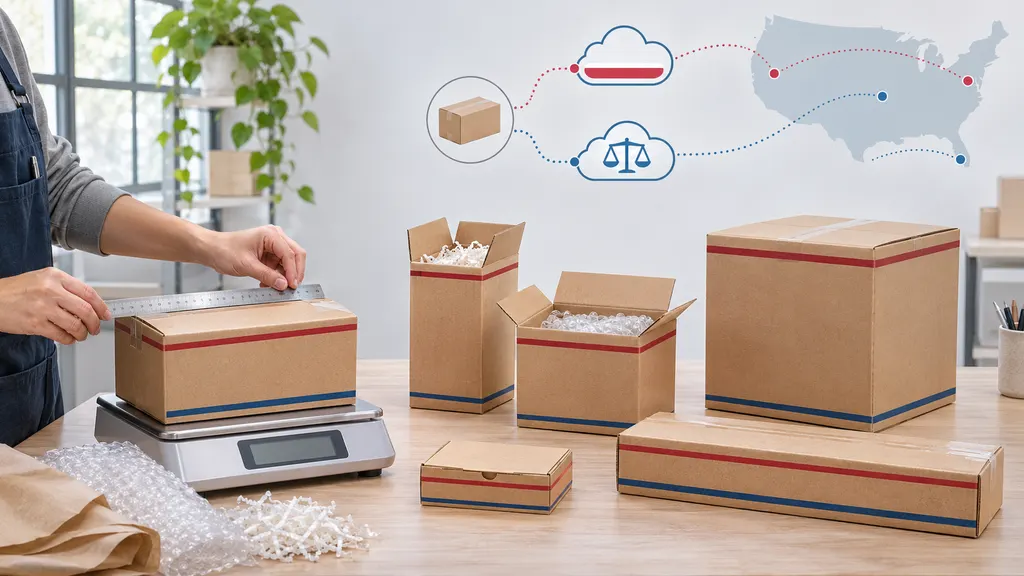
This guide explains the commonly used USPS box sizes, how Flat Rate packaging differs from regular Priority Mail packaging, and how to select and measure a box before buying postage. USPS packaging specifications and availability can change, so confirm the current details in the official USPS supply catalog and Domestic Mail Manual before shipping a high-value, unusually large, or time-sensitive package.
USPS Priority Mail box sizes at a glance
The table below summarizes commonly listed Priority Mail boxes. Dimensions are shown as length by width by height. They are practical reference dimensions rather than a guarantee that every box currently stocked at every post office will be available.
| Box type | Approximate dimensions | Typical use |
|---|---|---|
| Small Flat Rate Box | 8 11/16 × 5 7/16 × 1 3/4 in | Small, dense items, documents, accessories, and compact merchandise |
| Medium Flat Rate Box, top-loading | 11 1/4 × 8 3/4 × 6 in | Books, household items, and several smaller products |
| Medium Flat Rate Box, side-loading | 14 × 12 × 3 1/2 in | Flat, wide items that do not fit well in a taller box |
| Large Flat Rate Box | 12 1/4 × 12 1/4 × 6 in | Bulky merchandise that fits within the square footprint |
| Large APO/FPO/DPO Flat Rate Box | 12 × 12 × 5 1/2 in | Eligible military and diplomatic address shipments |
| Board game box | 23 11/16 × 11 3/4 × 3 in | Long, shallow items such as board games and similar packages |
| Shoebox | 14 7/8 × 5 1/8 × 4 3/8 in | Shoes, clothing, and narrow retail products |
USPS also offers regular Priority Mail cartons in multiple shapes and sizes. Those cartons are not priced as Flat Rate packaging merely because they carry Priority Mail branding. The postage method depends on the product and the label selected.
What is the difference between Flat Rate and regular Priority Mail?
A Flat Rate box has a specific USPS Flat Rate marking and must be used with the corresponding Flat Rate service. When the package fits and the service rules are met, the postage is based primarily on the selected Flat Rate packaging and destination category rather than the package’s exact weight and zone. This can be useful for dense items or shipments traveling a longer distance.
Regular Priority Mail packaging is different. Its postage is generally calculated using the package’s weight, dimensions, destination, and applicable USPS pricing rules. A lightweight shipment traveling a short distance may be cheaper in a regular box, while a heavy shipment in a compact Flat Rate box may make better economic sense. The result cannot be determined reliably from box size alone; compare the actual package details in the postage tool before purchasing a label.
Do not put an item in a Flat Rate box and select an unrelated service simply because the box is free. Packaging markings and service compatibility matter. USPS states that Priority Mail packaging is intended for the associated mail service, and misuse of branded packaging can lead to postage problems or additional charges.
How big is a USPS small Flat Rate box?
The commonly listed small Priority Mail Flat Rate box is approximately 8 11/16 inches long, 5 7/16 inches wide, and 1 3/4 inches high. It is a shallow carton, so it works best for compact merchandise that can be packed in a single layer or a low stack.
Examples may include small electronics, jewelry packaging, cosmetics, hardware, books with modest dimensions, or replacement parts. The product must fit without forcing the lid or distorting the carton. Leave enough room for protective material when the contents are fragile. A box that closes only when compressed is not a good fit, even if its nominal dimensions appear large enough.
How big are USPS medium Flat Rate boxes?
USPS commonly lists two medium Flat Rate configurations. The top-loading version is approximately 11 1/4 by 8 3/4 by 6 inches. The side-loading version is approximately 14 by 12 by 3 1/2 inches.
The top-loading box provides more height and is usually easier for grouped products, books, kitchen items, and compact household goods. The side-loading box has a larger length and width but is much shallower. It can be a better match for flat products, folders, clothing, prints, or other items that are wide rather than tall.
These two cartons do not have the same shape, even though both are medium Flat Rate options. Check the opening orientation and internal clearance before choosing one. A product’s longest side may fit the side-loading box while its height does not fit the top-loading box, or the reverse may be true.
How big is a USPS large Flat Rate box?
The standard large Priority Mail Flat Rate box is approximately 12 1/4 by 12 1/4 by 6 inches. Its square footprint makes it useful for bulky items that need a wider base, but the six-inch height limits the type of merchandise it can hold.
A large Flat Rate box is not automatically the best value for every large shipment. If the contents are light and the destination is nearby, regular Priority Mail pricing may be lower. If the contents are heavy or the destination is farther away, Flat Rate pricing may be worth comparing. Always include the packing material in the final weight and use the finished package measurements rather than the product measurements.
Are USPS Priority Mail boxes free?
USPS provides certain Priority Mail and Priority Mail Express shipping supplies at no charge when they are used with the corresponding USPS service. Supplies may be available at participating post offices or through the official USPS online store. Availability can vary by location, and some specialty cartons may not be stocked locally.
Free packaging is not a general-purpose source of boxes for other carriers or unrelated services. Do not use a Priority Mail-marked box for Ground Advantage, another carrier, or a private shipping purpose unless the packaging and service rules specifically allow it. For marketplace and business operations, keeping service-specific cartons separated from generic cartons can prevent fulfillment mistakes.
When ordering online, check the product description, pack quantity, dimensions, and service marking. A carton that looks similar to another box may have a different size or intended service. It is also sensible to order a sample before changing a packaging workflow for a product line.
How to choose the right USPS box
- Measure the item. Record the longest, widest, and tallest points after adding any fixed components such as handles or protective cases.
- Plan the cushioning. Add the clearance needed for bubble cushioning, paper, foam, or other protective material. Fragile products should not be sized to the bare internal dimensions.
- Compare the box opening. A carton may have enough total volume but still be unusable if the item cannot pass through the opening.
- Check the finished weight. Include the product, packaging, label, and any inserts. Weight can change the result for regular Priority Mail.
- Compare Flat Rate and regular Priority Mail. Enter the origin, destination, weight, and package dimensions into the official postage calculator or your approved shipping system.
- Inspect the closure. The box should close normally, with seams and flaps secured without bulging. Do not rely on excessive tape to compensate for an undersized carton.
- Verify the current rules. Confirm the current service, weight limit, dimensional requirements, and packaging restrictions before mailing.
For repeat shipments, create a packaging profile for each product. Store the box’s outside dimensions, typical packed weight, cushioning method, and preferred USPS service. This makes rate comparisons more consistent and helps reduce dimensional errors when multiple people prepare orders.
Important size and weight checks
Priority Mail packages are subject to USPS size and weight rules. USPS commonly states a maximum weight of 70 pounds for domestic Priority Mail, but a specific destination, mail class, or special service can have additional requirements. Large packages may also be evaluated under dimensional-weight rules. That means a low-weight package can be priced according to the space it occupies when it exceeds applicable dimensional thresholds.
Measure the outside of the sealed package, not just the inside of the empty carton. Round measurements as required by the postage system, and do not assume that a free box eliminates the need to enter dimensions. If a package is close to a size threshold, remeasure it after taping and compare the result with the current USPS rules.
USPS box dimensions can also be presented differently across product listings, supply pages, and mailing standards. For that reason, the official product listing and current Domestic Mail Manual should take priority over an old blog post, an unverified seller listing, or a measurement copied from a packaging forum.
Common mistakes to avoid
- Choosing by volume alone: The product may fit mathematically but fail at the opening or require unsafe compression.
- Confusing box type with postage type: A regular Priority Mail carton is not automatically Flat Rate.
- Ignoring cushioning: The usable space is smaller once protection is added.
- Using branded packaging with the wrong service: Service markings are operational instructions, not decoration.
- Reusing damaged cartons: Weak seams, crushed corners, or missing flaps can create a failure during handling.
- Relying on an old price: Postage prices and supply availability can change, so obtain the current rate at label purchase.
FAQ
What is the biggest USPS Flat Rate box?
The standard large Priority Mail Flat Rate box is commonly listed at approximately 12 1/4 by 12 1/4 by 6 inches. A separate large box configuration may apply to eligible APO, FPO, or DPO shipments, so verify the address category and current packaging listing.
Can I use a USPS Flat Rate box for regular Priority Mail?
Use a Flat Rate-marked box with the corresponding Flat Rate service. If you want weight-and-zone Priority Mail pricing, select packaging and postage that comply with the current USPS rules rather than assuming any Priority Mail carton can be used interchangeably.
Are all USPS boxes free?
No. USPS supplies certain service-specific boxes at no charge, but availability and eligibility depend on the packaging and service. Generic boxes purchased from a retailer are not necessarily free, and free Priority Mail packaging should not be used for unrelated services.
Should I choose a medium or large Flat Rate box?
Choose the smallest box that safely holds the product and cushioning. Use the medium top-loading box for taller compact items, the medium side-loading box for broad shallow items, and the large box when its square footprint and six-inch height match the packed product. Compare the actual postage before deciding.
Do USPS box dimensions include the flaps and outside measurements?
Product listings generally provide the dimensions USPS uses to identify the carton, but usable interior space can be smaller because of corrugation, seams, and the closing structure. Treat the listed size as a reference, test-fit the packed item, and verify the finished package measurements when buying postage.