For businesses working with multiple carriers, routine tracking can answer “Where is the package?” But it does not readily answer broader operational questions: Which carriers provide more efficient service? Which shipping channels frequently have delayed tracking updates? Which shipments are experiencing exceptions or are at risk of failed delivery?
Answering these questions requires aggregating tracking events across large numbers of shipments and analyzing transit times, tracking data quality, and exceptions, rather than checking shipments individually and compiling records manually.
Businesses need more than a shipment tracking tool. They need a solution that brings together multi-carrier data, analyzes shipping performance, and provides business insights.
17TRACK API retrieves and consolidates tracking data from carriers worldwide to analyze transit times, tracking data quality, and shipping exceptions. An analytics dashboard presents the results, helping businesses evaluate logistics service performance, identify potential risks, and make better operational decisions.
1. Which Tools Can Businesses Use to Analyze Shipping Data?
Businesses typically use the following tools to access shipping data and analyze logistics performance:
| Tool Type | Key Capabilities | Best Suited For |
|---|---|---|
| Carrier websites and reports | Provide tracking events and statistics for an individual carrier | Tracking shipments with a specific carrier, although consolidating and comparing data across carriers can be difficult |
| ERP, OMS, and BI systems | Combine order, warehouse, and shipping data to support customized analysis | Managing business operations internally, provided the business has the resources to integrate and process the data |
| Multi-carrier tracking and analytics tools | Consolidate carrier data to analyze transit times, tracking data quality, and exceptions | Managing multiple shipping channels, evaluating carriers, and improving logistics services |
For businesses using multiple carriers, relying solely on carrier websites and reports often means repeatedly exporting, organizing, and checking data. Differences in how carriers define and report their metrics can make comparisons even more difficult.
Businesses can focus on three areas when choosing a shipping analytics tool:
- Data coverage: Can the tool retrieve data from the carriers the business actually uses?
- Analysis capabilities: Can it evaluate shipping performance across transit times, tracking data quality, and exceptions?
- Business insights: Can it turn large volumes of tracking records into findings that support business decisions?
17TRACK API combines global tracking data retrieval, consolidation, and analysis to give businesses a unified data foundation across carriers.
2. Transit Time Analysis: Measure Delivery Performance and Evaluate Carrier Efficiency
Transit time is an important measure of logistics service quality. Knowing whether a package has been delivered is not enough. Businesses also need to understand performance at different shipping stages to assess whether carriers meet their requirements.
The 17TRACK Analytics Dashboard provides first tracking event and delivery time metrics, helping businesses evaluate logistics efficiency at both the initial shipping and final delivery stages.
First Tracking Event Metrics: Evaluating Early-Stage Shipping Efficiency
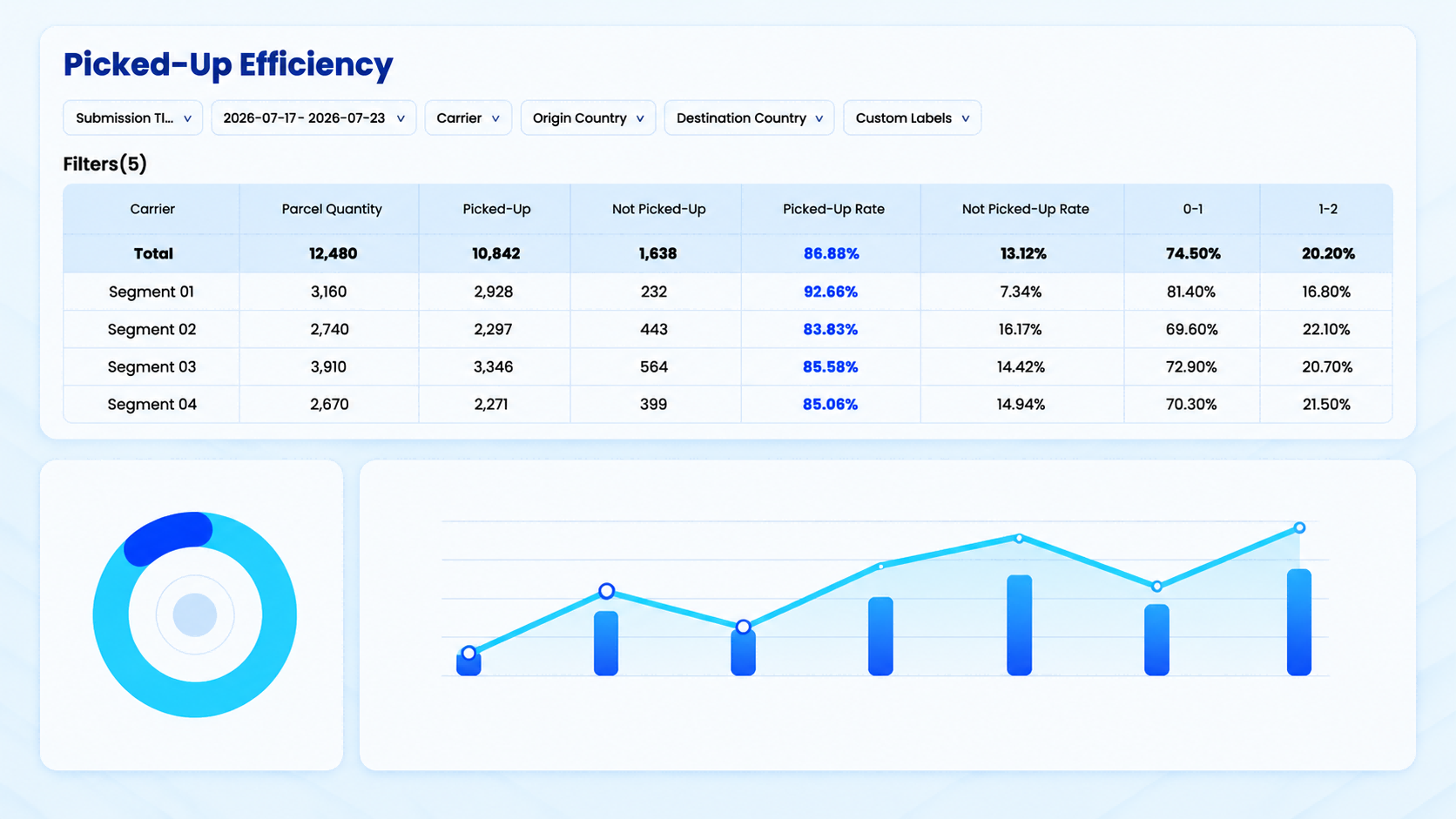
The time to the first tracking event reflects a carrier’s operational efficiency in parcel collection, sorting, and the initial stages of transportation.
By comparing this metric across carriers, service types, origin countries, and destination countries, businesses can identify differences between shipping channels and use the findings to support carrier selection, performance reviews, and contract renewals.
For businesses operating their own warehouses or forward-deployed warehouses, this metric can also help identify potential delays in tracking information entry and warehouse handoffs, supporting improvements to internal processes.
Delivery Event Metrics: Measure Performance Against Delivery Commitments
Delivery time statistics help businesses assess whether orders are delivered within the promised timeframe, directly affecting customer experience and logistics service quality.
Products, shipping routes, and delivery commitments vary between businesses, so a single calculation method may not fit every operation. The 17TRACK analytics dashboard supports configurable transit time calculations and time ranges, allowing businesses to define metrics around their requirements and compare actual performance with delivery commitments.
Businesses can also use time to delivery as a performance metric for carriers and last-mile delivery services to identify recurring delivery efficiency issues.
3. Tracking Data Quality Monitoring: Assess Timeliness and Completeness
The timeliness and completeness of tracking data affect customer experience, transaction security, and business decisions.
Long gaps between tracking updates can cause customer concern and make it difficult for businesses to assess a package’s shipping progress. Missing key milestones can also affect how platforms evaluate sellers’ logistics service quality.
The 17TRACK analytics dashboard helps businesses assess tracking data quality through tracking update timeliness and carrier milestone completeness metrics.
Tracking Update Timeliness: Identify Information Gaps Earlier
Tracking update timeliness measures how promptly carriers and tracking service providers update tracking information.
When a package has no new tracking events for an extended period, businesses need to determine whether this reflects a normal reporting delay or an actual interruption in transit. Comparing tracking update performance across carriers helps teams identify irregularities and investigate the affected shipments.
Tracking update timeliness is affected by factors such as carrier operations and service stability. 17TRACK continues to improve the relevant processes.
Carrier Milestone Completeness: Improve Tracking Data Quality
Carrier milestone completeness measures the availability of records for key events such as pickup, departure, customs clearance, and delivery attempts. It helps businesses assess how fully the tracking data represents a package’s journey.
For platforms, this metric can also help improve tracking rate metrics, assess the quality of seller-provided tracking IDs, and identify missing information in shipping records. Tracking IDs with incomplete information can affect tracking quality and may also indicate potential fraud risk.
For example, whether a carrier correctly transmits key information such as postal codes can affect a platform’s ability to assess the authenticity of shipping records. Analyzing milestone and related data completeness helps platforms identify unusual or incomplete tracking records that warrant further risk review.
4. Shipping Exception Monitoring: Identify Issues Proactively to Reduce Losses and Complaints
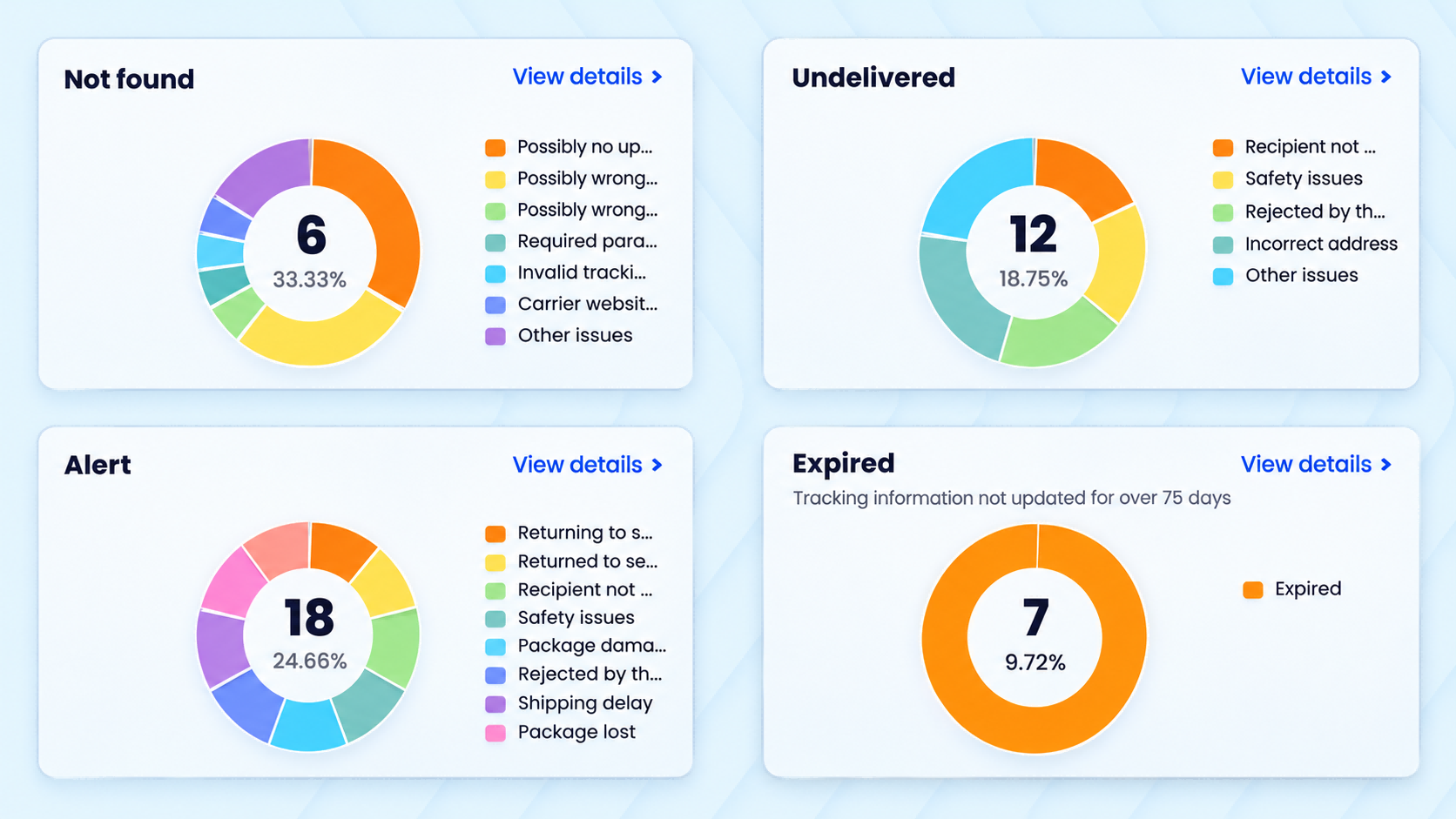
Shipping exceptions and failed deliveries can prevent successful delivery, increase the risk of shipment losses and refund disputes, and affect customer satisfaction.
For businesses managing large shipment volumes, checking each shipment manually makes it difficult to identify emerging patterns of problems promptly.
The 17TRACK analytics dashboard provides shipping exception and failed delivery statistics, giving businesses an overview of affected shipments and helping teams identify packages that need attention.
Shipping Exception and Failed Delivery Statistics: Identify Shipments That Need Attention
By aggregating shipping exception and failed delivery data, businesses can identify recurring problems in the shipping process and examine the related shipments.
17TRACK also uses intelligent models to analyze tracking events for affected shipments, helping businesses locate problems and handle exceptions more efficiently.
Key benefits:
- Reduce potential losses and complaints: Identify shipping exceptions and failed deliveries promptly to help reduce potential losses and refund disputes associated with lost or undeliverable packages.
- Intelligent cause analysis: Analyze tracking events for affected shipments to help locate problems and improve handling efficiency.
5. 17TRACK API: Turn Global Shipment Tracking Data into Business Insights
The value of shipping analytics lies in identifying problems, recognizing trends, and supporting business decisions, rather than simply accumulating more raw records.
17TRACK API connects to 3,600+ carriers worldwide, retrieving and consolidating tracking data across shipping channels to analyze transit times, tracking data quality, and shipping exceptions.
The analytics dashboard presents these findings in an accessible format. Businesses can use it to understand carrier service performance, tracking data quality, and exceptions, then apply the findings to carrier performance reviews, logistics service management, platform tracking rate improvements, and risk management.
17TRACK provides more than shipment tracking data. It helps businesses gain insights from large volumes of tracking events. By retrieving, consolidating, and analyzing data, businesses can move beyond “Where is the package?” to understand “How is our shipping performing?” and “Where are problems concentrated?” These findings support logistics management and operational improvements.
Make Shipping Data a Foundation for Business Decisions
From transit times and tracking data quality to shipping exceptions, the value of shipping data extends well beyond checking a package’s location.
By retrieving, consolidating, and analyzing global shipping data, 17TRACK API helps businesses uncover useful information within large volumes of tracking events and turn it into insights that support business decisions.