Transport Package
What Is a Transport Package?
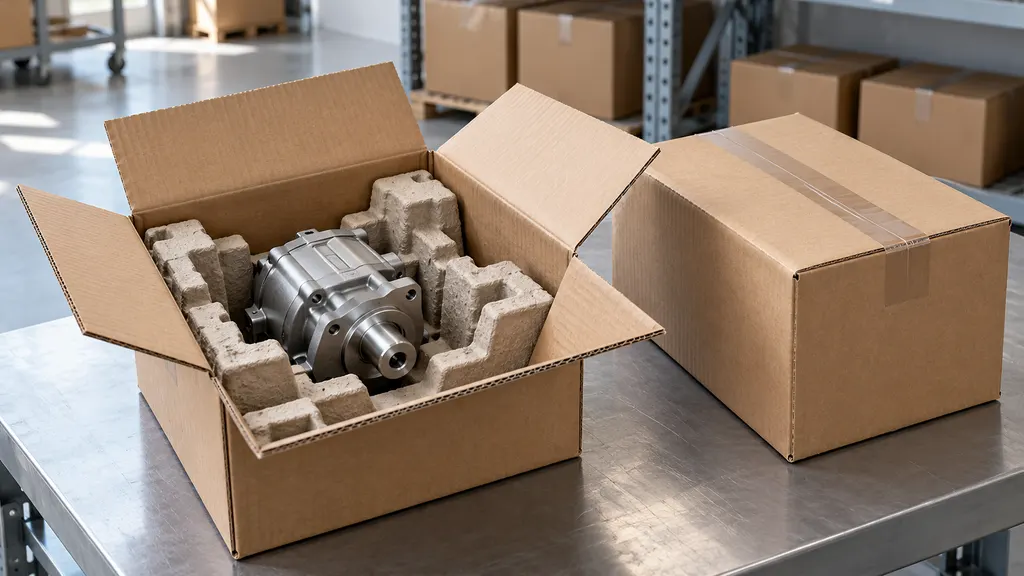
A transport package is a prepared unit of goods and protective packaging intended to be handled, stored, and moved through a distribution system. In logistics, it can be a shipping carton containing an ecommerce order, a crate holding machinery, or another packed unit prepared for carriage. Its purpose is to contain the goods, protect them against expected transport conditions, and make handling and identification possible.
The related term transport packaging usually refers to the packaging materials and components rather than the complete packed unit. Usage varies between commercial documents, packaging standards, and regulations. In dangerous goods transport, for example, the distinction between a package and its packaging has a specific regulatory meaning. The applicable definition should therefore be checked when the term appears in a compliance document.
What a Transport Package Includes
A transport package is more than an outer box. Depending on the goods and distribution route, it may combine an outer enclosure, internal protection, closures, and information needed for handling or delivery. These elements function together: a strong carton cannot compensate for an item that moves freely inside it, and suitable cushioning cannot prevent a poorly secured closure from opening.
- Outer enclosure: A carton, crate, sack, drum, or other receptacle selected for the contents and handling conditions.
- Internal protection: Dividers, cushioning, blocking, liners, or other components that separate, support, or protect the goods.
- Closure and securing components: Tape, straps, fasteners, or other means of maintaining package integrity.
- Identification and instructions: Shipping labels, handling marks, and any required regulatory markings or labels.
Not every package needs every component. A non-fragile item may require relatively little internal protection, while a sensitive instrument may need a closely fitted support system. Packaging selection should follow the characteristics of the actual product rather than its appearance or selling price alone.
Related Terms and Important Distinctions
Several terms overlap in ordinary shipping language. The following distinctions help explain their different roles without implying that every organization uses them identically.
| Term | Main meaning | Relationship to a transport package |
|---|---|---|
| Transport packaging | Packaging used to facilitate handling and transport and help prevent damage. | Usually describes the protective system or materials rather than the filled unit. |
| Sales or primary packaging | Packaging forming a sales unit for the final user or consumer. | May sit inside a transport package, although one enclosure can sometimes serve both purposes. |
| Grouped or secondary packaging | Packaging that groups sales units together. | May be enclosed by transport packaging; terminology depends on the classification being used. |
| Parcel | An individual item handled through a parcel delivery service. | A transport package may be shipped as a parcel, but transport packages also include units outside parcel services. |
| Shipment | Goods dispatched together under a particular shipping arrangement. | One shipment may contain one or several transport packages. |
| Unit load | Items assembled so they can be handled as one load. | Several packages secured to a pallet can form a unit load. |
| Freight container | Transport equipment used to carry cargo. | It can hold transport packages but is not automatically classified as packaging. |
European Union packaging legislation uses transport packaging, also called tertiary packaging, for packaging designed to facilitate handling and transport of sales units or grouped sales units. That definition excludes road, rail, ship, and air containers. This is a regulatory classification, not a rule that every third physical layer of material is necessarily transport packaging.
How Transport Packages Are Used in Logistics
Order preparation and dispatch
During fulfillment, goods are selected from inventory and assembled into one or more packed units. The packing decision determines which items can travel together, what protection is necessary, and how each unit will be identified. An order and a package are not the same thing: one customer order may require separate packages because of product dimensions, compatibility, or dispatch arrangements.
For example, a retailer may place a boxed kitchen appliance inside a shipping carton with fitted protective inserts. The appliance's retail box remains its sales packaging, while the outer carton and inserts provide additional transport protection. If the retail box is itself designed and evaluated for direct shipment, a separate outer carton may not be necessary.
Handling, storage, and carriage
A package may encounter lifting, conveyor transfers, stacking, vibration, impacts, or changes in environmental conditions. The relevant hazards depend on the distribution system. A parcel moving through automated sorting equipment and a crated machine moved by forklift do not require identical packaging designs.
Protection must also be considered at the load level. Individually adequate cartons can still be damaged if a pallet is unstable or if stacked loads exceed what the packages can support. Conversely, a stable pallet does not establish that each carton is suitable for separate parcel handling after the load is broken down.
Delivery and returns
At receipt, the transport package provides a physical unit that can be counted, inspected, and associated with shipping records. Damage to the outer packaging may justify closer inspection, but it does not by itself establish that the contents are damaged. Similarly, an apparently intact exterior does not prove that the goods are unaffected.
For returns, the original packaging should be reassessed rather than automatically reused. Torn corrugated board, crushed protective inserts, missing components, or weakened closures can change its protective performance. Reuse is a condition-dependent decision, not a guarantee provided by the fact that the package survived the outbound journey.
Selecting and Evaluating a Transport Package
Package design is a product-and-route decision. The following workflow describes practical assessment steps rather than a universal regulatory classification.
- Describe the contents. Establish dimensions, mass, fragility, exposed surfaces, and any sensitivity to moisture, temperature, leakage, or movement. Identify whether special transport rules apply.
- Describe the distribution environment. Determine whether the goods will move as individual parcels, palletized freight, or another handling unit. Consider transfers, storage, stacking, and the conditions expected along the route.
- Select the containment and protection system. Choose an enclosure, internal supports, and closures that work together. Avoid unsupported assumptions that a larger box or more cushioning always provides better protection.
- Check handling and identification. Confirm that the package can be lifted or mechanically handled as intended and that labels remain visible and attached. Handling instructions should supplement suitable construction, not replace it.
- Evaluate the packed configuration. Assess the actual combination of product and packaging. Where testing is appropriate, select a procedure relevant to the distribution environment and acceptance criteria.
- Review changes. Reconsider suitability when the product, packaging material, packing method, load configuration, or transport route changes.
The International Safe Transit Association publishes test procedures for evaluating packaged products against specified distribution hazards. Such testing concerns the selected configuration and procedure; it is not a promise that damage is impossible on every journey. A test result for one product and packaging combination should not automatically be extended to different contents or a substantially different configuration.
Cross-Border and Regulated Transport Considerations
Cross-border shipments may involve additional handling stages and packaging-related requirements. The relevant obligations depend on the goods, materials, route, and jurisdictions. Ordinary packaging suitability, dangerous goods compliance, and plant-health requirements are separate questions; satisfying one does not establish compliance with the others.
Wood packaging material
Wooden pallets, crates, and dunnage can fall within the scope of the International Plant Protection Convention's ISPM 15, which addresses wood packaging material in international trade. Its scope includes specified raw-wood packaging material and excludes certain materials, including wood processed in ways described by the standard. Applicable import requirements should be checked rather than assuming that every wooden component requires the same treatment or marking.
Dangerous goods packages
Under the United States hazardous materials definitions in 49 CFR 171.8, a package is the complete product of the packing operation, consisting of the packaging and its contents prepared for transportation. Packaging refers to the receptacle and other components or materials necessary for containment and compliance with the relevant minimum packing requirements.
This distinction matters because an ordinary shipping carton is not automatically suitable for regulated dangerous goods. Applicable requirements may concern permitted packaging, compatibility, closures, quantity limits, testing, and hazard communication. The requirements must be determined for the particular material and transport circumstances rather than inferred from a general glossary definition.
Practical Inspection Points
Before dispatch, an operational check can identify visible problems. It does not replace required testing or regulatory verification, but it can help confirm that the intended packaging system has actually been assembled.
- Confirm that the enclosure has no obvious tears, punctures, deformation, or other damage affecting its intended function.
- Check that the contents are supported as designed and that required inserts, dividers, or protective components are present.
- Verify that closures and securing components have been applied according to the relevant packing instructions.
- Ensure that shipping information corresponds to the packed unit and that obsolete labels will not create conflicting routing information.
- Where packages form a unit load, inspect the load arrangement and securing method as well as the individual packages.
- Check any material-specific or goods-specific requirements separately, including applicable wood packaging and dangerous goods provisions.
QA
Is a transport package the same as a cardboard box?
No. A cardboard box can be one component of a transport package. The complete packed unit includes the goods and any internal protection, closures, and other necessary components. Transport packages can also use materials and forms other than cardboard.
Can one ecommerce order have several transport packages?
Yes. An order is a commercial record, while a transport package is a physical packed unit. A retailer may divide an order into several packages to accommodate the goods or dispatch arrangements.
Is a pallet a transport package?
A pallet alone is a load-supporting platform. Packages secured on it can form a unit load. Whether a complete palletized configuration is described as a package depends on the applicable standard, regulation, or operational terminology.
Does transport packaging guarantee protection against damage?
No. Protection depends on the packaging design, product characteristics, assembly, condition, and transport environment. Evaluation can provide evidence of suitability under specified conditions, but it cannot guarantee every delivery outcome.
Sources
- European Union: Regulation (EU) 2025/40 on packaging and packaging waste — Definitions of sales, grouped, and transport packaging, including the exclusion of transport containers.
- Electronic Code of Federal Regulations: 49 CFR 171.8 — Definitions of package and packaging in United States hazardous materials transportation regulations.
- International Plant Protection Convention: ISPM 15 — Scope and phytosanitary requirements concerning wood packaging material in international trade.
- International Safe Transit Association: Test Procedures — Packaged-product testing and the selection of procedures addressing distribution hazards.