Sorting and Picking System
What Is a Sorting and Picking System?
A sorting and picking system is an arrangement of workers, equipment, software, and operating procedures used to retrieve goods from storage and separate or direct them into the groups required for fulfillment or further handling. In warehouses and ecommerce fulfillment centers, picking selects the items needed for an order, while sorting organizes items, containers, or parcels by order, destination, or another operational rule.
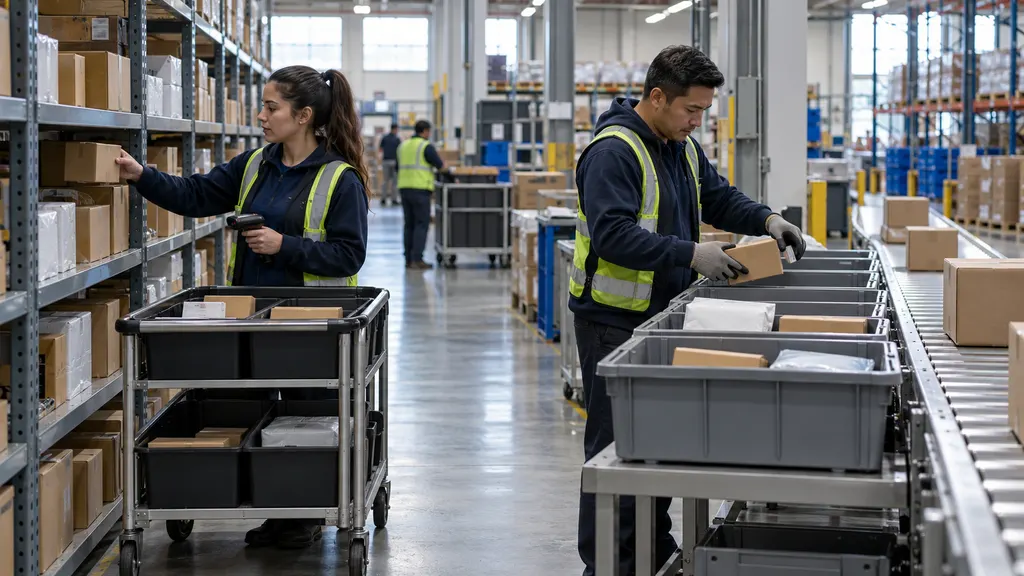
The phrase describes a combination of warehouse functions rather than one universally standardized machine or system design. It can refer to a manual operation using carts and labeled bins, a partly automated arrangement using scanners and conveyors, or an integrated installation with automated storage equipment and sorters. Its meaning should therefore be interpreted from the workflow and the unit being handled.
Picking, Sorting, and Related Operations
Picking and sorting are closely connected, but they perform different tasks. Picking answers which goods and quantities must be retrieved. Sorting answers where each retrieved item or handling unit should go. Depending on the operating method, sorting may occur during picking, after picking, or at several points before dispatch.
| Operation | Main purpose | Illustrative warehouse activity |
|---|---|---|
| Picking | Retrieve the required goods and quantities from inventory. | A worker takes two units of a product from a storage bin. |
| Sorting | Separate or direct goods according to an assigned rule. | Items picked together are distributed into individual customer-order bins. |
| Consolidation | Bring together components that belong to the same order or shipment. | Items arriving from different warehouse zones are combined before packing. |
| Packing | Prepare goods in suitable packaging for shipment. | A completed order is placed in a carton with protective material. |
| Shipping sortation | Direct prepared shipments toward their next transport movement. | Labeled parcels are routed to designated carrier collection lanes. |
Sortation is commonly used for the controlled routing of items or handling units, particularly with mechanical equipment. Sorting is a broader word that also covers manual separation. In practice, the terms may overlap; their use does not by itself establish a particular automation level.
Position in the Fulfillment Process
A sorting and picking system sits between available inventory and the downstream preparation or movement of orders. It depends on accurate storage locations, identifiable goods, and instructions describing what must be retrieved. Its outputs may be completed order bins, replenished workstations, consolidated cartons, or parcels directed toward dispatch.
In ecommerce, one order may contain several products stored in different locations. The system must preserve the relationship between each item, its quantity, and the order to which it belongs. A picking task is not necessarily the same as a customer order: one task may cover several orders, while one order may generate tasks in several warehouse zones.
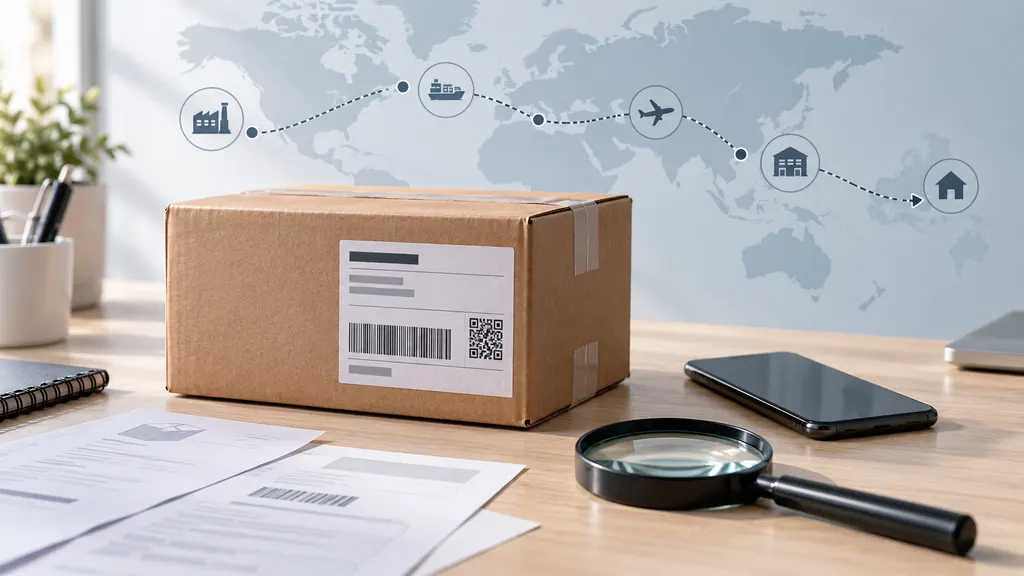
In cross-border fulfillment, picking remains a physical inventory operation. Sorting rules may additionally separate orders by destination country, service, or processing requirement. These rules do not replace customs declarations, product classification, or regulatory checks. Physical routing must remain consistent with the shipment records and documentation prepared elsewhere in the fulfillment process.
How a Sorting and Picking System Works
The exact sequence depends on the facility. The following workflow illustrates an order-fulfillment operation in which goods are picked from stock and then prepared for shipment.
- Release work. Order requirements are translated into executable tasks. The operation determines which inventory locations, quantities, and handling instructions apply.
- Assign resources. Tasks are directed to workers, workstations, or automated equipment. Routing and grouping decisions may consider storage layout, order priority, and available capacity.
- Retrieve goods. Required units are removed from storage. Confirmation may use barcode scanning, voice instructions, light-directed displays, or other identification methods.
- Maintain identity. Retrieved items remain associated with an order, tote, carton, or task. Where goods from multiple orders travel together, the process must retain enough information to separate them correctly later.
- Sort and consolidate. Goods are directed into the appropriate order containers or downstream destinations. Items from separate zones may be brought together before packing.
- Check completion. The operation verifies whether the required items and quantities have arrived. Shortages, unidentified items, or conflicting records require exception handling.
- Transfer downstream. Completed work moves to packing, staging, or dispatch. Relevant task and inventory records are updated according to the facility's system design.
Not every installation contains a separate sorting stage. For example, a worker who places each picked item directly into its assigned order compartment performs picking and order separation together. Conversely, a batch-picking operation may collect goods into shared containers and require a distinct downstream sorting step.
Common Operating Arrangements
Picking methods describe how retrieval work is organized. They should not be confused with automation levels: a method can be supported by different combinations of people and equipment, and several methods can coexist in one facility.
| Arrangement | How work is organized | Relationship to sorting |
|---|---|---|
| Discrete order picking | A picking assignment handles one order at a time. | Order identity is maintained during retrieval, although later consolidation may still be needed. |
| Batch picking | Goods for multiple orders are retrieved together. | Items need allocation to individual orders during or after retrieval. |
| Zone picking | Picking responsibilities are divided among defined warehouse areas. | Goods or order containers may move between zones, or separately picked items may be consolidated. |
| Cluster picking | Several orders are picked on one trip using separate containers or compartments. | Items are separated into their assigned orders as they are picked. |
| Wave-based release | Work is released in planned groups according to scheduling rules. | Sorting and packing capacity must accommodate the released workload. |
Wave-based release concerns timing and coordination rather than the physical retrieval method itself. It may be combined with batch, zone, or other picking arrangements. Likewise, goods-to-person describes how stock reaches a workstation; it does not, by itself, specify how completed orders are sorted.
Equipment, Software, and Identification
A system may use shelving, carts, totes, conveyors, chutes, barcode readers, light-directed locations, automated storage and retrieval equipment, or robotic transport. Equipment selection depends on the goods and workflow. A conveyor suitable for rigid cartons is not automatically suitable for loose garments, irregular objects, or fragile products.
A warehouse management system can maintain inventory locations and coordinate fulfillment tasks. In automated facilities, execution and control software may also coordinate work release, equipment movement, and destination assignments. The boundaries between these software functions vary by implementation; a particular software label does not guarantee a fixed set of capabilities.
Identification connects physical movement with digital records. A product identifier establishes what an item is, while a tote or other handling-unit identifier can link a group of goods to a task or destination. GS1 standards provide identification and barcode frameworks, but a barcode alone does not determine the warehouse's routing logic or confirm that the correct quantity was physically handled.
Design Conditions and Operational Checks
The suitability of a sorting and picking system depends on the work it must perform, not simply on whether it is automated. Important evaluation conditions include the following:
- Order profile: Examine items per order, units per line, demand variation, and the extent to which different orders request the same products.
- Physical characteristics: Check dimensions, weight, fragility, packaging stability, and any restrictions on handling or mixing goods.
- Inventory availability: Confirm that replenishment can keep picking locations supplied. Empty pick locations can interrupt work even when downstream equipment has spare capacity.
- Destination capacity: Check the number and availability of sorting positions, order bins, consolidation spaces, and packing stations.
- Identification quality: Verify that labels remain readable and that item, container, and destination records agree.
- Exception routes: Define what happens to damaged goods, unexpected items, unreadable labels, full destinations, and incomplete orders.
- Safety and access: Evaluate manual lifting, repetitive movement, pedestrian interaction with equipment, and safe access for maintenance or blockage removal.
Performance measures also require clear definitions. Picking accuracy, sorting accuracy, throughput, order completion time, and exception frequency describe different aspects of operation. An equipment throughput figure does not establish end-to-end fulfillment capacity: replenishment, consolidation, packing, or dispatch may constrain the overall process. Comparisons are meaningful only when the measurement boundaries, workload, and error definitions are comparable.
Illustrative Ecommerce Example
A retailer may release several orders containing overlapping products. Instead of making a separate retrieval trip for every order, a worker collects the combined quantities into a shared tote. At a sorting station, items are identified and placed into compartments assigned to individual orders. Once the required contents of an order are present, that order moves to packing.
If an expected item is missing, the affected order can be held for investigation while other completed orders proceed, provided the workflow supports that separation. After packing, parcels may undergo another sort by dispatch destination. This later parcel sort handles shipments rather than the individual product units handled at the order-sorting stage.
QA
Does a sorting and picking system have to be automated?
No. It can be manual, partly automated, or extensively automated. The defining functions are retrieving required goods and directing or separating them appropriately.
Does sorting always happen after picking?
No. Order separation can happen during picking, as with compartmented carts, or afterward at a dedicated sorting station. Additional sorting may occur after packing.
Is a warehouse management system the same as a sorting and picking system?
No. A warehouse management system is software that can coordinate inventory and warehouse tasks. A sorting and picking system includes the physical workflow, people, equipment, and supporting software.
Does destination sorting complete customs clearance?
No. Sorting goods or parcels by destination is a physical routing activity. Customs declarations and regulatory requirements remain separate responsibilities.
Sources
- Bartholdi and Hackman, Warehouse & Distribution Science — Warehouse operations, order-picking arrangements, material flow, and system design.
- De Koster, Le-Duc, and Roodbergen, Design and Control of Warehouse Order Picking: A Literature Review — Academic treatment of picking methods, batching, zoning, routing, and operational coordination.
- GS1: Barcodes — Identification and machine-readable data capture in supply-chain operations.
- Occupational Safety and Health Administration: Warehousing — Warehouse safety considerations, including material handling and ergonomic hazards.