Shippable Christmas Food Gifts 2026: What Ships Well and Last Days to Order
For Christmas 2026, the safest food gifts to ship are shelf-stable products, sturdy baked goods, and items designed for parcel delivery. Fresh, frozen, and temperature-sensitive gifts can also work, but they require validated packaging, a delivery service with an appropriate transit time, and a larger holiday buffer. Because carriers have not necessarily published their 2026 holiday schedules yet, the last day to order should be calculated from the promised delivery date rather than guessed from a calendar.
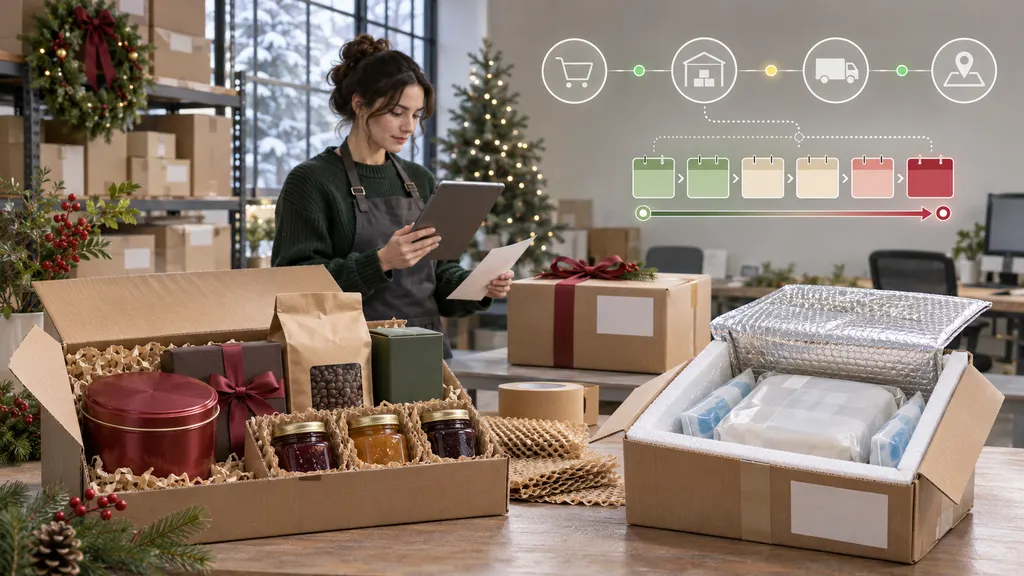
This guide helps shoppers, gift senders, and ecommerce teams choose food that can tolerate handling, understand when to place an order, and reduce the risk of a late, damaged, or unsafe delivery.
The best Christmas food gifts for parcel shipping
A good shipped food gift has three characteristics: it remains safe without constant refrigeration, it is unlikely to break or leak, and its quality does not depend on arriving at an exact hour. Products with these characteristics are more forgiving when a parcel is delayed by weather, peak-season volume, or a missed delivery attempt.
| Gift type | Shipping fit | Main precautions |
|---|---|---|
| Tea, coffee, cocoa, spices, and drink mixes | Very good | Use sealed packaging and protect glass containers. |
| Hard candies, chocolate bars, and packaged snacks | Good in cool conditions | Heat and crushing can affect quality; avoid unprotected chocolate in warm weather. |
| Cookies, biscotti, fruitcake, and other firm baked goods | Good | Choose low-moisture products and prevent movement inside the box. |
| Jams, sauces, honey, and preserves | Good with careful packing | Seal each jar, cushion it, and place it in a leak-resistant inner bag. |
| Cheese, smoked foods, meal kits, and frozen desserts | Conditional | Confirm the seller’s cold-chain method, delivery window, and receiving instructions. |
| Fresh seafood, raw meat, and highly perishable foods | High risk | Use only a documented temperature-controlled service and follow food-safety instructions. |
Shelf-stable gifts are the most reliable choice
Coffee, tea, spices, packaged biscuits, roasted nuts, sealed candy, dry baking mixes, and unopened specialty ingredients usually offer the simplest holiday shipping experience. They do not require an ice pack or a guaranteed same-day handoff, and the recipient can often accept the parcel without being at home immediately.
Check the product label before buying. A food that is commercially sealed and shelf-stable is a different shipping proposition from a homemade item containing cream, custard, fresh fruit, or another ingredient that requires refrigeration. If the seller does not clearly state storage requirements and best-before information, ask before ordering.
Baked goods need structure, not just padding
Firm cookies, biscotti, crackers, dense cakes, and similar products generally travel better than soft pastries or frosted desserts. Separate layers with food-safe paper, place fragile pieces in a rigid container, and fill empty space so the contents cannot slide. The shipping carton should be strong enough for stacking and should not be much larger than the gift.
Avoid relying on a label such as “fragile” as the main protection. Parcel networks use automated handling and packages may be placed under other cartons. The packaging must protect the food even when the box is turned, compressed, or exposed to ordinary transit vibration.
Perishable gifts require a delivery plan
Fresh and frozen gifts are not automatically unsuitable, but they leave less room for error. The seller should identify the required temperature range, the expected transit time, the refrigerant or insulation used, and what the recipient should do when the parcel arrives. The U.S. Department of Agriculture advises consumers to keep perishable foods cold and to avoid leaving them at room temperature for extended periods; its mail-order food guidance is a useful reference for both senders and recipients.
For a perishable gift, choose delivery to an address where someone can receive it. Do not schedule arrival immediately before a weekend or a long holiday absence unless the seller specifically designs the service for that situation. If a seller cannot explain how it handles a carrier delay, select a shelf-stable alternative.
How to calculate the last day to order for Christmas 2026
There is no single safe cutoff for every gift, destination, or carrier service. The practical calculation is:
Last safe order day = required delivery date − advertised transit time − seller processing time − holiday buffer.
Use the seller’s stated processing time, not only the carrier’s transit estimate. A product that takes two business days to prepare cannot meet the same cutoff as an item that is packed the day it is ordered. Add extra time when the destination is remote, the parcel crosses a border, the item is perishable, or the delivery date is non-negotiable.
- For shelf-stable gifts: order as soon as the gift is chosen, and leave several business days beyond the carrier’s published estimate where possible.
- For made-to-order baked goods: add the seller’s production queue to the transit estimate. Holiday production capacity may be more limiting than the carrier service.
- For refrigerated or frozen gifts: use the seller’s recommended order window and request a delivery date that gives the recipient time to receive the package.
- For international shipments: add time for customs processing and check whether the destination permits the specific food category.
The U.S. Postal Service, UPS, and FedEx publish holiday service information through their official websites. Their 2026 dates should be checked when released, and the relevant origin, destination, service level, and holiday exclusions should be reviewed together. A general “Christmas cutoff” from a blog or previous year is not a substitute for the carrier’s current schedule.
A practical Christmas ordering timeline
| Planning point | What to do |
|---|---|
| Before the holiday season | Confirm the recipient’s address, dietary restrictions, storage needs, and whether someone can receive the parcel. |
| When the 2026 schedule is published | Compare the seller’s processing time with the carrier’s service-specific holiday cutoff. |
| Several weeks before Christmas | Place orders for popular, made-to-order, international, or temperature-sensitive gifts. |
| One to two weeks before Christmas | Use an in-stock, shelf-stable product and select a service with a visible delivery commitment. |
| After the normal cutoff | Ask the seller about available expedited services instead of assuming an upgrade guarantees delivery. |
Packaging checks before a food gift leaves
- Use food-safe primary packaging that is closed and intact.
- Wrap jars, bottles, and other rigid containers individually so they cannot strike one another.
- Add an absorbent or leak-containment layer where a breakage risk exists.
- Fill voids with cushioning that prevents movement without crushing the food.
- Use insulation and refrigerant only when the seller or packer has selected them for the product and transit conditions.
- Put the recipient’s name, address, and a contact number inside the parcel as well as on the label.
- Avoid including loose ice, unprotected liquids, or decorations that can contaminate the food.
Freight packaging principles also matter for small parcels: protect the contents first, stabilize the load, and select a carton that can withstand normal distribution handling. A decorative gift box can be placed inside a protective shipping carton rather than used as the only outer package.
Tracking and delivery follow-up
Send the tracking number to the recipient when appropriate, especially for a perishable gift. Tracking does not make a parcel arrive faster, but it can reveal an address problem, an attempted delivery, or a delay while there is still time to contact the seller or carrier. For ecommerce orders, a multi-carrier tracking page such as 17TRACK tracking can help a recipient monitor the shipment in one place when the carrier is known or changes during the journey.
If tracking stops updating, check the carrier’s official status page and the seller’s support process before sending a replacement. For food, replacement decisions should consider both the product’s shelf life and its temperature history. Do not consume a perishable item if the packaging is damaged, the product is warm when it should be cold, or the seller’s safety instructions are not satisfied.
A final decision rule
Choose a shelf-stable gift when the delivery date matters more than freshness. Choose a refrigerated or frozen gift only when the seller provides a clear cold-chain plan and the recipient can accept it promptly. For international orders, confirm destination rules before payment. For any order placed near the holiday cutoff, use the seller’s written processing promise, the carrier’s current service information, and a realistic buffer rather than an optimistic estimated arrival date.
FAQ
What food gifts are safest to ship for Christmas?
Commercially packaged, shelf-stable foods such as tea, coffee, spices, sealed snacks, hard candy, and firm baked goods are usually the most forgiving. They can tolerate a longer transit window than foods that require refrigeration.
When is the last day to order Christmas food gifts in 2026?
The date depends on the seller’s processing time, the destination, the selected service, and the required arrival date. Calculate the cutoff from those factors and verify the carrier’s official 2026 holiday schedule when it is published. Perishable and made-to-order gifts should be ordered earlier than ordinary in-stock products.
Can frozen food be shipped during the holidays?
Yes, but only when the seller has an appropriate insulated package, refrigerant, transit plan, and delivery procedure. The recipient should be available to receive and store the food promptly.
Should I ship food internationally as a Christmas gift?
International food shipping can involve customs requirements, import restrictions, documentation, and additional transit time. Check the destination’s current rules and the seller’s experience with that route before ordering.
Does package tracking guarantee delivery by Christmas?
No. Tracking provides shipment visibility, but it does not remove carrier delays, weather disruptions, customs holds, or an unavailable recipient. Use tracking to respond quickly to exceptions, not as a substitute for ordering early.