How to Ship Food Overnight: Services, Cutoff Times, and Packing for Freshness
To ship food overnight safely, choose a delivery service with a time-definite next-day option, pack the food in an insulated container with enough coolant for the full transit window, and confirm the carrier’s local acceptance cutoff before you ship. Overnight delivery reduces travel time, but it does not by itself keep food at a safe temperature. The food, packaging, weather, destination, pickup time, and carrier handling all affect the result.
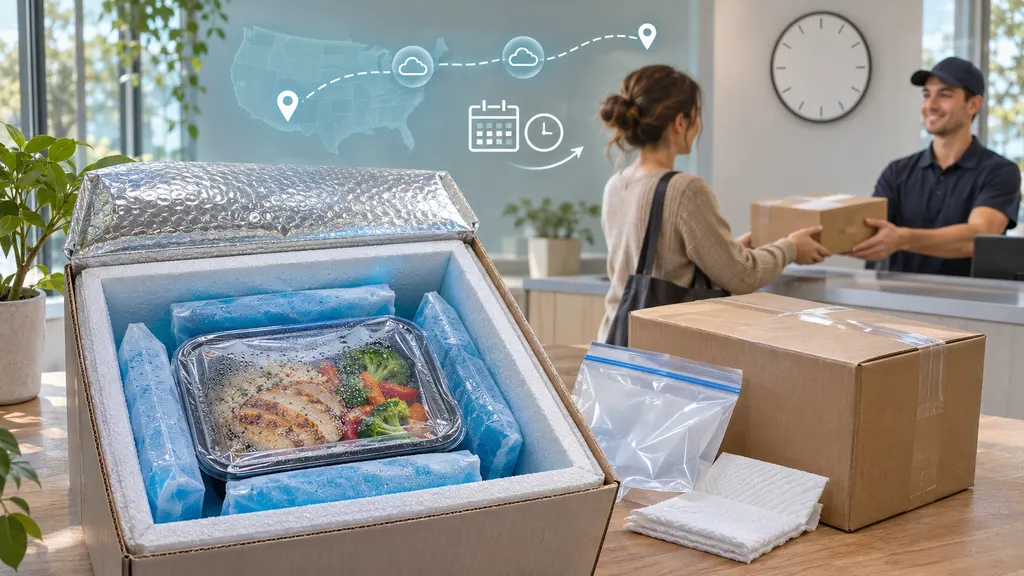
This guide is intended for U.S. domestic shipments of perishable and shelf-stable food. Carrier rules, service availability, delivery commitments, and cutoff times vary by origin ZIP Code, destination, package size, day of the week, and holiday schedule. Check the carrier’s current service information for the exact shipment before paying for postage.
Choose the right food before choosing the service
Not every food needs overnight shipping. Shelf-stable items such as sealed snacks, baked goods with low moisture, canned products, coffee, tea, and many dry ingredients may travel by a slower service if their packaging and labeling permit it. Perishable foods require more planning because bacterial growth can accelerate when food remains in the temperature danger zone for too long.
Foods that commonly need temperature control include fresh meat, poultry, seafood, dairy products, prepared meals, some desserts, and foods containing cream or custard. Fresh produce varies widely: whole, sturdy produce may tolerate ordinary parcel transit, while cut fruit, leafy greens, and prepared salads need more careful temperature management. If a product is regulated, medically sensitive, alcoholic, frozen, or subject to import controls, review the applicable rules before accepting an order.
For a home shipment, the sender is responsible for deciding whether the food can tolerate the expected transit conditions. A next-day label is not a substitute for a validated packing method. The U.S. Food and Drug Administration’s food-safety guidance is a useful starting point for handling and temperature decisions; commercial shippers may also need documented procedures and a food-safety plan.
Which overnight services can you use?
Major carriers offer time-definite services that may support next-business-day delivery in eligible lanes. Examples include FedEx Priority Overnight, UPS Next Day Air, and USPS Priority Mail Express. These services are not interchangeable: their delivery windows, Saturday options, guarantees, geographic coverage, packaging rules, and claims policies can differ.
| Service type | Useful when | Check before shipping |
|---|---|---|
| Time-definite overnight parcel service | The package must arrive on the next business day and the origin and destination are within the service area. | The exact delivery commitment, Saturday availability, remote-area rules, and late-acceptance options. |
| Priority express postal service | You need an express postal option and the destination is eligible for the selected commitment. | The published commitment, acceptance time, weekend treatment, and rules for perishables or dry ice. |
| Same-day or local courier | The delivery radius is local and the food is highly time-sensitive. | Service area, temperature controls, proof of delivery, and contingency plans. |
The best choice is not always the service with the earliest advertised arrival. A late pickup on Friday, a destination that is not served on Saturday, or a package sent before a holiday can add non-transit time. Compare the complete route from handoff to delivery, not just the name of the service.
How carrier cutoff times work
A cutoff time is the latest time a carrier or approved drop-off location accepts a shipment for a particular service and operating day. It is not necessarily the same as the closing time shown on a storefront. A staffed counter may stop accepting express parcels earlier than the location closes, and a package placed in a drop box may not receive its first scan until the next pickup.
Before shipping, confirm these points:
- Whether the service is available from your origin ZIP Code to the destination ZIP Code.
- The latest acceptance time at the specific carrier facility, retail location, or scheduled pickup.
- Whether the cutoff applies to the day you plan to ship or to the next operating day.
- Whether Saturday delivery or Saturday pickup is available and whether it costs extra.
- Whether a holiday, severe weather event, or remote destination changes the commitment.
- Whether the shipment is being tendered to the carrier directly or through a third-party drop-off point.
Use the carrier’s official delivery-time or service-availability tool with the actual origin and destination. Do not rely on a generic “overnight” estimate from a marketplace checkout page. If freshness is critical, ship early in the week so an unexpected delay is less likely to leave the parcel over a weekend. That approach does not remove delay risk, but it can reduce the amount of non-business time in the route.
How to pack food for overnight freshness
1. Prepare the food for transit
Start with food that is fresh, properly chilled, and packaged in a leak-resistant primary container. Seal soups, sauces, marinades, and other liquids in a container designed to resist leakage. Use a separate sealed bag around liquid containers to limit contamination if a closure fails. Do not ship food that has already spent an unsafe amount of time warm and expect cooling packs to make it safe again.
Freeze or chill the product only when that treatment is appropriate for the food. Some foods change texture after freezing, while others benefit from being shipped frozen. If the recipient needs to use the food immediately, include clear storage instructions rather than assuming the recipient knows whether it should be refrigerated, frozen, or discarded.
2. Use an insulated inner container
Place the food inside a purpose-built insulated shipper or a sturdy container lined with suitable insulation. The insulation slows heat transfer; it does not create cold by itself. Select an interior size that leaves enough room for coolant but not so much empty space that the contents move freely.
Put a barrier between coolant and food when direct contact could damage packaging or freeze a product unintentionally. Absorbent material can help contain condensation or a minor leak, but it is not a replacement for a sealed primary package. Arrange the contents so they remain surrounded by cold sources rather than placing all coolant on only one side.
3. Select the coolant for the product
Gel packs are commonly used for chilled shipments because they are easier to handle than dry ice and can maintain a cold environment when used in adequate quantity. They may not keep a product frozen for the entire route. Dry ice can be appropriate for some frozen products, but it introduces carrier, packaging, ventilation, labeling, and regulatory requirements. Dry ice must not be placed in an airtight container because sublimation produces carbon dioxide gas.
Carrier rules for dry ice and other regulated materials depend on the transport mode and destination. Review the current carrier instructions and the U.S. Postal Service rules if using postal service. If you are unfamiliar with dry ice handling, use a qualified packing supplier or a carrier-approved process instead of improvising.
4. Choose the outer box carefully
Use a new or structurally sound corrugated box that can withstand normal parcel handling. The box must be large enough for the insulated container and coolant without forcing the lid open. Seal every seam with pressure-sensitive shipping tape. Do not rely on household gift wrap, string, or a thin grocery bag as the outer packaging.
Place the shipping label on a flat surface and keep it away from seams, condensation, and areas that may be covered by tape. Include the recipient’s phone number when the carrier permits it, plus a clear delivery instruction if the recipient has an approved location for the package. The recipient should know the expected delivery date and should be available to refrigerate or freeze the contents promptly.
A practical overnight packing sequence
- Confirm that the food is suitable for parcel shipping and identify the required storage condition.
- Check the carrier’s current restrictions and the exact service availability for the route.
- Chill or freeze the food as appropriate before packing.
- Seal each food container and place it in a leak-resistant secondary bag or liner.
- Line the insulated shipper and position coolant around the food.
- Fill large voids with suitable packing material so the contents do not shift.
- Close and tape the insulated container, then place it in the outer box.
- Apply the shipping label and any required handling or dry-ice markings.
- Hand the parcel to the carrier before the confirmed cutoff, preferably at a staffed location.
- Send the tracking number and storage instructions to the recipient.
For repeat shipments, test the pack-out before selling or sending valuable food. Use a temperature indicator or data logger when the product’s safety or quality depends on a defined temperature range. Test the longest realistic route, including a delay scenario if possible. A package that arrives cold on a short local route may not perform the same way on a longer route, in hot weather, or when delivery is attempted after the recipient leaves.
Common mistakes that reduce freshness
- Shipping late in the week: A delay can extend the time before the recipient can refrigerate the food.
- Using too little coolant: One small gel pack may not be enough for the product volume, insulation, or weather conditions.
- Leaving empty space: Loose contents can move, damage seals, and create warmer areas inside the package.
- Assuming a delivery promise protects quality: A carrier commitment concerns transportation service, not necessarily the food’s internal temperature.
- Using an airtight container with dry ice: Gas buildup can create a serious packaging hazard.
- Ignoring the recipient’s schedule: A successful delivery is less useful if no one can bring the food inside promptly.
- Failing to plan for exceptions: Weather, address problems, missed delivery attempts, and carrier disruptions can change the route.
What should you do if the package is delayed?
Track the shipment and contact the carrier promptly if the scan history shows an exception or the package misses its expected delivery. Ask the recipient not to taste food that arrived warm, leaking, damaged, or with an uncertain temperature history. When safety is uncertain, follow the guidance of a qualified food-safety authority rather than relying on smell or appearance alone.
For commercial shipments, document the product, pack-out, coolant, handoff time, tracking events, delivery condition, and customer report. This record can help identify whether the problem came from packaging, an unsuitable service commitment, an address issue, or a carrier delay. It also gives you evidence for improving the next shipment without promising customers a result your process has not demonstrated.
FAQ
Can I ship fresh food overnight without dry ice?
Sometimes. Chilled products may be suitable for gel packs and insulation, while frozen products may need a different coolant or a validated frozen pack-out. The answer depends on the food, the required temperature, the package size, and the full transit time. Dry ice is not automatically better; it also creates handling and carrier-rule requirements.
What time should I ship food for overnight delivery?
Ship before the carrier’s confirmed cutoff for the exact location and service. Because cutoffs vary, use the carrier’s official tool or ask the staffed facility rather than relying on a general online estimate. Shipping earlier in the week can reduce the risk of a weekend delay.
Does overnight shipping guarantee that food will arrive safe to eat?
No. Overnight transportation shortens the route but does not guarantee a safe internal temperature. The food must be handled correctly before shipment, packed with appropriate insulation and coolant, accepted on time, and received promptly.
Can I ship frozen food in a regular cardboard box?
A regular box alone is usually not sufficient for temperature-sensitive food. Use an insulated inner shipper inside a strong outer box, with coolant selected for the required condition. The package should also protect against leaks, movement, and ordinary parcel handling.
Should I ship food on Friday?
Friday shipping can create additional risk if the route, service, or destination does not support weekend movement or delivery. If Friday is unavoidable, confirm Saturday handling and delivery, verify the cutoff, and use a pack-out designed for the longest realistic transit period.