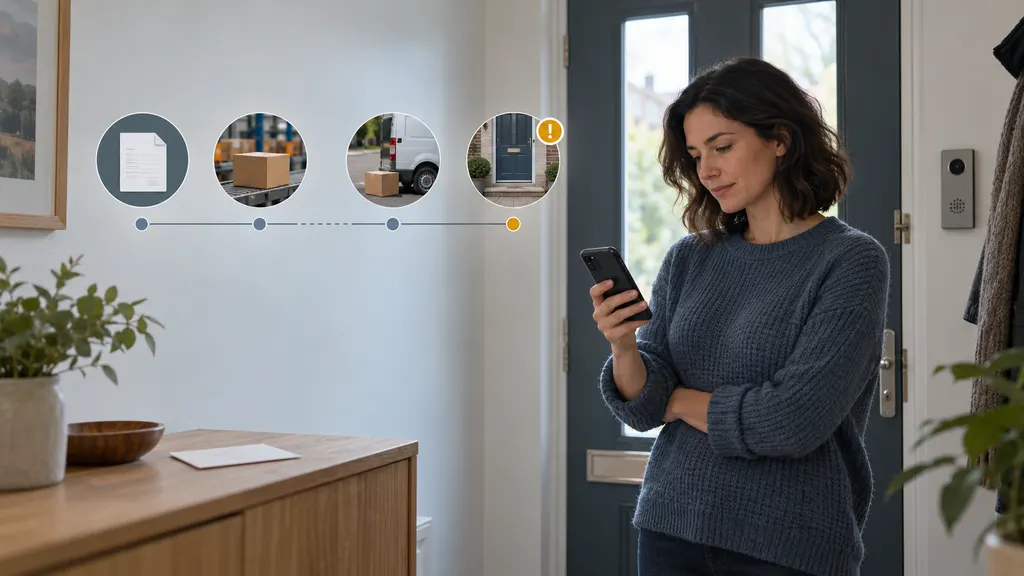
Estimated Delivery Meaning: What the Date Means and When to Worry
Estimated delivery means the date or date range when a seller or carrier expects your package to arrive. It is usually a forecast, not a guarantee. A missed estimate alone does not mean the package is lost. What matters is the latest tracking event, whether anything requires your attention, and whether the shipment has passed the seller’s promised delivery window or the carrier’s published support threshold.

What an estimated delivery date actually tells you
An estimated delivery date answers a practical question: when is this shipment expected to reach its destination? The answer depends on who produced the estimate and what information they had at that moment.
A date shown at checkout may account for order preparation as well as shipping. A date shown in carrier tracking is generally tied to the shipment’s transportation progress. These dates can differ without either necessarily being an error.
For example, a store might show a delivery window before it has packed your order. Later, the carrier may display a different date after receiving the parcel. Compare the wording and source before assuming that the delivery commitment has changed.
- Estimated delivery date: An expected arrival date that may be revised.
- Estimated delivery window: An expected range of dates or hours, rather than one precise arrival time.
- Estimated shipping or dispatch date: When the seller expects to send the order, not when you should receive it.
- Guaranteed delivery: A separate commitment governed by the applicable service terms, eligibility requirements, and exclusions.
The word “estimated” does not create a delivery guarantee. If you paid for a time-definite service, check the actual service terms rather than relying on the appearance of a date in tracking.
Why the estimate can change
A delivery estimate is based on a plan that can become more accurate as the shipment moves. Order processing, carrier acceptance, sorting, transportation, border clearance, and local delivery can all affect that plan.
Not every tracking system uses the same forecasting method. Avoid treating an estimated date as proof that the parcel has reached a particular location. The tracking events provide that context.
Before the carrier receives the package
A seller can create a shipping label before handing over the parcel. A status such as “label created” or “shipment information received” generally indicates that shipping information exists; it does not, by itself, establish that the carrier has physical possession.
If the estimate is approaching but tracking still shows only label information, ask the seller whether the parcel has actually been dispatched. The seller is better placed to verify warehouse processing and handoff than a carrier that has not recorded receipt.
While the package is moving
Once the parcel is in transit, a revised route or operational disruption can change the expected arrival. Weather, transportation interruptions, sorting delays, and address problems are possible explanations, but do not assume a specific cause unless the tracking record or support team confirms it.
A period without a new scan does not automatically mean that the package has stopped moving. Tracking records show reported events, not a continuous live location. Equally, an unchanged delivery estimate is not proof that the original schedule remains achievable.
During international shipping
Cross-border shipments may involve customs processing and a handoff to a destination delivery operator. These stages can make the original estimate less dependable, particularly if clearance or the handoff takes longer than expected.
Look for a request for documents, address information, or payment rather than assuming every customs-related status requires action. If you receive a payment message, verify it through the carrier’s official website or another trusted channel before entering personal or payment details.
Read the date together with the tracking status
The delivery date is useful, but the latest event usually tells you more about what to do next. Carrier wording varies, so use these interpretations as a guide rather than a universal status dictionary.
| What you see | What it tells you | What to do |
|---|---|---|
| Label created | Shipping details have been generated; carrier possession may not yet be confirmed. | Check the seller’s dispatch window and ask about handoff if that window has passed. |
| In transit | The shipment is in the transportation process, not necessarily near your address. | Read the latest event and any delay notice alongside the estimate. |
| Out for delivery | The shipment has reached the local delivery stage, but delivery is not complete. | Follow the carrier’s displayed window and check for access or delivery-attempt messages. |
| Exception or action required | Something has interrupted the normal process or needs attention. | Open the detailed event and resolve any verified request promptly. |
| Delivered | The carrier has recorded delivery; the earlier estimate is no longer the main issue. | If you cannot find it, check delivery details and use the carrier’s missing-delivery process. |
UPS’s official tracking-status guide, for example, distinguishes label creation, transportation, out-for-delivery, delivery, and exception events. Those distinctions are more useful than reading every status as another way of saying “arriving today.”
When a missed estimate is a reason to act
There is no universal number of days you should wait after an estimated delivery date. The right response depends on the service, the tracking event, the seller’s delivery commitment, and the relevant claim or buyer-protection deadlines.
The estimated day has not finished
A date without an hourly window does not tell you that the parcel will arrive in the morning or by a particular hour. Check whether the carrier provides a delivery window and whether the latest status supports delivery that day. If the parcel is still far from its destination, prepare for a revised estimate rather than assuming it must arrive because the date has not changed.
The date has passed, but tracking shows progress
A recent movement event and a revised estimate are generally less concerning than an unresolved exception. Continue monitoring, but compare the new date with the seller’s promised window. You can contact the seller about a missed delivery commitment even if the carrier still expects to complete delivery.
Do not allow repeated revisions to push you beyond a marketplace dispute deadline or another applicable protection period. Tracking progress and your right to seek assistance are separate issues.
The shipment is overdue and the status is unexplained
Check the carrier’s official guidance for that shipment type. Support and missing-mail procedures can have service-specific eligibility rules. USPS, for example, publishes a missing-mail process with conditions that should be checked before submitting a search request.
If the carrier’s guidance is unclear, contact the seller and ask for a shipment investigation. You do not need to declare the package lost yourself to request help.
A status requires action
An address correction, unsuccessful delivery attempt, collection notice, or customs-information request can matter more than whether the estimated date has passed. Follow the verified instructions promptly. Waiting for the estimate to update will not resolve an issue that needs your input.
The package says delivered, but you do not have it
Treat this as a missing-delivery problem, not simply a late shipment. Review any delivery photo, signature, collection location, or delivery instructions. Check with household members, building reception, or another authorized receiving location where appropriate, then contact the carrier and seller if the parcel remains missing.
What to check before contacting support
- Identify which date you are reading. Save the original order confirmation and distinguish the seller’s delivery window from the carrier’s current estimate.
- Open the full tracking history. Note the latest physical event, its timestamp, and any explanation. A refreshed page does not necessarily mean a new shipment event occurred.
- Confirm carrier acceptance. If there is only a label-creation event, ask the seller for dispatch confirmation.
- Check for required action. Look for collection instructions, delivery attempts, address issues, or clearance requests.
- Check the applicable deadlines. Read the carrier’s investigation guidance and the seller or marketplace’s support and dispute rules.
- Keep a record. Save tracking screenshots, order details, and support messages so you can explain what changed.
For a shipment involving more than one carrier, a tracking service such as 17TRACK can be a useful additional place to check tracking information. Use the carrier’s own instructions for delivery arrangements and investigations. A tracking page cannot release a parcel from customs, correct a shipping address, or authorize a refund.
Who should you contact: the seller or the carrier?
Contact the seller when the order has not been handed over, the promised delivery window has passed, you need a replacement or refund, or the carrier says the sender must initiate an investigation. For a retail purchase, the seller is usually the practical starting point for an order-level resolution; the exact responsibilities depend on the transaction and applicable rules.
Contact the carrier for questions about a recorded delivery attempt, collection location, access issue, or tracking exception. Some changes and claims may need to come from the sender, so ask what the recipient is authorized to arrange.
A useful support message is specific: “My order’s delivery window ended on [date]. Tracking number [number] last shows [status] on [date]. Please confirm whether I need to take action and whether you can start an investigation.” This is more actionable than asking only why the estimate changed.
FAQ
Can a package arrive before its estimated delivery date?
Yes. An estimate is not a rule preventing earlier arrival. Follow the latest tracking information, and do not assume a later estimated date means you can ignore a collection notice or delivery attempt.
Does “estimated delivery today” mean it is out for delivery?
No. The estimate and the shipment status describe different things. Look for a separate out-for-delivery event. Even that event indicates an intended delivery stage, not a completed delivery.
Why did my estimated delivery date disappear?
The tracking system may no longer be displaying a usable forecast, but a missing date alone does not explain why. Check the event history for a delay or exception. If the shipment is overdue and no explanation appears, ask the carrier or seller for clarification.
Does estimated delivery include weekends and holidays?
That depends on the service and location. Do not assume every service delivers on weekends or holidays. Also distinguish a displayed calendar date from a transit-time statement expressed in business days.
Am I entitled to a refund if the estimated date is missed?
A missed estimate does not automatically establish refund eligibility. The answer depends on the seller’s commitment, the service terms, marketplace protections, and applicable consumer law. Check those conditions and raise the issue before any relevant deadline expires.
Sources
- UPS: Understanding Tracking Status — explanations of shipment stages and exception statuses.
- USPS: Find Missing Mail — official guidance on checking tracking and requesting help with missing mail.
- 17TRACK: Package Tracking — an additional tracking resource for checking shipment information.