Cyber Monday Phone Deals 2026: Unlocked Phones vs. Carrier Offers
For Cyber Monday 2026, an unlocked phone is usually the simpler choice if you want to keep your current plan or switch carriers freely. A carrier offer can cost less if its bill credits, trade-in requirements, and required service plan fit what you would choose anyway. Do not compare the advertised phone discounts alone: compare the total cost of the phone and service over the full promotional period.
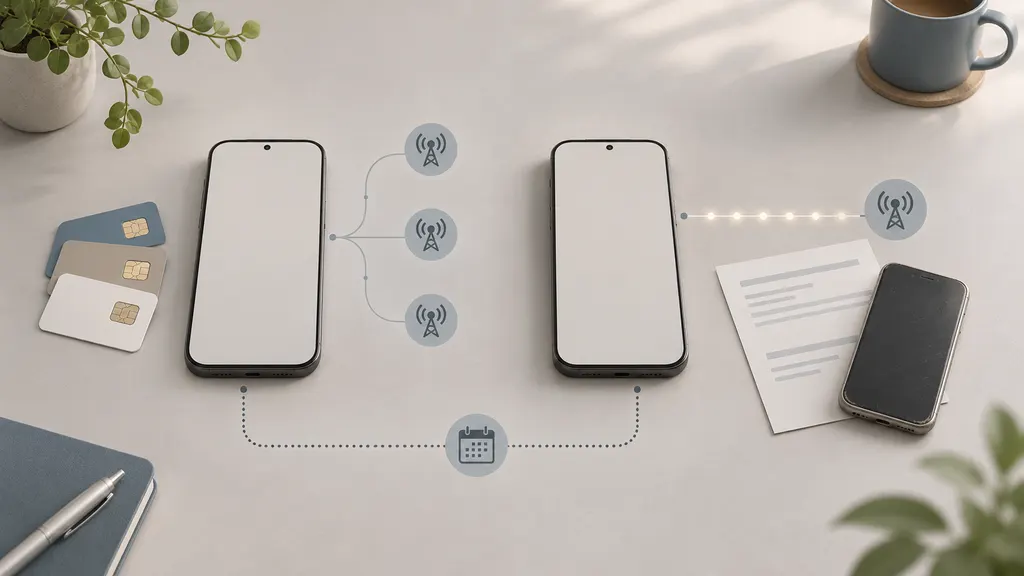
Cyber Monday falls on November 30, 2026. Specific offers and terms may change before then, so this guide focuses on how to evaluate a deal once its final terms are published—not on unverified predictions about sale prices.
The difference that matters: an immediate price cut or a conditional discount
An unlocked-phone deal generally reduces the amount you pay for the device at checkout, although financing, trade-in offers, and other conditions can still apply. You then choose a compatible service provider and plan. Buying a phone described as “unlocked” does not guarantee that every feature will work on every network; check the exact model and the carrier’s compatibility requirements before ordering.
A carrier offer may advertise a larger device discount but deliver some or all of it as monthly bill credits. Those credits can depend on maintaining an eligible plan, keeping a line active, financing the phone, or submitting an eligible trade-in. The precise conditions differ by promotion. If you leave before all credits have been applied, you may lose future credits while still owing any unpaid device balance.
This is not a rule that unlocked phones are cheaper. If a carrier’s required plan is already the plan you want, its promotion may be excellent value. If you would otherwise use a less expensive plan, a large phone discount can be outweighed by the additional service cost.
Unlocked versus carrier: what to compare
| Decision point | Unlocked phone offer | Carrier phone offer |
|---|---|---|
| Device discount | Often reflected in the purchase price; check whether financing or trade-in terms change the offer. | May be delivered through bill credits rather than an immediate price reduction. |
| Service plan | Usually lets you select a compatible provider and plan separately. | A particular plan, new line, or account status may be required. |
| Switching providers | No promotional bill credits to forfeit, though device financing and compatibility still matter. | Leaving early may end remaining credits; check the device balance and unlocking policy. |
| Trade-in | May be optional, depending on the seller’s offer. | The headline value may require a specific eligible device and an accepted trade-in. |
| Best fit | Someone who values plan choice or may change providers. | Someone comfortable meeting the offer’s conditions for its full duration. |
Neither column describes every promotion. Treat the written offer terms and checkout total as controlling, especially if an advertisement summarizes a discount as “free” or “on us.”
Calculate the total, not the headline discount
Start with the period over which the carrier promises credits. For each option, add the device cost, required service payments, applicable fees, and any expected trade-in value. Use the same number of months for both options. If one plan includes benefits you would otherwise pay for, count only their value to you—not their advertised value.
The following numbers are hypothetical and are not 2026 deals. Suppose an unlocked phone costs $800 and you can keep a suitable $30-per-month plan. Over 24 months, that is $800 + ($30 × 24) = $1,520 before taxes and fees. Now suppose a carrier offers the same $800 phone with $800 in credits spread over 24 months but requires a $65-per-month plan. If you receive every credit, the comparison is $0 net device cost + ($65 × 24) = $1,560. In this example, the unlocked option is $40 cheaper, despite the carrier’s much larger advertised phone discount.
Change one assumption and the conclusion changes. If you already want the $65 plan and would keep it for 24 months with either phone, the carrier’s credits may provide a meaningful saving. Conversely, if you switch plans or providers before all hypothetical credits arrive, recalculate using only the credits you actually expect to receive and the remaining device balance you would have to pay.
Before relying on a quoted monthly figure, check whether it includes the full cost of every required line and any taxes or fees. Also check whether the promotion starts with a higher first bill, whether credits take time to appear, and what happens if a trade-in is rejected. Do not assume the advertised credit is an upfront payment toward the phone.
Check these terms before placing a Cyber Monday order
1. Confirm the exact phone and its network compatibility
Compare the model number, storage capacity, condition, and region—not just the phone’s marketing name. For an unlocked purchase, ask the intended carrier to confirm that the specific model can be activated on your plan. Check any features you depend on, such as eSIM support, calling features, or international service. An unlocked status and full network compatibility are separate questions.
2. Identify how the discount is delivered
Look for an immediate checkout reduction, a rebate, a trade-in credit, or recurring bill credits. They are not interchangeable. A $600 reduction at checkout has a different switching risk from $600 paid as credits over many bills. If an offer combines discounts, write down when each one is earned and what could cause it to stop.
3. Read the plan and line requirements
Check whether the advertised price requires a new line, a number transfer, a particular plan tier, or an existing-account upgrade. If your current plan is not eligible, use the price of the required plan in your calculation. For a family account, verify whether the promotion changes the price of other lines or affects discounts you already receive.
4. Verify the trade-in value you can actually claim
A headline trade-in amount may apply only to qualifying devices or conditions. Confirm the accepted models, condition rules, submission method, deadline, and what happens if the assessed value differs from the estimate. Photograph the device and record its identifiers and condition before sending it. Do not spend an estimated trade-in credit as though it were guaranteed cash.
5. Check financing, unlocking, and exit terms separately
Device financing tells you how an unpaid balance is collected; unlocking determines whether a phone can be used with another carrier. They are related in some policies but are not the same thing. Read the seller’s financing agreement and the carrier’s current unlocking policy before assuming that paying off a phone will immediately make it usable elsewhere. The FCC’s consumer guide to cell phone unlocking provides a useful starting point, while the carrier’s own policy governs its devices.
6. Check returns and delivery before the sale ends
Confirm when the return period begins, whether opening or activating the phone changes your options, and whether a restocking fee applies. If the purchase is a gift, make sure the recipient has enough time to test activation and compatibility. Keep the order confirmation, promotional terms, trade-in instructions, and return policy together; the details visible on sale day may be harder to reconstruct later.
Which offer should you choose?
Choose an unlocked deal when the phone’s price is competitive after accounting for service, you want to keep a lower-cost plan, or you are likely to switch providers during the period covered by a carrier promotion. It is also the cleaner choice when you are buying for someone whose carrier or plan is uncertain. It is not ideal if the model lacks compatibility with the intended network or if an eligible carrier promotion clearly lowers your total cost.
Choose a carrier offer when you have confirmed the plan suits you, you expect to keep the line for the full credit period, and the verified total cost beats the unlocked alternative. It is less attractive if the discount requires a plan upgrade you do not need, an uncertain trade-in, or a commitment longer than you are comfortable making. A person who frequently changes carriers should put particular weight on the cost of leaving early.
On Cyber Monday, compare two complete offers for the same phone rather than two advertisements: save screenshots or copies of the checkout price, plan terms, credit schedule, trade-in conditions, and return rules. Then run the calculation using your actual plan choices. If a condition is unclear, get confirmation before ordering rather than assuming the largest advertised discount applies to you.
FAQ
Is an unlocked phone always more expensive upfront?
No. Prices and payment options vary by seller and promotion. An unlocked purchase may require a larger payment at checkout, but some sellers offer financing or trade-ins. Compare the total cost and financing terms, not only the first payment.
Can I use an unlocked phone with any carrier?
Not necessarily. The phone must be compatible with the carrier’s network and activation requirements. Check the exact model with the carrier before buying, especially if you plan to transfer an existing number or use eSIM.
What happens to promotional credits if I switch carriers?
Do not assume you will keep credits scheduled for future bills. Review the promotion’s terms and your device installment agreement to determine what credits would stop and what unpaid balance would remain. Ask the carrier to confirm the amount you would owe if you left at a specific point.
Does paying off a carrier phone automatically unlock it?
Do not assume so. Unlocking requirements depend on the carrier’s current policy and the device’s status. Check that policy and request confirmation of the phone’s unlock status before relying on it for another network.
Should I wait until November 30 for the lowest phone price?
There is no reliable way to promise that Cyber Monday will beat every earlier or later offer. Establish your acceptable total cost in advance, monitor the exact model you want, and check the return and price-adjustment terms before buying.
Sources
- Federal Communications Commission: Cell Phone Unlocking — consumer guidance on unlocking and carrier policies.
- AT&T: Device Unlock — carrier-specific unlocking information to consult when evaluating an AT&T device.
- Verizon: Device Unlocking Policy — carrier-specific unlocking terms.
- T-Mobile: Unlock Your Mobile Wireless Device — carrier-specific unlocking guidance.