Containerized Transport
What Is Containerized Transport?
Containerized transport is the movement of goods in reusable freight containers that can be handled as a single unit and transferred between compatible ships, trains, and road vehicles without unloading the goods inside. In logistics and international trade, the term usually refers to transport using standardized intermodal freight containers. The container provides a common physical interface for cargo handling, while the goods remain packed inside until unpacking, inspection, or another operational requirement makes access necessary.
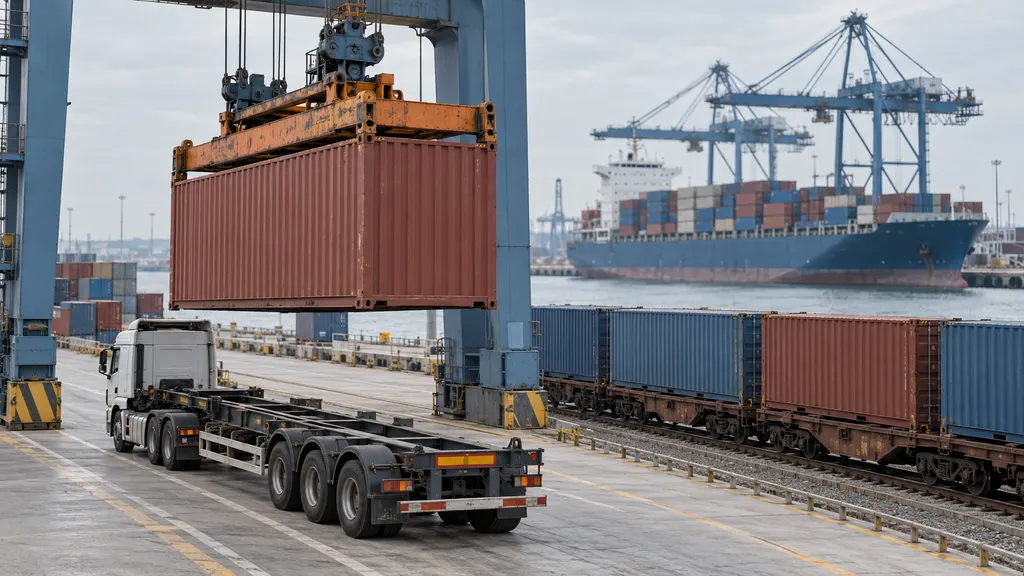
Containerized transport describes how cargo is carried, not a particular transport mode or delivery service. A container may travel entirely by road or make a journey involving ocean, rail, and road transport. Containerization is the broader system of using containers, compatible handling equipment, terminals, vehicles, and operating procedures to move cargo.
How Containerized Transport Works
The central principle is to handle the loaded container rather than repeatedly handling individual cartons, pallets, or other cargo units at each change of transport mode. Standardized dimensions and handling interfaces allow compatible equipment to lift, secure, stack, and transfer containers. However, compatibility does not mean every container can travel on every route: vehicle limits, terminal capabilities, infrastructure restrictions, and equipment condition still matter.
- Equipment selection and booking: The shipper or its service provider selects a container suitable for the cargo, route, loading requirements, and transport service. Weight, dimensions, temperature requirements, and any dangerous-goods restrictions influence the choice.
- Container inspection and packing: Before loading, the container is checked for suitability and visible defects. Cargo is distributed and secured to address movement, concentrated loads, and other foreseeable transport stresses. Loading goods into a container is also called stuffing.
- Identification and documentation: The container identifier connects the physical equipment with booking and shipment records. Where a seal is used, its number may also be recorded. Commercial, transport, and customs documents describe the shipment and support its movement.
- Origin movement and terminal handling: A truck or train moves the container toward a terminal, or directly to another transport connection. Terminal equipment transfers the container between vehicles, storage positions, and vessels as required.
- Main carriage and intermediate transfers: The container travels on its booked service. It may pass through an intermediate terminal or transfer between vessels without the cargo being unpacked.
- Destination release and unpacking: After applicable carrier, terminal, and customs requirements are met, the container moves to its unloading location. Unpacking is also called stripping or devanning.
- Equipment return: When the container is supplied under an arrangement requiring return, the empty unit is delivered to the designated location under the applicable equipment terms.
This sequence is illustrative rather than universal. Customs examinations, consolidation operations, transloading, damage, or changes in transport arrangements may interrupt the otherwise continuous movement of a packed container.
Container Equipment and Shipment Arrangements
Container equipment and commercial shipment arrangements describe different things. Equipment categories concern the physical unit and its cargo-handling capabilities. Full container load and less than container load concern how container capacity is booked and shared.
Common Container Equipment
| Equipment | Main characteristic | Typical application |
|---|---|---|
| General-purpose dry container | Enclosed cargo space without active temperature control | Cartons, packaged manufactured goods, and other compatible dry cargo |
| Refrigerated container | Temperature-control equipment requiring suitable operating arrangements | Goods with specified temperature requirements |
| Open-top container | Roof opening that supports loading from above | Cargo whose dimensions or handling needs make roof access useful |
| Flat-rack container | Platform-based equipment with end structures and open sides | Machinery and other cargo requiring specialized securing or dimensional planning |
| Tank container | Tank mounted within a supporting frame | Compatible liquid or gaseous cargo, subject to equipment and regulatory requirements |
Nominal container dimensions do not establish the usable capacity or permitted cargo weight for a particular shipment. Internal dimensions, door openings, equipment ratings, and route restrictions must be checked. A cargo item may fit inside a container but still be unsuitable because of its weight distribution, securing requirements, or unloading method.
Full Container Load and Less Than Container Load
Full container load (FCL) is an arrangement in which container capacity is booked for a shipment rather than purchased as space within a consolidated container. The name does not mean that the container must be physically full. A shipper may use FCL even when some space remains unused.
Less than container load (LCL) involves cargo that is consolidated with other shipments in a container. Consolidation and deconsolidation introduce additional cargo-handling stages. The choice between FCL and LCL depends on shipment volume, cargo compatibility, handling requirements, service availability, and the quoted commercial terms; neither arrangement is universally cheaper or faster.
Related Transport Terms
| Term | Meaning | Relationship to containerized transport |
|---|---|---|
| Intermodal transport | Movement using successive transport modes while retaining goods in the same loading unit or road vehicle, without handling the goods themselves at the mode change | Containerized transport is intermodal when a loaded container moves between modes under this principle. |
| Multimodal transport | Movement of goods by two or more transport modes | A container journey may be multimodal, but containerization itself does not require multiple modes. |
| Breakbulk transport | Carriage of separate cargo units, such as crates or machinery, outside freight containers | The cargo units are handled individually rather than through a container interface. |
| Bulk transport | Carriage of unpackaged commodities in quantities, such as grain or liquid cargo | Bulk cargo may use dedicated vessel spaces or vehicles; some bulk commodities can also move in suitable containers. |
| Palletization | Grouping goods on pallets for handling as unit loads | Palletized goods can be packed inside a container; pallets and containers are different levels of unitization. |
Containerized transport should also be distinguished from parcel delivery. A container may carry goods that will later become individual customer parcels, but moving the container does not itself complete those parcel deliveries.
Role in Ecommerce and Cross-Border Trade
In ecommerce supply chains, containerized transport can connect factories or suppliers with import warehouses, distribution centers, and fulfillment facilities. It is particularly relevant to inventory replenishment, where goods move in larger shipments before individual customer orders are picked and packed.
For example, an online retailer may purchase household accessories from an overseas supplier. The supplier packs cartons into a container, which travels by truck to a port, by ship to the destination country, and then by road to a warehouse. After the goods are unpacked and received into inventory, the warehouse prepares separate parcels for customer orders. The container journey and the subsequent parcel journeys are distinct transport operations.
Readers may encounter the term in freight quotations, shipment bookings, transport statistics, port documentation, and warehouse receiving plans. Operational records may reference container numbers, seal numbers, container types, terminal movements, and unpacking appointments.
Container tracking and order tracking are not interchangeable. A container event can indicate where the transport equipment is in its journey, but it does not by itself establish that every product has cleared customs, been received into warehouse inventory, or reached its buyer. Connecting container-level visibility with purchase orders and inventory requires accurate shipment records.
Handling, Safety, and Operational Limits
Containerization reduces the need to handle individual cargo items during transfers, but it does not remove the need for appropriate packaging and securing. Cargo can move inside a closed container if restraint is inadequate. Moisture, incompatible cargo, uneven loading, and unsuitable equipment can also create risks. The joint IMO/ILO/UNECE Code of Practice for Packing of Cargo Transport Units provides guidance on packing and securing cargo across the intermodal transport chain.
For containers within the scope of the relevant SOLAS requirements, a verified gross mass must be provided before loading onto a ship. Gross mass includes the container and its contents, not merely the commercial goods. Providing verified gross mass does not replace checks on cargo distribution, container ratings, or road and rail limits.
A seal is not a guarantee that the contents are undamaged or correctly declared. It supports security and chain-of-custody procedures, but inspections may require authorized opening. Likewise, containerization does not remove customs obligations: classification, valuation, declarations, examinations, and release requirements still apply to the goods as required by the relevant jurisdiction.
Container movements also depend on operational coordination. A vessel arriving at a port does not automatically mean the container is available for collection. Discharge, terminal handling, documentary release, customs status, and onward transport arrangements can affect availability.
Practical Checks for a Shipment
- Confirm that the cargo fits through the container opening and can be loaded and unloaded safely.
- Check equipment suitability, permitted weights, load distribution, and securing arrangements.
- Identify temperature-control, dangerous-goods, or other special requirements before booking.
- Keep container, seal, booking, and cargo-document references consistent across operational records.
- Clarify responsibility for packing, documentation, terminal collection, unpacking, and equipment return.
- Distinguish vessel arrival, container availability, customs release, and warehouse receipt when interpreting shipment status.
QA
Does containerized transport always involve a ship?
No. Containers can move by road or rail without an ocean leg. The defining feature is the use of freight containers as handling units, not the presence of a particular transport mode.
Is containerized transport the same as intermodal transport?
No. Containerized transport describes the use of containers. Intermodal transport describes movement between modes without handling the goods inside the loading unit at each transfer. A container journey can satisfy both descriptions.
Does FCL mean the container is completely full?
No. FCL describes a container booking arrangement, not a requirement to fill every available space. Equipment and route weight limits still apply.
Does a container tracking update confirm delivery of an ecommerce order?
No. It reports an event associated with the container. Warehouse receipt, order fulfillment, and customer delivery are separate events that require their own records.
Sources
- UNECE, European Conference of Ministers of Transport, and European Commission: Terminology on Combined Transport — Definitions and distinctions concerning containers, intermodal transport, multimodal transport, and related handling concepts.
- IMO/ILO/UNECE Code of Practice for Packing of Cargo Transport Units — Guidance on equipment suitability, packing, load distribution, securing, and responsibilities across the transport chain.
- International Maritime Organization: Containers — Container safety framework and verified gross mass requirements for packed containers carried by sea.