What Does "Arrived at Sort Facility" Mean? How Long Packages Stay & What Comes Next?
“Arrived at sort facility” means tracking has recorded your package reaching a processing hub, where shipments are organized for the next part of their journey. It does not mean the package is out for delivery or ready for collection. There is no universal holding time: a shipment may leave during the next available dispatch cycle, while congestion, transport schedules, customs processing, or routing problems can extend the wait. The next update is often another processing event, a departure scan, or arrival at a different facility.
For a recipient, the useful question is not simply how long this status has appeared. It is whether the shipment is still progressing within its delivery estimate, whether the facility is near the destination, and whether tracking shows an exception or a request for action.
What happens inside a sort facility?
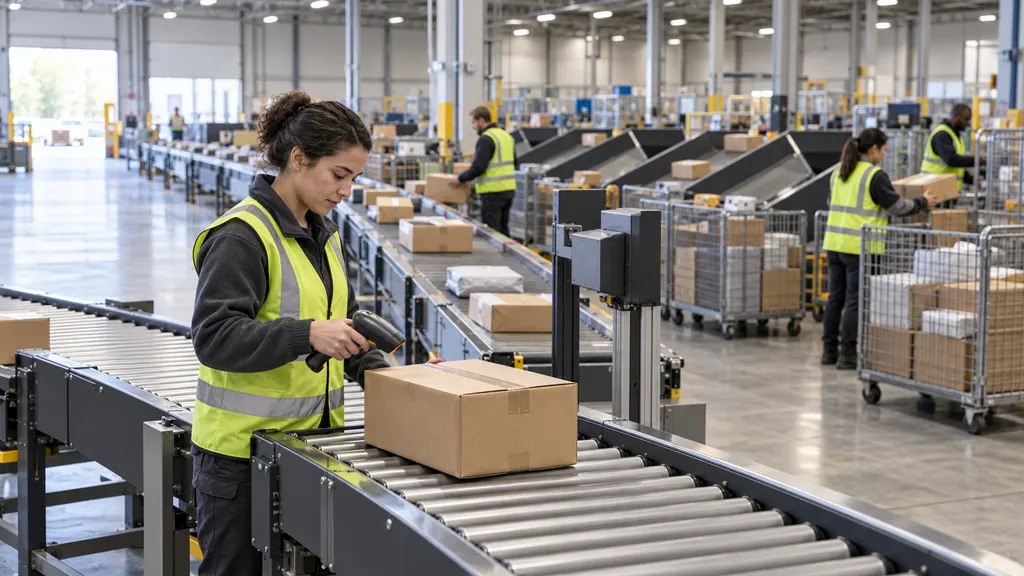
A sort facility is a point in a delivery network where packages are grouped by their next destination. Depending on the network, that destination could be another regional hub, an international gateway, a local delivery depot, or a partner carrier.
At a facility, a package may be unloaded, scanned, routed through sorting equipment or manual handling, and assigned to an outbound load. The arrival event records one stage of that process. It does not confirm that sorting is complete, that a vehicle is ready, or that the parcel will leave immediately.
Carriers use different wording for these events. “Arrived at sorting center,” “arrived at processing facility,” and similar messages can describe broadly comparable steps, but they are not necessarily identical operational codes. Read them alongside the carrier name, location, timestamp, and surrounding events rather than treating the phrase as a precise delivery countdown.
- At an origin facility: The parcel may still be near the sender and waiting to enter the main transport network.
- At an intermediate hub: It may be changing routes or transport connections, with more facilities still ahead.
- At a destination-area facility: It may be closer to final delivery, but further sorting and transfer can still be necessary.
A facility in your city is encouraging, but proximity alone does not mean delivery is scheduled for that day. The package still needs to reach the appropriate delivery operation and be assigned to a delivery route.
How long do packages stay at a sort facility?
The status itself does not provide a reliable number of hours or days. Departure depends on the service purchased, the facility’s dispatch schedule, available transport, and any disruption affecting that shipment. A universal rule such as “all packages leave within 24 hours” would be misleading.
A parcel that arrives before an outbound loading cutoff may make that connection. One arriving after the cutoff may wait for a later departure. Even after it moves, the public tracking page may not immediately show a new event. For example, UPS explains that shipments traveling long distances may not be scanned again until they reach their destination hub.
Use the following signals to judge the wait more accurately:
- The delivery estimate: An unchanged sort-facility event before the expected delivery date is different from the same event after that date has passed.
- The service level: Express, economy, and international services should not be assessed against the same transit expectations.
- The latest event time: Check when the event happened, not just when you last opened the tracking page. Note any displayed time zone.
- The route: An origin-country hub can represent an early stage of an international journey, even if the package has already spent time in transit.
- Any exception message: A customs request, address problem, or operational alert is more actionable than an ordinary arrival scan.
If the carrier publishes service-specific guidance for delayed tracking or missing shipments, use that guidance rather than a generic waiting period found online. An estimated delivery date is useful context, but it is not automatically a guaranteed delivery commitment.
What tracking update comes next?
There is no single mandatory sequence visible to every recipient. Some networks show detailed processing scans; others expose only major milestones. These are common types of updates you may see after arrival:
- Processed or sorted: The shipment has passed another handling stage within the facility. It may still be there.
- Departed facility or in transit: Tracking indicates onward movement. This does not necessarily mean the parcel is traveling directly to your address.
- Arrived at another facility: The shipment has reached another point in the network. Several such arrivals can be part of a normal route.
- Transferred to a delivery partner: Another operator may handle the next stage. Look for a partner name or additional tracking number if one is provided.
- Out for delivery: The package has reached the delivery stage, rather than merely arriving at a sorting hub. Follow the carrier’s accompanying delivery information.
For international shipments, customs-related events may appear between transport and delivery milestones. An arrival at a sorting facility does not, by itself, prove that customs clearance is complete. Look for an explicit clearance update or instructions from the carrier or customs authority.
Why the status may stay unchanged
The package is waiting for its next connection
Sorting and transport are separate steps. A parcel can be correctly sorted but still wait for the scheduled truck, aircraft, or other onward service. Whether weekends or holidays affect that connection depends on the carrier, route, and service; do not assume every facility closes or operates normally on the same days.
The public tracking history has not caught up
Tracking is a record of reported events, not a continuous live location feed. A missing departure scan does not establish that the package is still physically at the last facility. Equally, a tracking gap is not proof that it has moved. The correct conclusion is that its latest publicly reported location has not changed.
Operations are disrupted
High shipment volumes, severe weather, equipment problems, or transport interruptions can delay processing or departure. Check the carrier’s service alerts for the relevant location. Do not assume a particular disruption caused your delay unless the tracking details, an official alert, or carrier support connects it to the shipment.
The parcel needs additional handling
An unreadable label, incomplete address, damaged packaging, or a routing error can require intervention. However, a normal arrival message does not diagnose any of these problems. Look for an exception event or ask the carrier to investigate if the shipment meets its criteria for assistance.
What to do if your package appears stuck
1. Open the full tracking history
Check the carrier’s own tracking page, not only the order summary in a store account. Confirm the latest event, facility location, delivery estimate, and any instructions. If several packages belong to the order, make sure you are reviewing the correct tracking number.
For a cross-border shipment, a tracking service such as 17TRACK can be an additional place to check the shipment’s reported events. If a local delivery partner is identified, check that carrier’s tracking page as well. A tracking service can help you review updates, but it cannot release a parcel, change its route, or make the carrier generate a new scan.
2. Check whether action is actually required
If tracking shows only an ordinary arrival event and delivery is still within the expected window, continued monitoring is usually more useful than immediately opening a missing-package case. If it requests an address correction, documents, or another response, follow the verified carrier instructions instead of waiting for movement.
Verify unexpected payment or address-update requests through the carrier’s official website or a trusted contact channel. Do not treat an unsolicited message as genuine merely because you are expecting a parcel.
3. Contact the carrier when the delivery expectation is no longer being met
If the expected date has passed, an exception remains unresolved, or the carrier’s published inquiry threshold has been reached, contact support. Have the tracking number, destination postal code, latest event, and expected delivery date ready.
Ask specific questions: Is there an active exception? Is recipient action required? Can an inquiry be opened, and must the sender initiate it? These questions are more useful than asking only why the parcel has not moved.
4. Involve the seller when necessary
For an online purchase, the seller may need to initiate a carrier investigation or handle a replacement or refund under the applicable order terms and consumer protections. Notify the seller if delivery is overdue, particularly if a marketplace or payment-provider protection deadline is approaching. Do not let repeated requests to wait cause you to overlook those deadlines.
Missing-mail searches, loss claims, and seller remedies are separate processes. Their eligibility rules and time limits vary. For example, USPS publishes its own missing-mail assistance process; its requirements should not be applied to a shipment carried by another operator.
How to interpret unusual tracking patterns
Repeated arrivals at the same facility: These can reflect separate processing events or repeated reporting, rather than multiple physical journeys. Compare timestamps and the complete history. Repetition combined with an overdue delivery estimate is a reason to ask for clarification, not proof that the package is lost.
A facility farther from your address: Carrier networks do not always follow the shortest geographic path. A farther-away hub is not enough to establish a misroute. A repeated loop between locations or an explicit routing exception gives you a stronger reason to contact support.
A sudden jump to out for delivery: Not every intermediate movement appears in public tracking. A later delivery-stage update can appear without a visible departure from the previous sorting facility.
No delivery estimate: Without an estimate, rely on the purchased service’s published transit guidance, the seller’s delivery commitment, and the carrier’s inquiry rules. Do not calculate an exact delivery date from the arrival scan alone.
FAQ
Does “arrived at sort facility” mean my package will arrive today?
No. It confirms a processing milestone, not assignment to a delivery route. Check for an “out for delivery” update and the carrier’s delivery estimate. Even arrival at a nearby facility does not guarantee same-day delivery.
Can I collect my package from the sorting facility?
Do not travel there unless the carrier explicitly confirms collection is available and the parcel is ready. Sorting facilities may not serve customers, and a location in tracking is not a pickup invitation. Use the carrier’s official hold or collection options if offered for your shipment.
Does this status mean customs has cleared my package?
No. Sorting-facility arrival and customs clearance are different events. For an international shipment, check for an explicit clearance message or a request for documents or payment through verified channels.
Is my package lost if tracking has not changed?
An unchanged event alone does not establish loss. It can reflect a processing wait, a transport gap, or delayed reporting. Escalate according to the delivery estimate and the carrier’s inquiry rules rather than treating a fixed number of silent days as universal proof.
Can a tracking app speed up a delayed shipment?
No. Tracking tools display shipment information; they do not control facility operations or transport. The carrier handles operational investigations, while the seller may need to help with an inquiry or an order remedy.
Sources
- UPS: Understanding Tracking Status — explanations of shipment progress, gaps between scans during long-distance movement, and delivery-stage statuses.
- USPS: Where Is My Package? — guidance on interpreting tracking information and next steps for delivery concerns.
- USPS: Find Missing Mail — the carrier’s process for seeking help and requesting a missing-mail search.
- 17TRACK: Package Tracking — an additional tracking lookup option for reviewing shipment updates.